Difference between revisions of "Mao Zedong"
Mao Zedong (talk | contribs) |
|||
| (16 intermediate revisions by one other user not shown) | |||
| Line 1: | Line 1: | ||
| − | + | [[File:mao_zedong.jpg]] | |
| + | (Chairman Mao Zedong) | ||
| − | In the physical world, the center is my body; in the spiritual/mental realm, the center is my mind. In short, among the ten thousand things in the universe, I am the essence. The emperor is my emperor; the father is my father; the teacher is my teacher; the wealth is my wealth; heaven and earth are my heaven and earth. . . . Mencius said: “All things in the world are complete in me.” . . . Everything in the universe is also my responsibility. | + | Let me introduce myself, my name is Mao Zedong. My story is one of humble beginnings followed by decades of struggle until the eventual triumph of our glorious revolution which brought about a new and better China. I was born in Shaoshan, Hunan Province, on December 26, 1893. During my childhood, I attended the village primary school, but for some time stopped attending in order to work on the family farm. I eventually left the farm to continue my studies at a secondary school at the capital of Hunan province, Changsha. When Revolution broke out against the Qing Dynasty in 1911, I joined the Revolutionary Army in Hunan. By the spring of 1912 the war had ended and I returned to school (Feigon 17). I attended the First Provincial Normal School of Hunan whose mission it was to train county elementary schoolteachers. The school’s curriculum combined traditional Chinese and modern Western subjects. It was the highest level of schooling available in Hunan (Liu 497). While at the school, I was greatly influenced by my teacher Yang Changji. Changji wrote that: |
| + | |||
| + | In the physical world, the center is my body; in the spiritual/mental realm, the center is my mind. In short, among the ten thousand things in the universe, I am the essence. The emperor is my emperor; the father is my father; the teacher is my teacher; the wealth is my wealth; heaven and earth are my heaven and earth. . . . Mencius said: “All things in the world are complete in me.” . . . Everything in the universe is also my responsibility. | ||
I absorbed a strong sense of responsibility to society from Yang Changji (Liu 509). In 1918, I graduated from the First Normal and traveled to Beijing, where I lived with my teacher Yang Changji, who had taken a position at Peking University (Chang 15). | I absorbed a strong sense of responsibility to society from Yang Changji (Liu 509). In 1918, I graduated from the First Normal and traveled to Beijing, where I lived with my teacher Yang Changji, who had taken a position at Peking University (Chang 15). | ||
| + | |||
I began work as an assistant librarian at the Peking University Library where I was introduced to communism. I worked under Li Dazhao, the curator of the library, and a leading communist intellectual who cofounded China’s Communist Party in 1921. Dazhao came to greatly influence my thinking (Chang 22-24). | I began work as an assistant librarian at the Peking University Library where I was introduced to communism. I worked under Li Dazhao, the curator of the library, and a leading communist intellectual who cofounded China’s Communist Party in 1921. Dazhao came to greatly influence my thinking (Chang 22-24). | ||
| Line 9: | Line 13: | ||
During the Kuomintang’s Northern Expedition, in early 1927, I was dispatched by the Party to Hunan to investigate the peasant uprisings. I spent thirty-two days, from January to early February, in Hunan investigating the struggles of the peasants. After much criticism of the peasant’s actions from within and outside of the party, my Report on an Investigation of the Peasant Movement in Hunan was not only a response to the criticisms, but also the first step towards the application of my revolutionary theories. What I witnessed was the peasants rising against their local tyrants—fighting back after generations of indignities and injustices. What I witnessed was a mobilization of the masses— something that could ultimately benefit the revolution. They formed new associations and empowered themselves after generations of being repressed. This force of rising peasants was powerful enough to help bring about the new China. While some criticized the so-called “atrocities” that the peasants were committing, I understood, as the son of a peasant farmer myself, that these so-called “atrocities” were necessary to right generations of wrongs. And, after all, as I stated in my report: | During the Kuomintang’s Northern Expedition, in early 1927, I was dispatched by the Party to Hunan to investigate the peasant uprisings. I spent thirty-two days, from January to early February, in Hunan investigating the struggles of the peasants. After much criticism of the peasant’s actions from within and outside of the party, my Report on an Investigation of the Peasant Movement in Hunan was not only a response to the criticisms, but also the first step towards the application of my revolutionary theories. What I witnessed was the peasants rising against their local tyrants—fighting back after generations of indignities and injustices. What I witnessed was a mobilization of the masses— something that could ultimately benefit the revolution. They formed new associations and empowered themselves after generations of being repressed. This force of rising peasants was powerful enough to help bring about the new China. While some criticized the so-called “atrocities” that the peasants were committing, I understood, as the son of a peasant farmer myself, that these so-called “atrocities” were necessary to right generations of wrongs. And, after all, as I stated in my report: | ||
| − | A revolution is not a dinner party, or writing an essay, or painting a picture, or doing embroidery; it cannot be so refined, so leisurely and gentle, so temperate, kind courteous, restrained. A revolution is magnanimous. A revolution is an insurrection, an act of violence by which one class overthrows another. (Mao Zedong) | + | |
| + | "A revolution is not a dinner party, or writing an essay, or painting a picture, or doing embroidery; it cannot be so refined, so leisurely and gentle, so temperate, kind courteous, restrained. A revolution is magnanimous. A revolution is an insurrection, an act of violence by which one class overthrows another." (Mao Zedong) | ||
Unfortunately, the Right opportunists in the Party rejected my views. They failed to support the peasant uprisings, leaving the working class and consequently the Party isolated from one another (Spence 338-339). | Unfortunately, the Right opportunists in the Party rejected my views. They failed to support the peasant uprisings, leaving the working class and consequently the Party isolated from one another (Spence 338-339). | ||
| Line 22: | Line 27: | ||
I further consolidated power over the Communist Party in 1942 by launching the Shu Fan movement, or “Rectification” campaign against rival CCP members (Spence 447-448). During the Sino-Japanese War we increased support of the people by our anti-Japanese activities. I also greatly expanded the Party’s influence in areas outside of Japanese control through rural mass organizations, and administrative land and tax reform measures favoring poor peasants. After the Japanese defeat in 1945, there was a year of talks between the CCP and Kuomintang but it only lasted a year before fighting broke out again and the civil war recommenced. Our victory would not be achieved until three years later. Meanwhile, in 1948, under my direct order, the People’s Liberation Army starved out the Kuomintang forces occupying the city of Changchun. The siege lasted from June until October. Many died during the siege. | I further consolidated power over the Communist Party in 1942 by launching the Shu Fan movement, or “Rectification” campaign against rival CCP members (Spence 447-448). During the Sino-Japanese War we increased support of the people by our anti-Japanese activities. I also greatly expanded the Party’s influence in areas outside of Japanese control through rural mass organizations, and administrative land and tax reform measures favoring poor peasants. After the Japanese defeat in 1945, there was a year of talks between the CCP and Kuomintang but it only lasted a year before fighting broke out again and the civil war recommenced. Our victory would not be achieved until three years later. Meanwhile, in 1948, under my direct order, the People’s Liberation Army starved out the Kuomintang forces occupying the city of Changchun. The siege lasted from June until October. Many died during the siege. | ||
| − | The next year, January 21, 1949, Kuomintang forces suffered great losses in battles against our forces. The People's Republic of China was established on October 1, 1949. It was the culmination of over two decades of struggle. Finally, “[t]he Chinese people have stood up.” In the early morning of December 10, 1949, People’s Liberation Army troops laid siege to Chengdu which was the last Kuomintang held city in mainland China. Chiang Kai-shek evacuated to Taiwan. | + | The next year, January 21, 1949, Kuomintang forces suffered great losses in battles against our forces. The People's Republic of China was established on October 1, 1949. It was the culmination of over two decades of struggle. Finally, “[t]he Chinese people have stood up.” In the early morning of December 10, 1949, People’s Liberation Army troops laid siege to Chengdu which was the last Kuomintang held city in mainland China. Chiang Kai-shek evacuated to Taiwan. |
| + | |||
| + | In 1951, I initiated the three-anti campaign aimed at members within the Chinese Communist Party (CCP), former Kuomintang members and bureaucratic officials who were not party members. The targets were: corruption, waste, and bureaucracy(Spence 509). The next year (1952) a second campaign, the Five-anti campaign, rid urban areas of corruption by targeting those participating in bribery, theft of state property, tax evasion, cheating on government contracts, and stealing state economic information(Spence 510). I insisted that minor offenders be criticized and reformed or sent to labor camps, "while the worst among them should be shot." These campaigns help rid the China of a hundred thousand corrupt right opportunists; though not as many were killed, those that did die, a majority of died not by our hand, they simply committed suicide. How can I be blamed for those deaths? | ||
| + | |||
| + | Following this cleansing in 1953, we launched the First Five-Year Plan. With this plan, China would end its dependence on agriculture and become a world power. We built new industrial plants and industry began to produce enough capital for us to grow independent of U.S.S.R. support. The First-Five Year Plan was a great success (Spence 515). In 1958, the Second Five-Year Plan, the Great Leap Forward, was launched. During this time, the Hundred Flowers Campaign was initiated. Under this campaign I was willing to consider different opinions about how China should be governed. Unfortunately, the Right opportunists took advantage of my good will and dared criticize me rather than offer serious ideas of how to better run the government. What nerve! After a few months, I had to reverse this policy! Once again I had to cleanse China of these counterrevolutionary rats and their dangerous thoughts(Spence 546). I am not exactly sure how many Rightists we rid ourselves of with this Anti-Rightist Movement, it is difficult to keep track. You’ll have to forgive me; do you know how many dangerous thinkers I’ve had to protect the revolution from? I am sure it was millions of well-deserved deaths. | ||
| + | |||
| + | The Great Leap Forward did have some setbacks, I’ll admit. We ordered the implementation of a variety of new agricultural techniques for use by the new communes which did not work out as well as planned. This combined with the shortage of labor in the fields led to an approximately 15 percent drop in grain production in 1959 followed by a further 10 percent reduction in 1960 and no recovery in 1961 (Spence, 553). We just did not have enough labor to work in steel production and infrastructure projects and also work in agriculture. | ||
| + | |||
| + | I ordered the party to procure up to one third of all the grain. There were reports of food shortages in the countryside but I’m pretty sure the peasants were lying and those rightists and kulaks were hoarding grain. I launched a series of anti-grain concealment drives to once again purge our worker’s paradise of undesirables. At the Lushan Conference in late 1959, some expressed concern that the Great Leap Forward had not been as successful as planned. Chief among these right opportunists was Minister of Defense Peng Dehuai(Spence 551). Not to worry though, a good old fashion purge took care of that problem. Despite the questionable reports of famine, we continued to claim record harvests to the rest of the world. In fact, we increased exports by 50 percent. We also gave free grain to fellow Communist such as North Korea and North Vietnam. Though, after the less than desirable outcomes of the Great Leap Forward, I retired from the post of chairman of the People’s Republic of China but remained important in determining overall policy. | ||
| + | |||
| + | In 1966, I become concerned that the revolution had replaced the old elite with a new one. A revolution of culture was necessary for keeping China in a state of perpetual revolution which would serve the interests of the majority, rather than allowing an elite class to settle in and consolidate their power over time. The Great Proletarian Cultural Revolution permeated every part of Chinese life. The Cultural Revolution may have deposed much of China's traditional cultural heritage but success of the Revolution required a fundamental change in the sentiments and values of the people. The events of the Revolution were necessary. There was much loss of life; many driven to suicide (Spence 572-578). When I was informed of people being driven to suicide I ordered: “People who try to commit suicide — don't attempt to save them! . . . China is such a populous nation, it is not as if we cannot do without a few people.” In 1969, I declared the Cultural Revolution over but it really continued until my death 1976. | ||
| + | |||
| + | [[File:MaoZedongbody.jpg]] | ||
| + | |||
| − | [[User:Mao Zedong|Mao Zedong]] | + | [[User:Mao Zedong|Mao Zedong]] 03:25, 17 October 2011 (UTC) |
== Works Cited == | == Works Cited == | ||
| − | Chang, Jung, and Jon Holiday. Mao: The Unknown Story. New York: Knopf, 2005. Print. | + | Chang, Jung, and Jon Holiday. ''Mao: The Unknown Story''. New York: Knopf, 2005. Print. |
| − | Feigon, Lee. Mao: A Reinterpretation. Chicago: Ivan R. Dee, 2002. Print. | + | Feigon, Lee. ''Mao: A Reinterpretation''. Chicago: Ivan R. Dee, 2002. Print. |
| − | Fuller, Francis F. “Mao Tse-Tung: Military Thinker.” Military Affairs, Vol. 22, No. 3 (Autumn, 1958), pp. 139-145. | + | Fuller, Francis F. “Mao Tse-Tung: Military Thinker.” ''Military Affairs'', Vol. 22, No. 3 (Autumn, 1958), pp. 139-145. |
| − | Katzenbach, Jr., Edward, and Gene Hanrahan. “The Revolutionary Strategy of Mao Tse-Tung.” Political Science Quarterly, Vol. 70, No. 3 (Sep., 1955), pp. 321-340. | + | Katzenbach, Jr., Edward, and Gene Hanrahan. “The Revolutionary Strategy of Mao Tse-Tung.” ''Political Science Quarterly'', Vol. 70, No. 3 (Sep., 1955), pp. 321-340. |
| − | Liu, Liyan. “The Man Who Molded Mao: Yang Changji and the First Generation of Chinese Communists.” Modern China, Vol. 32, No. 4 (Oct., 2006), pp. 483-512. | + | Liu, Liyan. “The Man Who Molded Mao: Yang Changji and the First Generation of Chinese Communists.” ''Modern China'', Vol. 32, No. 4 (Oct., 2006), pp. 483-512. |
| − | North, Robert C. “The Rise of Mao Tse-Tung.” The Far Eastern Quarterly, Vol. 11, No. 2 (Feb., 1952), pp. 137-145. | + | North, Robert C. “The Rise of Mao Tse-Tung.” ''The Far Eastern Quarterly'', Vol. 11, No. 2 (Feb., 1952), pp. 137-145. |
| − | Spence, Jonathan D. The Search for Modern China, Second Edition. New York: W.W. Norton & Company, 1999. Print. | + | Spence, Jonathan D. ''The Search for Modern China, Second Edition''. New York: W.W. Norton & Company, 1999. Print. |
| − | Zedong, Mao. “Report on an Investigation of the Peasant Movement in Hunan, March 1927.” Marxists.org. Web. | + | Zedong, Mao. “Report on an Investigation of the Peasant Movement in Hunan, March 1927.” ''Marxists.org''. Web. |
Latest revision as of 22:24, 21 October 2011
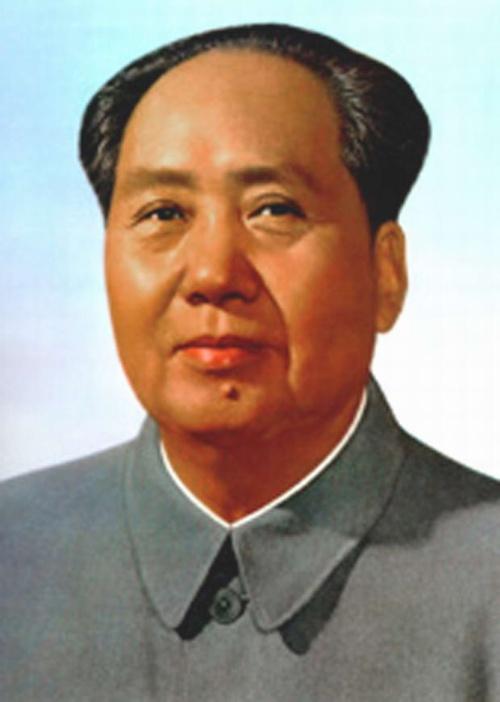 (Chairman Mao Zedong)

Let me introduce myself, my name is Mao Zedong. My story is one of humble beginnings followed by decades of struggle until the eventual triumph of our glorious revolution which brought about a new and better China. I was born in Shaoshan, Hunan Province, on December 26, 1893. During my childhood, I attended the village primary school, but for some time stopped attending in order to work on the family farm. I eventually left the farm to continue my studies at a secondary school at the capital of Hunan province, Changsha. When Revolution broke out against the Qing Dynasty in 1911, I joined the Revolutionary Army in Hunan. By the spring of 1912 the war had ended and I returned to school (Feigon 17). I attended the First Provincial Normal School of Hunan whose mission it was to train county elementary schoolteachers. The school’s curriculum combined traditional Chinese and modern Western subjects. It was the highest level of schooling available in Hunan (Liu 497). While at the school, I was greatly influenced by my teacher Yang Changji. Changji wrote that:
In the physical world, the center is my body; in the spiritual/mental realm, the center is my mind. In short, among the ten thousand things in the universe, I am the essence. The emperor is my emperor; the father is my father; the teacher is my teacher; the wealth is my wealth; heaven and earth are my heaven and earth. . . . Mencius said: “All things in the world are complete in me.” . . . Everything in the universe is also my responsibility.
I absorbed a strong sense of responsibility to society from Yang Changji (Liu 509). In 1918, I graduated from the First Normal and traveled to Beijing, where I lived with my teacher Yang Changji, who had taken a position at Peking University (Chang 15).
I began work as an assistant librarian at the Peking University Library where I was introduced to communism. I worked under Li Dazhao, the curator of the library, and a leading communist intellectual who cofounded China’s Communist Party in 1921. Dazhao came to greatly influence my thinking (Chang 22-24).
I eventually moved back to Changsha, where I became headmaster of a school and married Professor Yang's daughter, Yang Kaihui. In 1921, I attended the first session of the National Congress of the Communist Party of China in Shanghai as a delegate from Hunan (Spence 311). Throughout the 1920s, I led several labor struggles; however, these struggles were suppressed by the government. I came to realize that industrial workers were unable to lead the revolution because they made up only a small portion of China's population. It became clear that a successful revolution would depend on the Chinese peasants.
During the Kuomintang’s Northern Expedition, in early 1927, I was dispatched by the Party to Hunan to investigate the peasant uprisings. I spent thirty-two days, from January to early February, in Hunan investigating the struggles of the peasants. After much criticism of the peasant’s actions from within and outside of the party, my Report on an Investigation of the Peasant Movement in Hunan was not only a response to the criticisms, but also the first step towards the application of my revolutionary theories. What I witnessed was the peasants rising against their local tyrants—fighting back after generations of indignities and injustices. What I witnessed was a mobilization of the masses— something that could ultimately benefit the revolution. They formed new associations and empowered themselves after generations of being repressed. This force of rising peasants was powerful enough to help bring about the new China. While some criticized the so-called “atrocities” that the peasants were committing, I understood, as the son of a peasant farmer myself, that these so-called “atrocities” were necessary to right generations of wrongs. And, after all, as I stated in my report:
"A revolution is not a dinner party, or writing an essay, or painting a picture, or doing embroidery; it cannot be so refined, so leisurely and gentle, so temperate, kind courteous, restrained. A revolution is magnanimous. A revolution is an insurrection, an act of violence by which one class overthrows another." (Mao Zedong)
Unfortunately, the Right opportunists in the Party rejected my views. They failed to support the peasant uprisings, leaving the working class and consequently the Party isolated from one another (Spence 338-339).
The Kuomintang exploited this weakness. They launched a purge of communists from their ranks later that year. In September, I led a small army called the Revolutionary Army of Workers and Peasants in Hunan Province, but our Autumn Harvest Uprising was ultimately suppressed and we retreated to Sanwan, Jiangxi where other’s had fled after the purge (Spence 340). There I established peasant-based soviets, transforming the Party’s base from urban proletariats to country peasantry (Spence 385). I reorganized the soldiers, and rearranged the military division into smaller regiments. I ordered a party branch office in each company with a commissar from the Party as leader of the each company. This rearrangement insured the Party had absolute control over our military force. Later, we moved to the Jinggang Mountains in Jiangxi (North 140).
In the Jinggang Mountains I joined my army with Zhu De’s to create the Workers’ and Peasants’ Red Army of China. From 1931 to 1934, we establish the Soviet Republic of China and I was elected Chairman of the republic; unfortunately my authority was challenged by the Jiangxi branch of the Party and some of the military officers (North 139). They opposed my land policies and my proposals to reform the local party branch and army leadership. These opportunists had to be purged for the sake of the revolution. Needless to say, my authority was secure after these Kulaks were dealt with. Around 1930, there were more than ten soviet areas under Party control. The prosperity of our soviet areas worried that rat Chiang Kai-shek. He waged five waves of besieging campaigns against the central soviet area. Due to the relatively poor armament and training of the Red Army, we practiced guerrilla and mobile warfare. I believe “Weapons are an important factor in war but not the decisive one; it is man and not material that counts” (Katzenbach 327). Our revolutionary passions and the aspiration for our worker’s paradise helped drive us to victory against the first four campaigns. Unfortunately, under the increasing pressure from the Kuomintang Encirclement Campaigns, there emerged a struggle for power within the Communist leadership. I was removed from my positions and replaced by individuals of the 28 Bolsheviks loyal to the orthodox line advocated by Moscow. By October 1934, we were surrounded by the Kuomintang. We retreated from Jiangxi in a Long March southeast to Shaanxi; a 6,000 mile, year-long journey. By our arrival in Shaanxi in 1935, Chiang Kai-shek no longer considered us much of a threat; he underestimated us (Fuller 141).
In 1936, warlord Zhang Xueliang, from Japanese occupied Manchuria, kidnapped that rat Chiang Kai-shek in Xi'an. To secure the release of Chiang, the Kuomintang agreed to a temporary end to the Civil War and the formation of a United Front between the Communist Party and Kuomintang against Japan. During the Sino-Japanese War, I avoided open confrontations with the Japanese army and concentrating on guerrilla warfare from Yan'an. This left the Kuomintang to take on the brunt of the fighting and to suffer tremendous casualties. Instead, I directed the CCP forces to concentrate on absorbing, or eliminating if necessary, Chinese militia behind enemy lines. This fragile alliance broke down after the Nationalists treachery in the New Fourth Army Incident in January 1941.
I further consolidated power over the Communist Party in 1942 by launching the Shu Fan movement, or “Rectification” campaign against rival CCP members (Spence 447-448). During the Sino-Japanese War we increased support of the people by our anti-Japanese activities. I also greatly expanded the Party’s influence in areas outside of Japanese control through rural mass organizations, and administrative land and tax reform measures favoring poor peasants. After the Japanese defeat in 1945, there was a year of talks between the CCP and Kuomintang but it only lasted a year before fighting broke out again and the civil war recommenced. Our victory would not be achieved until three years later. Meanwhile, in 1948, under my direct order, the People’s Liberation Army starved out the Kuomintang forces occupying the city of Changchun. The siege lasted from June until October. Many died during the siege.
The next year, January 21, 1949, Kuomintang forces suffered great losses in battles against our forces. The People's Republic of China was established on October 1, 1949. It was the culmination of over two decades of struggle. Finally, “[t]he Chinese people have stood up.” In the early morning of December 10, 1949, People’s Liberation Army troops laid siege to Chengdu which was the last Kuomintang held city in mainland China. Chiang Kai-shek evacuated to Taiwan.
In 1951, I initiated the three-anti campaign aimed at members within the Chinese Communist Party (CCP), former Kuomintang members and bureaucratic officials who were not party members. The targets were: corruption, waste, and bureaucracy(Spence 509). The next year (1952) a second campaign, the Five-anti campaign, rid urban areas of corruption by targeting those participating in bribery, theft of state property, tax evasion, cheating on government contracts, and stealing state economic information(Spence 510). I insisted that minor offenders be criticized and reformed or sent to labor camps, "while the worst among them should be shot." These campaigns help rid the China of a hundred thousand corrupt right opportunists; though not as many were killed, those that did die, a majority of died not by our hand, they simply committed suicide. How can I be blamed for those deaths?
Following this cleansing in 1953, we launched the First Five-Year Plan. With this plan, China would end its dependence on agriculture and become a world power. We built new industrial plants and industry began to produce enough capital for us to grow independent of U.S.S.R. support. The First-Five Year Plan was a great success (Spence 515). In 1958, the Second Five-Year Plan, the Great Leap Forward, was launched. During this time, the Hundred Flowers Campaign was initiated. Under this campaign I was willing to consider different opinions about how China should be governed. Unfortunately, the Right opportunists took advantage of my good will and dared criticize me rather than offer serious ideas of how to better run the government. What nerve! After a few months, I had to reverse this policy! Once again I had to cleanse China of these counterrevolutionary rats and their dangerous thoughts(Spence 546). I am not exactly sure how many Rightists we rid ourselves of with this Anti-Rightist Movement, it is difficult to keep track. You’ll have to forgive me; do you know how many dangerous thinkers I’ve had to protect the revolution from? I am sure it was millions of well-deserved deaths.
The Great Leap Forward did have some setbacks, I’ll admit. We ordered the implementation of a variety of new agricultural techniques for use by the new communes which did not work out as well as planned. This combined with the shortage of labor in the fields led to an approximately 15 percent drop in grain production in 1959 followed by a further 10 percent reduction in 1960 and no recovery in 1961 (Spence, 553). We just did not have enough labor to work in steel production and infrastructure projects and also work in agriculture.
I ordered the party to procure up to one third of all the grain. There were reports of food shortages in the countryside but I’m pretty sure the peasants were lying and those rightists and kulaks were hoarding grain. I launched a series of anti-grain concealment drives to once again purge our worker’s paradise of undesirables. At the Lushan Conference in late 1959, some expressed concern that the Great Leap Forward had not been as successful as planned. Chief among these right opportunists was Minister of Defense Peng Dehuai(Spence 551). Not to worry though, a good old fashion purge took care of that problem. Despite the questionable reports of famine, we continued to claim record harvests to the rest of the world. In fact, we increased exports by 50 percent. We also gave free grain to fellow Communist such as North Korea and North Vietnam. Though, after the less than desirable outcomes of the Great Leap Forward, I retired from the post of chairman of the People’s Republic of China but remained important in determining overall policy.
In 1966, I become concerned that the revolution had replaced the old elite with a new one. A revolution of culture was necessary for keeping China in a state of perpetual revolution which would serve the interests of the majority, rather than allowing an elite class to settle in and consolidate their power over time. The Great Proletarian Cultural Revolution permeated every part of Chinese life. The Cultural Revolution may have deposed much of China's traditional cultural heritage but success of the Revolution required a fundamental change in the sentiments and values of the people. The events of the Revolution were necessary. There was much loss of life; many driven to suicide (Spence 572-578). When I was informed of people being driven to suicide I ordered: “People who try to commit suicide — don't attempt to save them! . . . China is such a populous nation, it is not as if we cannot do without a few people.” In 1969, I declared the Cultural Revolution over but it really continued until my death 1976.

Mao Zedong 03:25, 17 October 2011 (UTC)
Works Cited
Chang, Jung, and Jon Holiday. Mao: The Unknown Story. New York: Knopf, 2005. Print.
Feigon, Lee. Mao: A Reinterpretation. Chicago: Ivan R. Dee, 2002. Print.
Fuller, Francis F. “Mao Tse-Tung: Military Thinker.” Military Affairs, Vol. 22, No. 3 (Autumn, 1958), pp. 139-145.
Katzenbach, Jr., Edward, and Gene Hanrahan. “The Revolutionary Strategy of Mao Tse-Tung.” Political Science Quarterly, Vol. 70, No. 3 (Sep., 1955), pp. 321-340.
Liu, Liyan. “The Man Who Molded Mao: Yang Changji and the First Generation of Chinese Communists.” Modern China, Vol. 32, No. 4 (Oct., 2006), pp. 483-512.
North, Robert C. “The Rise of Mao Tse-Tung.” The Far Eastern Quarterly, Vol. 11, No. 2 (Feb., 1952), pp. 137-145.
Spence, Jonathan D. The Search for Modern China, Second Edition. New York: W.W. Norton & Company, 1999. Print.
Zedong, Mao. “Report on an Investigation of the Peasant Movement in Hunan, March 1927.” Marxists.org. Web.