Difference between revisions of "User:Zhang Jiaxin"
Zhang Jiaxin (talk | contribs) |
Zhang Jiaxin (talk | contribs) |
||
| (26 intermediate revisions by the same user not shown) | |||
| Line 1: | Line 1: | ||
| − | |||
=文学:哪吒的文化内涵的演变= | =文学:哪吒的文化内涵的演变= | ||
| + | |||
| + | 张嘉欣 202470081582 | ||
| + | |||
| + | ==摘要== | ||
| + | |||
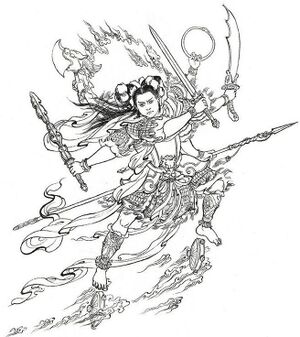
哪吒(Nezha)是中国古代神话中最具反叛精神的少年神祗,其形象融合了道教、佛教与民间信仰,即是护法神将,也是“逆天改命”的象征。其故事最早可追溯至元代《三教源流搜神大全》,后在明代小说《封神演义》中定型,成为家喻户晓的弑龙英雄。随着时代演变,哪吒的形象从宗教符号逐渐演变为文化母题,在当代影视与文学中被赋予新的哲学内涵,成为传统与现代价值碰撞的载体。 | 哪吒(Nezha)是中国古代神话中最具反叛精神的少年神祗,其形象融合了道教、佛教与民间信仰,即是护法神将,也是“逆天改命”的象征。其故事最早可追溯至元代《三教源流搜神大全》,后在明代小说《封神演义》中定型,成为家喻户晓的弑龙英雄。随着时代演变,哪吒的形象从宗教符号逐渐演变为文化母题,在当代影视与文学中被赋予新的哲学内涵,成为传统与现代价值碰撞的载体。 | ||
| − | == | + | [[File:Nezha1.jpg|300px|center|link=]] |
| − | + | ||
| + | ==神话故事的核心版本== | ||
| + | |||
| + | 哪吒形象从佛教护法神演变为道教孩童天神的过程,体现了跨文化融合的经典路径。付方彦指出,哪吒的故事在《封神演义》中达到了巅峰,“《封神演义》定型了后世哪吒的形象,也使得哪吒形象完全中国化、本土化、道教化。”(付方彦,2014:20)。这一转变不仅完成了宗教形象的世俗化,更通过“剔骨还父”情节富裕其本土伦理冲突的张力。 | ||
===《封神演义》中的世俗化叙事=== | ===《封神演义》中的世俗化叙事=== | ||
| Line 14: | Line 21: | ||
在佛教文献中,哪吒为毗沙门天王第三子,三头六臂、脚踏风火轮,手持乾坤圈与混天绫,象征降妖伏魔之力。其形象强调“护法”职能,如《佛说毗沙门天王经》记载哪吒镇守天门、护卫佛法,与《封神演义》的反叛者形象形成鲜明对比。唐代文献《开天传信记》记载了哪吒托举坠落的宣律法师,展现其《护法者》的细腻一面;而宋代禅宗公案中“剔骨还父”的比喻,实为探讨“灵与肉”的哲学命题,为后世文学创作提供了思想土壤。 | 在佛教文献中,哪吒为毗沙门天王第三子,三头六臂、脚踏风火轮,手持乾坤圈与混天绫,象征降妖伏魔之力。其形象强调“护法”职能,如《佛说毗沙门天王经》记载哪吒镇守天门、护卫佛法,与《封神演义》的反叛者形象形成鲜明对比。唐代文献《开天传信记》记载了哪吒托举坠落的宣律法师,展现其《护法者》的细腻一面;而宋代禅宗公案中“剔骨还父”的比喻,实为探讨“灵与肉”的哲学命题,为后世文学创作提供了思想土壤。 | ||
| − | == | + | ==哲学与象征意义的升华== |
===“弑父”行为蕴含深刻的哲学悖论=== | ===“弑父”行为蕴含深刻的哲学悖论=== | ||
| − | + | 据北宋苏辙著《栾城集》第 3 集卷 1《哪吒诗》记载:北方天王有狂子,只知拜佛不拜父。佛知其愚难教语,宝塔令父左手举。儿来见佛头辄俯,且与拜佛略相似。佛如优县难值遇,见者闻道出生死。嗟尔何为独如此,业果已定不去。佛灭到今千万祀,只在江湖挽船处。郭俊叶据此分析得出信息,“‘不拜父’又说明天王父子关系不和......佛在协调天王父子关系上发挥了作用......哪吒因拜佛而拜父,‘以佛为父’”,(郭俊叶 2008, 34)即揭示了佛教信仰对父子关系的调解功能。塔作为镇压与和解的象征,既事对传统孝道的颠覆,亦暗含个体在神权与父权间的挣扎。 | |
===莲花化身的双重隐喻=== | ===莲花化身的双重隐喻=== | ||
| Line 32: | Line 39: | ||
混天绫:红色绸缎象征血脉与激情,其“搅动东海”的能力映射人类对自然力量的征服欲望,而柔软材质又暗含“以柔可刚”的东方智慧。 | 混天绫:红色绸缎象征血脉与激情,其“搅动东海”的能力映射人类对自然力量的征服欲望,而柔软材质又暗含“以柔可刚”的东方智慧。 | ||
| − | == | + | ==现代重构== |
| − | + | 当代影视作品对哪吒形象的解构,凸显了文化记忆的流动性。 | |
===文化符号的现代重构=== | ===文化符号的现代重构=== | ||
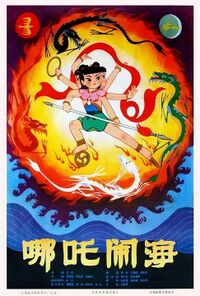
| − | + | 改革开放前后,“中国早期现代主义的代表者们吸收了西方二十世纪哲学问题的重要体系,并依据其自身经验、社会与艺术期待对其进行了重构——这些期待由内在的民族国家世界观所决定(即中华传统、共产主义身份认同与现代化进程交融而成的混合体)”。(Franziska Bruckner et al. 2019,73)1979年的动画《哪吒闹海》就是该阶段的代表作之一。其以自刎明志的悲壮结局,隐喻“旧秩序→新世界”的断裂,将反抗对象从家族伦理扩展至阶级压迫。这部跨越了二十年才得以完成的动画电影,“不仅是‘文革’结束后,中国社会进入新时期以来的首部大型长片动画电影,更是继承并创造性地发展了《大闹天宫》的人物塑造与叙事风格,并注入了新的社会主义价值观念,成为中国动画电影的经典之作”(褚亚男 2018,86)。 | |
| + | |||
| + | [[File:Nezha2.jpg|200px|center|link=]] | ||
| + | |||
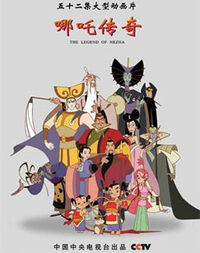
| + | 2003年《哪吒传奇》则通过童真化改编,将反叛精神弱化为少年成长中的“友情试炼”,反映世纪初大众文化对传统叙事的温和化处理。 | ||
| + | |||
| + | [[File:Nezha3.jpg|200px|center|link=]] | ||
2019年《哪吒之魔童降世》以“魔丸/灵珠”的二元设定重构天命与自我的对抗,将‘我命由我不由天’的口号升华为对青年队命运自主权的集体呐喊。影片通过三重策略完成文化转译: | 2019年《哪吒之魔童降世》以“魔丸/灵珠”的二元设定重构天命与自我的对抗,将‘我命由我不由天’的口号升华为对青年队命运自主权的集体呐喊。影片通过三重策略完成文化转译: | ||
| − | 矛盾转移:淡化“弑父”情节,将哪吒与李靖的冲突从血缘对抗转化为代际沟通困境; | + | 1.矛盾转移:淡化“弑父”情节,将哪吒与李靖的冲突从血缘对抗转化为代际沟通困境; |
| + | |||
| + | 2.符号重构:以“魔丸”象征被污名化的个体命运,呼应当代社会的身份焦虑; | ||
| + | |||
| + | 3.价值融合:结局中父子和解既保留“孝”的伦理外壳,又植入平等对话的现代内核。 | ||
| − | + | [[File:Nezha4.jpg|200px|center|link=]] | |
| − | + | 郑伟丽指出,借助了“镜像结构与浴火重生”的叙事策略的《哪吒之魔童降世》,“不仅是中国神话的表述,更杂糅着日漫的成长叙事与好莱坞的合家欢。从割肉自毁到改命而亡,从个体抗争走向镜像结构,从莲花中复生到浴火中变身,哪吒作为被关照主体,在凝视中完成了自我成长与大团圆......彻底消解了曾经哪吒的核心叙事及思想,把一个反抗上位权力压迫的革命寓言转换为反抗成见和宿命的成长寓言”(郑伟丽 2022,46)。这种改编既保留神话原型,又注入当代青年对抗偏见的集体情绪。 | |
===全球化语境下的文化延伸=== | ===全球化语境下的文化延伸=== | ||
| − | + | 2025年初,走进全球各地影院的《哪吒之魔童闹海》进一步将反叛对象从家庭伦理转向仙界规则,李靖从权威化身转化为隐忍父亲,哪吒的挣扎则映射青年对社会结构性压迫的双重反思——既批判原生家庭创伤,又反抗社会不公。这种改编策略暗合全球化时代的身份政治议题,使“逆天改命”的东方叙事与“反抗规训”的西方个体主义产生共振。影片通过视觉奇观与普世主题的嫁接,推动哪吒IP从区域神话向世界性文化符号转化。 | |
| + | |||
| + | 启示当代文化从业者,“要在坚定文化自信的基础上,进一步提升文化自强的实力和能力,以多模态叙事技术切实讲好中国故事,讲好中华优秀传统文化故事,充分发挥中华优秀传统文化价值,深度参与全球文化格局的重构,从而不断走向更加多元化、全球化的舞台中心。 | ||
| + | ”( 张新新,黄笑语,孙俨斌 2025,12) | ||
| − | == | + | ==术语和表达== |
Nezha:哪吒 | Nezha:哪吒 | ||
| Line 84: | Line 104: | ||
Cultural Memory: 文化记忆 | Cultural Memory: 文化记忆 | ||
| − | == | + | ==问题== |
1. 哪吒的“莲花化身”在佛教与道教中分别有何象征差异? | 1. 哪吒的“莲花化身”在佛教与道教中分别有何象征差异? | ||
| Line 90: | Line 110: | ||
2. 为何当代影视倾向于弱化哪吒的“弑父”情节?这反映了怎样的文化变迁? | 2. 为何当代影视倾向于弱化哪吒的“弑父”情节?这反映了怎样的文化变迁? | ||
| − | 3. 从《封神演义》到《魔童降世》, 哪吒形象的重构如何体现中西文化价值的交融? | + | 3.从《封神演义》到《魔童降世》, 哪吒形象的重构如何体现中西文化价值的交融? |
| − | == | + | ==回答== |
| + | |||
| + | 1.佛教象征“出淤泥而不染”的佛性,代表超越世俗的清净,而道教隐喻“肉身成圣”的修炼境界,体现精神自由需舍弃世俗羁绊。 | ||
| + | |||
| + | 2.当代影视(如《魔童降世》)将冲突转化为“代际沟通困境”,淡化血缘对抗,强调和解。反映的文化变迁为传统孝道伦理向现代平等对话转型,个体反抗转向对结构性压迫的批判。 | ||
| + | |||
| + | 3.保留了东方内核,延续了“逆天改命”精神,如“我命由我不由天”,反抗对象从父权扩展至社会偏见;融入西方价值,注入了积极的个人主义和亲子间的平等对话,将反叛嫁接为对抗“结构性压迫”的普世叙事,契合全球化身份政治议题。 | ||
| + | |||
| + | ==参考文献== | ||
| + | |||
| + | [1] 付方彦. 哪吒形象流变研究[D]. 长沙理工大学, 2014:20 | ||
| + | |||
| + | [2] 郭俊叶. 托塔天王与哪吒——兼谈敦煌毗沙门天王赴哪吒会图[J]. 敦煌研究,2008, (03): 32-40+121-122:34. | ||
| + | |||
| + | [3] 郑伟丽. 哪吒之死:英雄补偿、身份认同与时代纪念碑——基于文化记忆理论的哪吒形象经典化研究[J]. 北京电影学院学报,2022,(04):40-47:46 | ||
| + | |||
| + | [4] Bruckner, F., Gilic, N., Lang, H., Suljic, D., & Turkovic, H. (Eds.). Global animation theory: International perspectives at Animafest Zagreb. Bloomsbury Academic, 2019:73. | ||
| + | |||
| + | [5]褚亚男,肖扬. 重读《哪吒闹海》:神话移植与主体重构[J]. 当代动画,2018,(01):86-89: 86 | ||
| + | |||
| + | [6]张新新,黄笑语,孙俨斌. 中华优秀传统文化的丰富蕴涵、当代表达与策略机枢——《哪吒之魔童闹海》的文化现象分析[J/OL]. 中国编辑, 2025: 12 | ||
| − | |||
| − | |||
| − | |||
| − | |||
| − | |||
| − | |||
| − | |||
| − | |||
| − | |||
| − | |||
| − | |||
=Literature: The Legend and Evolution of Nezha in Ancient Mythology= | =Literature: The Legend and Evolution of Nezha in Ancient Mythology= | ||
| + | |||
| − | + | Zhang Jiaxin 202470081582 | |
| − | |||
| − | The transformation of Nezha's image from a Buddhist | + | ==Abstract== |
| − | + | ||
| + | Nezha is the most rebellious young deity in ancient Chinese mythology. His image incorporates elements from Daoism, Buddhism, and folk beliefs, portraying him as both a guardian deity and a symbol of defying fate. His story can be traced back to the Yuan dynasty’s Compendium of the Three Teachings on the Origins of Deities and was later solidified in the Ming dynasty novel Investiture of the Gods, where he became a widely known dragon-slaying hero. Over time, Nezha's image has evolved from a religious symbol into a cultural archetype. In contemporary film and literature, he has been endowed with new philosophical connotations, serving as a medium through which traditional and modern values collide. | ||
| + | |||
| + | [[File:Nezha1.jpg|300px|center|link=]] | ||
| + | |||
| + | ==Core Versions of the Myth== | ||
| + | |||
| + | The transformation of Nezha's image from a Buddhist guardian deity to a Daoist child god reflects a classic trajectory of cross-cultural integration. As Fu Fangyan points out, Nezha's story reached its peak in Investiture of the Gods:"The novel established the definitive image of Nezha for later generations, fully sinicizing, localizing, and Daoizing the character." This transformation not only secularized his religious persona but also infused it with the tension of native ethical conflict through the dramatic episode of "returning bones to the father."(Fu Fangyan 2014,20) | ||
| + | |||
===The Secularized Narrative in Investiture of Gods=== | ===The Secularized Narrative in Investiture of Gods=== | ||
| − | + | Nezha is the reincarnation of the Spirit Pearl and is born in the form of a fleshy sphere, which leads his father, Li Jing, to regard him as a monster. At the age of seven, after stirring up the sea and slaying a dragon—accidentally killing the third son of the Dragon King—he chooses to "return bones to his father and flesh to his mother" to protect the people of Chentang Pass, repaying the debt of kinship with his physical body. He is later reborn by the immortal Taiyi Zhenren, who reconstructs his body from a lotus. This version emphasizes the conflict between individual will and traditional filial piety through dramatic confrontation. | |
| − | + | ===The Dparmapala Image in Buddhist Scriptures=== | |
| − | + | In Buddhist texts, Nezha is the third son of Vaisravana (the Heavenly King of the North). He has three heads and six arms, rides on Wind-Fire Wheels, and wields the Universe Ring and the Cosmic Sash, symbolizing his power to vanquish demons and subdue evil. His image emphasizes the role of a Dharma Protector. For instance, the Sutra of Vaisravana records that Nezha guards the heavenly gate and defends the Dharma, forming a stark contrast with his rebellious figure in Investiture of the Gods. The Tang-dynasty text Record of the Proclamation of Heaven's Teachings recounts Nezha rescuing the falling monk Xuanlv, revealing a more nuanced side of his role as Dharma Protector. Meanwhile, the metaphor of "returning bones to the father" in Song Dynasty Chan (Zen) cases explores the philosophical issue of "spirit and flesh," providing conceptual ground for later literary creation. | |
| − | + | ==The Philosophical and Symbolic Elevation== | |
| − | The | + | ===The Patricidal Act and Its Profound Philosophical Paradox=== |
| − | + | According to Volume 1, Collection 3 of Collected Works from Luancheng by Su Zhe of the Northern Song dynasty, a poem on Nezha reads: "The Northern Heavenly King had a mad son, who knew only to worship the Buddha but not his father. Knowing his ignorance was hard to correct, the Buddha instructed the father to lift his left hand beside the pagoda. When the son approached the Buddha, he instinctively bowed his head—slightly resembling a bow to the father. The Buddha, like a rare sage, brings enlightenment to those who encounter him. Why do you, alone, remain unchanged? Karma is fixed, unshakable. Since the Buddha's passing, ten thousand generations have come and gone; only the sound of towlines echoes across the rivers and lakes." | |
| − | + | Based on this, Guo Junye analyzes: "Not bowing to his father reflects the strained relationship between the Heavenly King and his son... the Buddha intervenes to mediate the father-son conflict... Nezha bows to his father through the act of bowing to the Buddha, effectively taking the Buddha as father" (Guo Junye 2008,34), thus revealing Buddhism's reconciliatory function in resolving familial tension. | |
| − | + | The pagoda, as a symbol of both suppression and reconciliation, not only subverts traditional filial piety but also embodies the individual's struggle between divine authority and paternal power. | |
| − | === | + | ===The Dual Metaphor of the Lotus Reincarnation=== |
| − | In Buddhism, the lotus | + | In Buddhism, the lotus symbolizes the Buddha nature that remains unsullied despite growing from the mud; in Daoism, it represents the cultivated state of "attaining sainthood through the physical body." Nezha's rebirth in the form of a lotus is both a transcendence of physical limitations and an indication that spiritual freedom comes at the cost of renouncing worldly attachments. In the Song dynasty, Chan Buddhism once posed the question of whether Nezha continued to exist after "returning his bones to his father." The answer—his rebirth as a lotus incarnation—provided a resolution to the philosophical problem of the separation between spirit and flesh. This narrative device not only endows Nezha with divinity beyond life and death but also metaphorically reflects humanity's enduring pursuit of spiritual autonomy. |
===A Dialectic Between Magical Tools and Power=== | ===A Dialectic Between Magical Tools and Power=== | ||
| − | + | Qiankun Ring: Originally a magical implement used to restrain Nezha's violent nature, it later evolved into a weapon for defeating enemies—embodying the balance between "taming wildness" and "harnessing power." Its circular form subtly reflects the Daoist cosmology of ceaseless flow, while its metallic composition symbolizes the unity of rigid constraint and flexible transformation. | |
| − | + | Wind-Fire Wheels: Their swift movement grants Nezha a tactical advantage in battle, yet the flames they emit consume spiritual energy—signifying the dual nature of power. Their design may have originated from the "Fire-Wheel King" belief system, later integrated with the Daoist theory of the "mutual generation of the Five Elements," making them a paradoxical fusion of speed and danger. | |
| − | + | Huntian Ribbon: This red silk ribbon symbolizes bloodline and passion. Its ability to "stir the Eastern Sea" reflects humanity's desire to conquer natural forces, while its soft texture embodies the Eastern wisdom of "overcoming the rigid with the gentle." | |
| − | == | + | ==Modern Reconstruction== |
| − | Contemporary | + | Contemporary film and television deconstructions of the Nezha figure highlight the fluidity of cultural memory. |
===Modern Reconstruction of Cultural Symbols=== | ===Modern Reconstruction of Cultural Symbols=== | ||
| − | The 1979 animation Nezha Conquers the Dragon | + | Before and after the Reform and Opening-up, "the early representatives of Chinese modernism absorbed significant Western twentieth-century philosophical frameworks, and reconstructed them based on their own experiences and social and artistic expectations—expectations determined by an internal worldview combining Chinese tradition, communist identity, and modernization processes." (Franziska Bruckner et al. 2019,73) |
| + | |||
| + | The 1979 animation Nezha Conquers the Dragon King is one representative work from this period. Its tragic ending of self-slitting to prove resolve metaphorically depicts the rupture from the "old order to the new world," extending the target of rebellion from family ethics to class oppression. This animation, which took over twenty years to complete, "was not only the first large-scale feature animation since the end of the Cultural Revolution and the start of a new era in Chinese society but also inherited and creatively developed the character shaping and narrative style of The Monkey King, infused with new socialist values, becoming a classic of Chinese animation." (Chu Yanan 2018,86) | ||
| + | |||
| + | [[File:Nezha2.jpg|200px|center|link=]] | ||
| − | The | + | The 2003 Nezha Legend softened the rebellious spirit into "tests of friendship" in youth through childlike adaptations, reflecting the gentle handling of traditional narrative in early 21st-century popular cultures. |
| − | + | [[File:Nezha3.jpg|200px|center|link=]] | |
| − | + | The 2019 Nezha: Birth of the Demon Child reconstructed the conflict between destiny and self through a dual concept of "demon pearl/spiritual pearl," elevating the slogan "My fate is mine, not heaven's" into a collective shout for young people's autonomy over fate. The film achieved cultural translation through three strategies: | |
| − | Value | + | 1. Contradiction shift: downplaying the "patricide" plot, transforming the conflict between Nezha and Li Jing from bloodline antagonism to an intergenerational communication dilemma; |
| + | |||
| + | 2. Symbolic reconstruction: using the "demon pearl" to symbolize stigmatized individual fate, echoing contemporary social identity anxieties; | ||
| + | |||
| + | 3. Value integration: the reconciliation between father and son in the ending retains the ethical shell of "filial piety" while embedding a modern core of equal dialogue. | ||
| + | |||
| + | [[File:Nezha4.jpg|200px|center|link=]] | ||
| + | |||
| + | Zheng Weili notes that Nezha: Birth of the Demon Child, which employs narrative strategies of "mirrored structure and rebirth through fire," is "not merely a representation of Chinese mythology, but also interweaves elements of Japanese anime's coming-of-age narratives and Hollywood-style family entertainment." "From self-mutilation to death in defiance of fate, from individual resistance to mirrored narrative structure, from rebirth in a lotus to transformation through fire—Nezha, as the object of narrative attention, completes a journey of self-growth and reconciliation under the gaze of others... This entirely dissolves the core narrative and ideological thrust of the traditional Nezha, turning a revolutionary allegory of rebellion against authority into a coming-of-age parable about resisting prejudice and fatalism." (Zheng Weili 2022,46) Such adaptation retains the mythological prototype while injecting the collective sentiment of contemporary youth in their struggle against prejudice. | ||
===Cultural Extension in a Globalized Context=== | ===Cultural Extension in a Globalized Context=== | ||
| − | + | In early 2025, Nezha2—which screened in cinemas worldwide—further shifted the object of rebellion from familial ethics to the celestial order. Li Jing was reimagined from a figure of authority into a forbearing father, while Nezha's struggle mirrored a dual reflection of contemporary youth on structural oppression—critiquing both the trauma of the natal family and broader social injustice. | |
| + | |||
| + | This adaptation strategy resonates with the identity politics of the globalized era, allowing the Eastern narrative of "defying destiny" to find common ground with the Western tradition of individual resistance against discipline and control. By merging visual spectacle with universal themes, the film advances the Nezha IP from a regional myth to a global cultural symbol. | ||
| + | |||
| + | This offers inspiration to today's cultural practitioners: "On the foundation of firm cultural confidence, we must further strengthen our cultural competence and capacity. By using multimodal narrative techniques, we can effectively tell China's stories—especially the stories of its outstanding traditional culture—so as to fully realize their value, actively participate in the reshaping of the global cultural landscape, and continuously move toward a more diverse and global center stage." (Zhang Xinxin, Huang Xiaoyu, Sun Yanbin 2025,12) | ||
==Terms and Expressions== | ==Terms and Expressions== | ||
| Line 196: | Line 249: | ||
Cultural Memory: 文化记忆 | Cultural Memory: 文化记忆 | ||
| − | ==Questions | + | ==Questions== |
1. What are the symbolic differences of Nezha's Lotus Rebirth in Buddhism and Daoism, respectively? | 1. What are the symbolic differences of Nezha's Lotus Rebirth in Buddhism and Daoism, respectively? | ||
| Line 202: | Line 255: | ||
2. Why do contemporary film and television adaptations tend to downplay Nezha's Returning Flesh and Bones(patricide) episode? What kind of cultural shift does this reflect? | 2. Why do contemporary film and television adaptations tend to downplay Nezha's Returning Flesh and Bones(patricide) episode? What kind of cultural shift does this reflect? | ||
| − | + | From Investiture of the Gods to Nezha: Birth of the Demon Child, how does the reconstruction of Nezha's image reflect the integration of Chinese and Western values? | |
| + | |||
| + | ==Answers== | ||
| + | |||
| + | Buddhist symbolism of "remaining unsullied despite growing out of the mud" reflects Nezha's Buddha nature, representing transcendental purity. Meanwhile, the Daoist metaphor of "attaining sainthood through physical cultivation"expresses the spiritual freedom achieved by shedding worldly attachments. | ||
| + | |||
| + | Contemporary films—such as Nezha: Birth of the Demon Child—transform conflict into a problem of intergenerational communication, downplaying bloodline-based antagonism and emphasizing reconciliation. This reflects a broader cultural shift from traditional Confucian filial ethics to modern egalitarian dialogue, redirecting individual resistance toward a critique of structural oppression. | ||
| + | |||
| + | While preserving an Eastern core and continuing the rebellious spirit of "defying Heaven and changing fate"—as captured in the slogan "My fate is mine to decide"—the object of rebellion expands from patriarchal authority to social prejudice. The narrative integrates Western values, injecting positive individualism and emphasizing equal parent-child dialogue. This reframes rebellion into a universal narrative of resistance against structural injustice, resonating with identity politics in the global era. | ||
| + | |||
| + | |||
| + | ==References== | ||
| + | |||
| + | [1] Fu, Fangyan. A Study on the Evolution of Nezha's Image [D]. Changsha University of Science & Technology, 2014: 20. | ||
| + | |||
| + | [2] Guo, Junye. The Pagoda-Bearing Heavenly King and Nezha: A Discussion with Reference to the Dunhuang Mural "Vaisravana Visiting Nezha" [J]. Dunhuang Research, 2008, (03): 32–40+121–122: 34. | ||
| + | |||
| + | [3] Zheng, Weili. The Death of Nezha: Heroic Compensation, Identity Construction, and Monument of the Times—A Study on the Canonization of Nezha's Image Based on Cultural Memory Theory [J]. Journal of Beijing Film Academy, 2022, (04): 40–47: 46. | ||
| + | |||
| + | [4] Bruckner, F., Gilic, N., Lang, H., Suljic, D., & Turkovic, H. (Eds.). Global Animation Theory: International Perspectives at Animafest Zagreb. Bloomsbury Academic, 2019: 73. | ||
| + | |||
| + | [5] Chu, Yanan, & Xiao, Yang. Rereading Nezha Conquers the Dragon King: Myth Transplantation and Subject Reconstruction [J]. Contemporary Animation, 2018, (01): 86–89: 86. | ||
| + | |||
| + | [6]Zhang, Xinxin, Huang, Xiaoyu, & Sun, Yanbin. The Rich Connotation, Contemporary Expression, and Strategic Mechanism of Excellent Traditional Chinese Culture—An Analysis of the Cultural Phenomenon in Nezha: Birth of the Demon Child [J/OL]. China Editor, 2025: 12. | ||
| + | |||
| + | ==AI Statement== | ||
| + | |||
| + | I used the following AI tool to assist in writing my final paper: DeepSeek (R1). | ||
| + | |||
| + | ===Key Prompts Used and Partial Manual Operations=== | ||
| + | |||
| + | ====Structure Determination==== | ||
| + | |||
| + | Prompt: | ||
| + | |||
| + | Main task: Based on the following text, analyze the general structural composition of each chapter. Then answer: if a new chapter were to be written on the development of Nezha's cultural connotations, what would its general structure and content include? | ||
| + | |||
| + | Reference text: (Selected textbook chapters) | ||
| + | |||
| + | Ds output: | ||
| + | |||
| + | Based on the three sample chapters provided, the following general structure can be summarized: ...; Suggested structure and content for a new chapter on the development of Nezha's cultural connotations: ... | ||
| + | |||
| + | Identified Issue: | ||
| + | |||
| + | The subpoints in DS's proposed structure did not follow a logical progression from simple to complex. There were too many primary and secondary subpoints, and the descriptions for each were overly broad. | ||
| + | |||
| + | Prompt: | ||
| + | |||
| + | Main task: Please adjust the structure based on the narrative order of the sample chapters, revising the logic to follow a "simple to complex" progression. Do not add new subpoints; instead, refine the content direction and requirements under each existing subpoint. | ||
| + | |||
| + | ====Literature Analysis and Citation Selection==== | ||
| + | |||
| + | Once the structure and content direction for each subpoint were confirmed, I was able to determine the necessary search keywords and the general scope of literature suitable for citation. I conducted searches using CNKI and Google Scholar, and selected sources based on keywords and abstracts that would effectively support the argumentation. Then, I read through the relevant literature and broadly selected a sufficient number of citations with strong usability. | ||
| + | |||
| + | ====Text Composition and Refinement==== | ||
| + | |||
| + | After the above two stages, the preparatory work for writing the paper was complete. I then issued prompts with detailed writing instructions, prompting DS to generate a draft. | ||
| + | |||
| + | Prompt: | ||
| + | |||
| + | Main task: [Attachment 1: Structure.txt] [Attachment 2: Selected Quotes and Source Information.txt] | ||
| + | |||
| + | Writing instructions: 1. The entire paper must focus on the theme “the development of Nezha's cultural connotations."; 2. The paper must be written in Chinese, approximately 1,500 characters, with clear and coherent argumentation; 3. The given structure must be strictly followed, with a reasonable distribution of word count across subpoints; 4. Extracted technical terms should be limited to 10–12; 5. Question design must align with the text. | ||
| + | |||
| + | Citation requirements: 1. Appropriately select direct quotes from Attachment 2 that support the argument; 2. Do not alter quoted texts in any way; 3. Use in-text citations that include the author's name, publication title, year, and page number. | ||
| + | |||
| + | Ds output: | ||
| + | |||
| + | (Draft generated) | ||
| + | |||
| + | After receiving the draft, I reviewed it and added further prompts such as avoiding repeated citations and excluding unverifiable sources. I then revised the draft accordingly to ensure its acceptability. | ||
| − | + | Prompt: | |
| − | + | ||
| − | + | [Attachment: Manually Optimized Draft] | |
| − | + | ||
| − | + | Main task: Review and verify the draft based on all writing requirements mentioned in previous prompts. | |
| − | + | ||
| − | + | Ds output: | |
| − | + | ||
| − | + | (Reviewed draft generated) | |
| − | + | ||
| − | + | The draft was further refined manually. | |
| − | + | ||
| − | + | ====English Translation and Quality Assessment==== | |
| + | |||
| + | Prompt: | ||
| + | |||
| + | Extract technical terms and culturally significant expressions from the text and provide their official or widely accepted English equivalents in a clear bilingual table. | ||
| + | |||
| + | Ds output: | ||
| + | |||
| + | (Terminology table provided) | ||
| + | |||
| + | Then I translated the Chinese manuscript into English, using the AI-generated terminology table for consistency. | ||
| + | |||
| + | Prompt: | ||
| + | |||
| + | [Attachment: Chinese Original and English Translation] | ||
| + | |||
| + | Main task: Conduct a translation quality assessment based on the Chinese original. | ||
| + | |||
| + | Requirements: 1. Faithfulness to the original; no additions, omissions, or overinterpretation; 2. Eliminate grammatical errors; 3. Ensure natural and fluent expression; 4. Maintain consistency in terminology usage; 5. Evaluate paragraph by paragraph, offering detailed analysis and revision suggestions; 6. Present results in a clear table format including the original Chinese, original English, issues identified, and revision suggestions. | ||
| + | |||
| + | Then I revised the English translation accordingly based on the assessment table. | ||
| + | |||
| + | ====The final version is completed==== | ||
Latest revision as of 02:05, 20 June 2025
文学:哪吒的文化内涵的演变
张嘉欣 202470081582
摘要
哪吒(Nezha)是中国古代神话中最具反叛精神的少年神祗,其形象融合了道教、佛教与民间信仰,即是护法神将,也是“逆天改命”的象征。其故事最早可追溯至元代《三教源流搜神大全》,后在明代小说《封神演义》中定型,成为家喻户晓的弑龙英雄。随着时代演变,哪吒的形象从宗教符号逐渐演变为文化母题,在当代影视与文学中被赋予新的哲学内涵,成为传统与现代价值碰撞的载体。
神话故事的核心版本
哪吒形象从佛教护法神演变为道教孩童天神的过程,体现了跨文化融合的经典路径。付方彦指出,哪吒的故事在《封神演义》中达到了巅峰,“《封神演义》定型了后世哪吒的形象,也使得哪吒形象完全中国化、本土化、道教化。”(付方彦,2014:20)。这一转变不仅完成了宗教形象的世俗化,更通过“剔骨还父”情节富裕其本土伦理冲突的张力。
《封神演义》中的世俗化叙事
哪吒为灵珠子转世,出生时以肉球形态降生,被父亲李靖视为妖孽。七岁时因闹海屠龙、误杀龙王三太子,为保全陈塘关百姓,他选择“剔骨还父,割肉还母”,以肉身偿还血缘之债,后得太乙真人以莲花重塑真身。这一版本通过戏剧冲突凸显了个体意志与传统孝道的对立。
佛教典籍中的护法神形象
在佛教文献中,哪吒为毗沙门天王第三子,三头六臂、脚踏风火轮,手持乾坤圈与混天绫,象征降妖伏魔之力。其形象强调“护法”职能,如《佛说毗沙门天王经》记载哪吒镇守天门、护卫佛法,与《封神演义》的反叛者形象形成鲜明对比。唐代文献《开天传信记》记载了哪吒托举坠落的宣律法师,展现其《护法者》的细腻一面;而宋代禅宗公案中“剔骨还父”的比喻,实为探讨“灵与肉”的哲学命题,为后世文学创作提供了思想土壤。
哲学与象征意义的升华
“弑父”行为蕴含深刻的哲学悖论
据北宋苏辙著《栾城集》第 3 集卷 1《哪吒诗》记载:北方天王有狂子,只知拜佛不拜父。佛知其愚难教语,宝塔令父左手举。儿来见佛头辄俯,且与拜佛略相似。佛如优县难值遇,见者闻道出生死。嗟尔何为独如此,业果已定不去。佛灭到今千万祀,只在江湖挽船处。郭俊叶据此分析得出信息,“‘不拜父’又说明天王父子关系不和......佛在协调天王父子关系上发挥了作用......哪吒因拜佛而拜父,‘以佛为父’”,(郭俊叶 2008, 34)即揭示了佛教信仰对父子关系的调解功能。塔作为镇压与和解的象征,既事对传统孝道的颠覆,亦暗含个体在神权与父权间的挣扎。
莲花化身的双重隐喻
莲花在佛教中象征出淤泥而不染的佛性,在道教中代表“肉身成圣”的修炼境界。哪吒的莲花化身既是对肉身局限的超越,也暗示精神自由需以舍弃世俗羁绊为代价。宋代禅宗曾探讨“剔骨还父后哪吒是否存在”,最终以“莲花化身”解答“灵肉分离”的哲学命题。这一设定不仅赋予哪吒超脱生死的神性,更隐喻人类对精神独立性的永恒追求。
法器与力量的辩证关系
乾坤圈:原为禁锢哪吒暴戾之心的法器,后期转化为克敌武器,体现“驯服野性”与“驾驭力量”的平衡。其圆形结构暗含道家“周流不息”的宇宙观,而金属材质则象征刚性约束与柔性转化的统一。
风火轮:疾驰能力赋予哪吒战斗优势,但火焰亦需要消耗灵力,暗示力量的双面性。其设计灵感或源自“火轮天王”信仰,后融入道教“五行相生”理论,成为速度与危险的矛盾综合体。
混天绫:红色绸缎象征血脉与激情,其“搅动东海”的能力映射人类对自然力量的征服欲望,而柔软材质又暗含“以柔可刚”的东方智慧。
现代重构
当代影视作品对哪吒形象的解构,凸显了文化记忆的流动性。
文化符号的现代重构
改革开放前后,“中国早期现代主义的代表者们吸收了西方二十世纪哲学问题的重要体系,并依据其自身经验、社会与艺术期待对其进行了重构——这些期待由内在的民族国家世界观所决定(即中华传统、共产主义身份认同与现代化进程交融而成的混合体)”。(Franziska Bruckner et al. 2019,73)1979年的动画《哪吒闹海》就是该阶段的代表作之一。其以自刎明志的悲壮结局,隐喻“旧秩序→新世界”的断裂,将反抗对象从家族伦理扩展至阶级压迫。这部跨越了二十年才得以完成的动画电影,“不仅是‘文革’结束后,中国社会进入新时期以来的首部大型长片动画电影,更是继承并创造性地发展了《大闹天宫》的人物塑造与叙事风格,并注入了新的社会主义价值观念,成为中国动画电影的经典之作”(褚亚男 2018,86)。
2003年《哪吒传奇》则通过童真化改编,将反叛精神弱化为少年成长中的“友情试炼”,反映世纪初大众文化对传统叙事的温和化处理。
2019年《哪吒之魔童降世》以“魔丸/灵珠”的二元设定重构天命与自我的对抗,将‘我命由我不由天’的口号升华为对青年队命运自主权的集体呐喊。影片通过三重策略完成文化转译:
1.矛盾转移:淡化“弑父”情节,将哪吒与李靖的冲突从血缘对抗转化为代际沟通困境;
2.符号重构:以“魔丸”象征被污名化的个体命运,呼应当代社会的身份焦虑;
3.价值融合:结局中父子和解既保留“孝”的伦理外壳,又植入平等对话的现代内核。
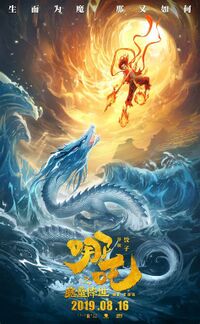
郑伟丽指出,借助了“镜像结构与浴火重生”的叙事策略的《哪吒之魔童降世》,“不仅是中国神话的表述,更杂糅着日漫的成长叙事与好莱坞的合家欢。从割肉自毁到改命而亡,从个体抗争走向镜像结构,从莲花中复生到浴火中变身,哪吒作为被关照主体,在凝视中完成了自我成长与大团圆......彻底消解了曾经哪吒的核心叙事及思想,把一个反抗上位权力压迫的革命寓言转换为反抗成见和宿命的成长寓言”(郑伟丽 2022,46)。这种改编既保留神话原型,又注入当代青年对抗偏见的集体情绪。
全球化语境下的文化延伸
2025年初,走进全球各地影院的《哪吒之魔童闹海》进一步将反叛对象从家庭伦理转向仙界规则,李靖从权威化身转化为隐忍父亲,哪吒的挣扎则映射青年对社会结构性压迫的双重反思——既批判原生家庭创伤,又反抗社会不公。这种改编策略暗合全球化时代的身份政治议题,使“逆天改命”的东方叙事与“反抗规训”的西方个体主义产生共振。影片通过视觉奇观与普世主题的嫁接,推动哪吒IP从区域神话向世界性文化符号转化。
启示当代文化从业者,“要在坚定文化自信的基础上,进一步提升文化自强的实力和能力,以多模态叙事技术切实讲好中国故事,讲好中华优秀传统文化故事,充分发挥中华优秀传统文化价值,深度参与全球文化格局的重构,从而不断走向更加多元化、全球化的舞台中心。 ”( 张新新,黄笑语,孙俨斌 2025,12)
术语和表达
Nezha:哪吒
Compendium of Divine Origins of the Three Teachings: 三教源流搜神大全
Investiture of the Gods: 封神演义
Returning Flesh and Bones: 剔骨还父
Attaining Sanctity in the Flesh: 肉身成圣
WindFire Wheels: 风火轮
Universe Ring: 乾坤圈
Red Armillary Sash:混天绫
Taiyi Zhenren:太乙真人
Spirit Pearl: 灵珠
Demon Pill: 魔丸
Defying Fate: 逆天改命
Master Xuanlv: 宣律法师
Chan Buddhist Koans: 禅宗公案
Cultural Memory: 文化记忆
问题
1. 哪吒的“莲花化身”在佛教与道教中分别有何象征差异?
2. 为何当代影视倾向于弱化哪吒的“弑父”情节?这反映了怎样的文化变迁?
3.从《封神演义》到《魔童降世》, 哪吒形象的重构如何体现中西文化价值的交融?
回答
1.佛教象征“出淤泥而不染”的佛性,代表超越世俗的清净,而道教隐喻“肉身成圣”的修炼境界,体现精神自由需舍弃世俗羁绊。
2.当代影视(如《魔童降世》)将冲突转化为“代际沟通困境”,淡化血缘对抗,强调和解。反映的文化变迁为传统孝道伦理向现代平等对话转型,个体反抗转向对结构性压迫的批判。
3.保留了东方内核,延续了“逆天改命”精神,如“我命由我不由天”,反抗对象从父权扩展至社会偏见;融入西方价值,注入了积极的个人主义和亲子间的平等对话,将反叛嫁接为对抗“结构性压迫”的普世叙事,契合全球化身份政治议题。
参考文献
[1] 付方彦. 哪吒形象流变研究[D]. 长沙理工大学, 2014:20
[2] 郭俊叶. 托塔天王与哪吒——兼谈敦煌毗沙门天王赴哪吒会图[J]. 敦煌研究,2008, (03): 32-40+121-122:34.
[3] 郑伟丽. 哪吒之死:英雄补偿、身份认同与时代纪念碑——基于文化记忆理论的哪吒形象经典化研究[J]. 北京电影学院学报,2022,(04):40-47:46
[4] Bruckner, F., Gilic, N., Lang, H., Suljic, D., & Turkovic, H. (Eds.). Global animation theory: International perspectives at Animafest Zagreb. Bloomsbury Academic, 2019:73.
[5]褚亚男,肖扬. 重读《哪吒闹海》:神话移植与主体重构[J]. 当代动画,2018,(01):86-89: 86
[6]张新新,黄笑语,孙俨斌. 中华优秀传统文化的丰富蕴涵、当代表达与策略机枢——《哪吒之魔童闹海》的文化现象分析[J/OL]. 中国编辑, 2025: 12
Literature: The Legend and Evolution of Nezha in Ancient Mythology
Zhang Jiaxin 202470081582
Abstract
Nezha is the most rebellious young deity in ancient Chinese mythology. His image incorporates elements from Daoism, Buddhism, and folk beliefs, portraying him as both a guardian deity and a symbol of defying fate. His story can be traced back to the Yuan dynasty’s Compendium of the Three Teachings on the Origins of Deities and was later solidified in the Ming dynasty novel Investiture of the Gods, where he became a widely known dragon-slaying hero. Over time, Nezha's image has evolved from a religious symbol into a cultural archetype. In contemporary film and literature, he has been endowed with new philosophical connotations, serving as a medium through which traditional and modern values collide.
Core Versions of the Myth
The transformation of Nezha's image from a Buddhist guardian deity to a Daoist child god reflects a classic trajectory of cross-cultural integration. As Fu Fangyan points out, Nezha's story reached its peak in Investiture of the Gods:"The novel established the definitive image of Nezha for later generations, fully sinicizing, localizing, and Daoizing the character." This transformation not only secularized his religious persona but also infused it with the tension of native ethical conflict through the dramatic episode of "returning bones to the father."(Fu Fangyan 2014,20)
The Secularized Narrative in Investiture of Gods
Nezha is the reincarnation of the Spirit Pearl and is born in the form of a fleshy sphere, which leads his father, Li Jing, to regard him as a monster. At the age of seven, after stirring up the sea and slaying a dragon—accidentally killing the third son of the Dragon King—he chooses to "return bones to his father and flesh to his mother" to protect the people of Chentang Pass, repaying the debt of kinship with his physical body. He is later reborn by the immortal Taiyi Zhenren, who reconstructs his body from a lotus. This version emphasizes the conflict between individual will and traditional filial piety through dramatic confrontation.
The Dparmapala Image in Buddhist Scriptures
In Buddhist texts, Nezha is the third son of Vaisravana (the Heavenly King of the North). He has three heads and six arms, rides on Wind-Fire Wheels, and wields the Universe Ring and the Cosmic Sash, symbolizing his power to vanquish demons and subdue evil. His image emphasizes the role of a Dharma Protector. For instance, the Sutra of Vaisravana records that Nezha guards the heavenly gate and defends the Dharma, forming a stark contrast with his rebellious figure in Investiture of the Gods. The Tang-dynasty text Record of the Proclamation of Heaven's Teachings recounts Nezha rescuing the falling monk Xuanlv, revealing a more nuanced side of his role as Dharma Protector. Meanwhile, the metaphor of "returning bones to the father" in Song Dynasty Chan (Zen) cases explores the philosophical issue of "spirit and flesh," providing conceptual ground for later literary creation.
The Philosophical and Symbolic Elevation
The Patricidal Act and Its Profound Philosophical Paradox
According to Volume 1, Collection 3 of Collected Works from Luancheng by Su Zhe of the Northern Song dynasty, a poem on Nezha reads: "The Northern Heavenly King had a mad son, who knew only to worship the Buddha but not his father. Knowing his ignorance was hard to correct, the Buddha instructed the father to lift his left hand beside the pagoda. When the son approached the Buddha, he instinctively bowed his head—slightly resembling a bow to the father. The Buddha, like a rare sage, brings enlightenment to those who encounter him. Why do you, alone, remain unchanged? Karma is fixed, unshakable. Since the Buddha's passing, ten thousand generations have come and gone; only the sound of towlines echoes across the rivers and lakes."
Based on this, Guo Junye analyzes: "Not bowing to his father reflects the strained relationship between the Heavenly King and his son... the Buddha intervenes to mediate the father-son conflict... Nezha bows to his father through the act of bowing to the Buddha, effectively taking the Buddha as father" (Guo Junye 2008,34), thus revealing Buddhism's reconciliatory function in resolving familial tension.
The pagoda, as a symbol of both suppression and reconciliation, not only subverts traditional filial piety but also embodies the individual's struggle between divine authority and paternal power.
The Dual Metaphor of the Lotus Reincarnation
In Buddhism, the lotus symbolizes the Buddha nature that remains unsullied despite growing from the mud; in Daoism, it represents the cultivated state of "attaining sainthood through the physical body." Nezha's rebirth in the form of a lotus is both a transcendence of physical limitations and an indication that spiritual freedom comes at the cost of renouncing worldly attachments. In the Song dynasty, Chan Buddhism once posed the question of whether Nezha continued to exist after "returning his bones to his father." The answer—his rebirth as a lotus incarnation—provided a resolution to the philosophical problem of the separation between spirit and flesh. This narrative device not only endows Nezha with divinity beyond life and death but also metaphorically reflects humanity's enduring pursuit of spiritual autonomy.
A Dialectic Between Magical Tools and Power
Qiankun Ring: Originally a magical implement used to restrain Nezha's violent nature, it later evolved into a weapon for defeating enemies—embodying the balance between "taming wildness" and "harnessing power." Its circular form subtly reflects the Daoist cosmology of ceaseless flow, while its metallic composition symbolizes the unity of rigid constraint and flexible transformation.
Wind-Fire Wheels: Their swift movement grants Nezha a tactical advantage in battle, yet the flames they emit consume spiritual energy—signifying the dual nature of power. Their design may have originated from the "Fire-Wheel King" belief system, later integrated with the Daoist theory of the "mutual generation of the Five Elements," making them a paradoxical fusion of speed and danger.
Huntian Ribbon: This red silk ribbon symbolizes bloodline and passion. Its ability to "stir the Eastern Sea" reflects humanity's desire to conquer natural forces, while its soft texture embodies the Eastern wisdom of "overcoming the rigid with the gentle."
Modern Reconstruction
Contemporary film and television deconstructions of the Nezha figure highlight the fluidity of cultural memory.
Modern Reconstruction of Cultural Symbols
Before and after the Reform and Opening-up, "the early representatives of Chinese modernism absorbed significant Western twentieth-century philosophical frameworks, and reconstructed them based on their own experiences and social and artistic expectations—expectations determined by an internal worldview combining Chinese tradition, communist identity, and modernization processes." (Franziska Bruckner et al. 2019,73)
The 1979 animation Nezha Conquers the Dragon King is one representative work from this period. Its tragic ending of self-slitting to prove resolve metaphorically depicts the rupture from the "old order to the new world," extending the target of rebellion from family ethics to class oppression. This animation, which took over twenty years to complete, "was not only the first large-scale feature animation since the end of the Cultural Revolution and the start of a new era in Chinese society but also inherited and creatively developed the character shaping and narrative style of The Monkey King, infused with new socialist values, becoming a classic of Chinese animation." (Chu Yanan 2018,86)
The 2003 Nezha Legend softened the rebellious spirit into "tests of friendship" in youth through childlike adaptations, reflecting the gentle handling of traditional narrative in early 21st-century popular cultures.
The 2019 Nezha: Birth of the Demon Child reconstructed the conflict between destiny and self through a dual concept of "demon pearl/spiritual pearl," elevating the slogan "My fate is mine, not heaven's" into a collective shout for young people's autonomy over fate. The film achieved cultural translation through three strategies:
1. Contradiction shift: downplaying the "patricide" plot, transforming the conflict between Nezha and Li Jing from bloodline antagonism to an intergenerational communication dilemma;
2. Symbolic reconstruction: using the "demon pearl" to symbolize stigmatized individual fate, echoing contemporary social identity anxieties;
3. Value integration: the reconciliation between father and son in the ending retains the ethical shell of "filial piety" while embedding a modern core of equal dialogue.
Zheng Weili notes that Nezha: Birth of the Demon Child, which employs narrative strategies of "mirrored structure and rebirth through fire," is "not merely a representation of Chinese mythology, but also interweaves elements of Japanese anime's coming-of-age narratives and Hollywood-style family entertainment." "From self-mutilation to death in defiance of fate, from individual resistance to mirrored narrative structure, from rebirth in a lotus to transformation through fire—Nezha, as the object of narrative attention, completes a journey of self-growth and reconciliation under the gaze of others... This entirely dissolves the core narrative and ideological thrust of the traditional Nezha, turning a revolutionary allegory of rebellion against authority into a coming-of-age parable about resisting prejudice and fatalism." (Zheng Weili 2022,46) Such adaptation retains the mythological prototype while injecting the collective sentiment of contemporary youth in their struggle against prejudice.
Cultural Extension in a Globalized Context
In early 2025, Nezha2—which screened in cinemas worldwide—further shifted the object of rebellion from familial ethics to the celestial order. Li Jing was reimagined from a figure of authority into a forbearing father, while Nezha's struggle mirrored a dual reflection of contemporary youth on structural oppression—critiquing both the trauma of the natal family and broader social injustice.
This adaptation strategy resonates with the identity politics of the globalized era, allowing the Eastern narrative of "defying destiny" to find common ground with the Western tradition of individual resistance against discipline and control. By merging visual spectacle with universal themes, the film advances the Nezha IP from a regional myth to a global cultural symbol.
This offers inspiration to today's cultural practitioners: "On the foundation of firm cultural confidence, we must further strengthen our cultural competence and capacity. By using multimodal narrative techniques, we can effectively tell China's stories—especially the stories of its outstanding traditional culture—so as to fully realize their value, actively participate in the reshaping of the global cultural landscape, and continuously move toward a more diverse and global center stage." (Zhang Xinxin, Huang Xiaoyu, Sun Yanbin 2025,12)
Terms and Expressions
Nezha:哪吒
Compendium of Divine Origins of the Three Teachings: 三教源流搜神大全
Investiture of the Gods: 封神演义
Returning Flesh and Bones: 剔骨还父
Attaining Sanctity in the Flesh: 肉身成圣
WindFire Wheels: 风火轮
Universe Ring: 乾坤圈
Red Armillary Sash:混天绫
Taiyi Zhenren:太乙真人
Spirit Pearl: 灵珠
Demon Pill: 魔丸
Defying Fate: 逆天改命
Master Xuanlv: 宣律法师
Chan Buddhist Koans: 禅宗公案
Cultural Memory: 文化记忆
Questions
1. What are the symbolic differences of Nezha's Lotus Rebirth in Buddhism and Daoism, respectively?
2. Why do contemporary film and television adaptations tend to downplay Nezha's Returning Flesh and Bones(patricide) episode? What kind of cultural shift does this reflect?
From Investiture of the Gods to Nezha: Birth of the Demon Child, how does the reconstruction of Nezha's image reflect the integration of Chinese and Western values?
Answers
Buddhist symbolism of "remaining unsullied despite growing out of the mud" reflects Nezha's Buddha nature, representing transcendental purity. Meanwhile, the Daoist metaphor of "attaining sainthood through physical cultivation"expresses the spiritual freedom achieved by shedding worldly attachments.
Contemporary films—such as Nezha: Birth of the Demon Child—transform conflict into a problem of intergenerational communication, downplaying bloodline-based antagonism and emphasizing reconciliation. This reflects a broader cultural shift from traditional Confucian filial ethics to modern egalitarian dialogue, redirecting individual resistance toward a critique of structural oppression.
While preserving an Eastern core and continuing the rebellious spirit of "defying Heaven and changing fate"—as captured in the slogan "My fate is mine to decide"—the object of rebellion expands from patriarchal authority to social prejudice. The narrative integrates Western values, injecting positive individualism and emphasizing equal parent-child dialogue. This reframes rebellion into a universal narrative of resistance against structural injustice, resonating with identity politics in the global era.
References
[1] Fu, Fangyan. A Study on the Evolution of Nezha's Image [D]. Changsha University of Science & Technology, 2014: 20.
[2] Guo, Junye. The Pagoda-Bearing Heavenly King and Nezha: A Discussion with Reference to the Dunhuang Mural "Vaisravana Visiting Nezha" [J]. Dunhuang Research, 2008, (03): 32–40+121–122: 34.
[3] Zheng, Weili. The Death of Nezha: Heroic Compensation, Identity Construction, and Monument of the Times—A Study on the Canonization of Nezha's Image Based on Cultural Memory Theory [J]. Journal of Beijing Film Academy, 2022, (04): 40–47: 46.
[4] Bruckner, F., Gilic, N., Lang, H., Suljic, D., & Turkovic, H. (Eds.). Global Animation Theory: International Perspectives at Animafest Zagreb. Bloomsbury Academic, 2019: 73.
[5] Chu, Yanan, & Xiao, Yang. Rereading Nezha Conquers the Dragon King: Myth Transplantation and Subject Reconstruction [J]. Contemporary Animation, 2018, (01): 86–89: 86.
[6]Zhang, Xinxin, Huang, Xiaoyu, & Sun, Yanbin. The Rich Connotation, Contemporary Expression, and Strategic Mechanism of Excellent Traditional Chinese Culture—An Analysis of the Cultural Phenomenon in Nezha: Birth of the Demon Child [J/OL]. China Editor, 2025: 12.
AI Statement
I used the following AI tool to assist in writing my final paper: DeepSeek (R1).
Key Prompts Used and Partial Manual Operations
Structure Determination
Prompt:
Main task: Based on the following text, analyze the general structural composition of each chapter. Then answer: if a new chapter were to be written on the development of Nezha's cultural connotations, what would its general structure and content include?
Reference text: (Selected textbook chapters)
Ds output:
Based on the three sample chapters provided, the following general structure can be summarized: ...; Suggested structure and content for a new chapter on the development of Nezha's cultural connotations: ...
Identified Issue:
The subpoints in DS's proposed structure did not follow a logical progression from simple to complex. There were too many primary and secondary subpoints, and the descriptions for each were overly broad.
Prompt:
Main task: Please adjust the structure based on the narrative order of the sample chapters, revising the logic to follow a "simple to complex" progression. Do not add new subpoints; instead, refine the content direction and requirements under each existing subpoint.
Literature Analysis and Citation Selection
Once the structure and content direction for each subpoint were confirmed, I was able to determine the necessary search keywords and the general scope of literature suitable for citation. I conducted searches using CNKI and Google Scholar, and selected sources based on keywords and abstracts that would effectively support the argumentation. Then, I read through the relevant literature and broadly selected a sufficient number of citations with strong usability.
Text Composition and Refinement
After the above two stages, the preparatory work for writing the paper was complete. I then issued prompts with detailed writing instructions, prompting DS to generate a draft.
Prompt:
Main task: [Attachment 1: Structure.txt] [Attachment 2: Selected Quotes and Source Information.txt]
Writing instructions: 1. The entire paper must focus on the theme “the development of Nezha's cultural connotations."; 2. The paper must be written in Chinese, approximately 1,500 characters, with clear and coherent argumentation; 3. The given structure must be strictly followed, with a reasonable distribution of word count across subpoints; 4. Extracted technical terms should be limited to 10–12; 5. Question design must align with the text.
Citation requirements: 1. Appropriately select direct quotes from Attachment 2 that support the argument; 2. Do not alter quoted texts in any way; 3. Use in-text citations that include the author's name, publication title, year, and page number.
Ds output:
(Draft generated)
After receiving the draft, I reviewed it and added further prompts such as avoiding repeated citations and excluding unverifiable sources. I then revised the draft accordingly to ensure its acceptability.
Prompt:
[Attachment: Manually Optimized Draft]
Main task: Review and verify the draft based on all writing requirements mentioned in previous prompts.
Ds output:
(Reviewed draft generated)
The draft was further refined manually.
English Translation and Quality Assessment
Prompt:
Extract technical terms and culturally significant expressions from the text and provide their official or widely accepted English equivalents in a clear bilingual table.
Ds output:
(Terminology table provided)
Then I translated the Chinese manuscript into English, using the AI-generated terminology table for consistency.
Prompt:
[Attachment: Chinese Original and English Translation]
Main task: Conduct a translation quality assessment based on the Chinese original.
Requirements: 1. Faithfulness to the original; no additions, omissions, or overinterpretation; 2. Eliminate grammatical errors; 3. Ensure natural and fluent expression; 4. Maintain consistency in terminology usage; 5. Evaluate paragraph by paragraph, offering detailed analysis and revision suggestions; 6. Present results in a clear table format including the original Chinese, original English, issues identified, and revision suggestions.
Then I revised the English translation accordingly based on the assessment table.