Difference between revisions of "User:Liao Zuoyun"
Liao Zuoyun (talk | contribs) |
Liao Zuoyun (talk | contribs) |
||
| (11 intermediate revisions by the same user not shown) | |||
| Line 1: | Line 1: | ||
| − | + | 2024 MTI Liao Zuoyun | |
==Chinese food: Hunan Cuisine== | ==Chinese food: Hunan Cuisine== | ||
| Line 5: | Line 5: | ||
[[File:Hunan Cuisine.jpg]] | [[File:Hunan Cuisine.jpg]] | ||
| − | Pic.1 | + | Pic.1:[https://p0.ssl.qhimgs1.com/t033109e350a64306e0.webp] |
| − | |||
| − | [https://p0.ssl.qhimgs1.com/t033109e350a64306e0.webp] | ||
Chinese cuisine, renowned worldwide for its diversity and complexity, is a reflection of the nation's vast geographical expanse, historical evolution, and cultural richness. Among the eight major culinary traditions of China, Hunan Cuisine, or Xiang Cuisine, stands out for its bold flavors, vibrant colors, and intricate cooking techniques. Originating from the Hunan Province, located in central southern China, Hunan Cuisine is a testament to the region's fertile land, abundant water resources, and the ingenuity of its people. This paper embarks on a gastronomic journey to explore the nuances of Hunan Cuisine, its historical roots, distinctive characteristics, iconic dishes, and its contemporary role in cultural exchange and dissemination. | Chinese cuisine, renowned worldwide for its diversity and complexity, is a reflection of the nation's vast geographical expanse, historical evolution, and cultural richness. Among the eight major culinary traditions of China, Hunan Cuisine, or Xiang Cuisine, stands out for its bold flavors, vibrant colors, and intricate cooking techniques. Originating from the Hunan Province, located in central southern China, Hunan Cuisine is a testament to the region's fertile land, abundant water resources, and the ingenuity of its people. This paper embarks on a gastronomic journey to explore the nuances of Hunan Cuisine, its historical roots, distinctive characteristics, iconic dishes, and its contemporary role in cultural exchange and dissemination. | ||
| Line 31: | Line 29: | ||
====Flavor Types==== | ====Flavor Types==== | ||
| − | “Hunan cuisine is a local flavor with a long history in China and is considered the third most popular folk cuisine. It is mainly distributed in the Xiangjiang River basin, the Dongting Lake area, and the Western Hunan mountainous region. Known for its rich oil, deep color, and flavors such as sourness, spiciness, saltiness, fragrance, tenderness, and strong freshness, it is particularly famous for stewed, braised, and steamed dishes. ” (Guo,2016:105) Hunan | + | “Hunan cuisine is a local flavor with a long history in China and is considered the third most popular folk cuisine. It is mainly distributed in the Xiangjiang River basin, the Dongting Lake area, and the Western Hunan mountainous region. Known for its rich oil, deep color, and flavors such as sourness, spiciness, saltiness, fragrance, tenderness, and strong freshness, it is particularly famous for stewed, braised, and steamed dishes. ” (Guo,2016:105) Hunan cuisine's soul lies in the masterful use of local chili peppers-such as Hengdong yellow chili and fermented chopped chil-renowned not only for their fiery intensity but also for their smoky, fruity aromas unlocked through techniques like fermentation and stir-frying. These chilies intertwine with aromatics like garlic, ginger, and perilla, creating a multidimensional taste experience that is both bold and nuanced. The tangy acidity, drawn from house-pickled ingredients (like sour beans or pickled chilies) or rice vinegar, cuts through richness while amplifying the layers of heat. Savory depth is meticulously calibrated using staples like fermented black beans and cured meats, forming a robust flavor base that anchors the dish. While sweetness occasionally appears in select dishes (e.g. Mao-style braised pork), it remains peripheral to Hunan cuisine's essence, which thrives on a philosophy of “domineering spiciness and soul-capturing aromas.” This culinary approach reflects Hunan's rich agricultural heritage and a cultural preference for flavors that are both assertive and deeply satisfying, making every bite a journey through the region's vibrant gastronomic traditions. |
===Famous Dishes and Snacks of Hunan Cuisine=== | ===Famous Dishes and Snacks of Hunan Cuisine=== | ||
| Line 41: | Line 39: | ||
[[File:duojiaoyutou.jpg]] | [[File:duojiaoyutou.jpg]] | ||
| − | Pic.2 | + | Pic.2:[http://picnew8.photophoto.cn/20140108/duojiaoyutoutupian-13402087_1.jpg] |
| − | |||
| − | [http://picnew8.photophoto.cn/20140108/duojiaoyutoutupian-13402087_1.jpg] | ||
“The fish head with chopped chili, made by people from Hunan, is mostly sourced from carp in their own ponds or reservoirs. They seek fresh and plump fish that are lively and jumping, and then freshly slaughtered.” (Mao & Li,2024:66) This classic Hunan dish features a fresh fish head steamed with a generous amount of diced hot red peppers, garlic, ginger, and fermented black beans. The result is a tender, flavorful fish head bathed in a spicy, aromatic sauce that perfectly showcases Hunan Cuisine's love for chili peppers and bold flavors. | “The fish head with chopped chili, made by people from Hunan, is mostly sourced from carp in their own ponds or reservoirs. They seek fresh and plump fish that are lively and jumping, and then freshly slaughtered.” (Mao & Li,2024:66) This classic Hunan dish features a fresh fish head steamed with a generous amount of diced hot red peppers, garlic, ginger, and fermented black beans. The result is a tender, flavorful fish head bathed in a spicy, aromatic sauce that perfectly showcases Hunan Cuisine's love for chili peppers and bold flavors. | ||
| Line 51: | Line 47: | ||
[[File:dongporou.jpg]] | [[File:dongporou.jpg]] | ||
| − | Pic.3 | + | Pic.3:[http://www.chinadaily.com.cn/xinmeishi/2011-11/21/content_14133654.htm] |
| − | |||
| − | [http://www.chinadaily.com.cn/xinmeishi/2011-11/21/content_14133654.htm] | ||
Because Chairman Mao was particularly fond of braised pork and he was from Hunan, this dish is named after him. The dish is made with pork belly, braised in a rich and savory sauce made of soy sauce, sugar, and Shaoxing wine. Its characteristics include a smooth and caramelized skin, tender and melt-in-your-mouth meat, which makes it a beloved delicacy among both locals and people from other regions, and a classic dish highly praised by all. | Because Chairman Mao was particularly fond of braised pork and he was from Hunan, this dish is named after him. The dish is made with pork belly, braised in a rich and savory sauce made of soy sauce, sugar, and Shaoxing wine. Its characteristics include a smooth and caramelized skin, tender and melt-in-your-mouth meat, which makes it a beloved delicacy among both locals and people from other regions, and a classic dish highly praised by all. | ||
| Line 61: | Line 55: | ||
[[File:lajiaochaorou.jpg]] | [[File:lajiaochaorou.jpg]] | ||
| − | Pic.4 | + | Pic.4:[https://p0.ssl.qhimgs1.com/t010161cff595bbe634.jpg] |
| − | |||
| − | [https://p0.ssl.qhimgs1.com/t010161cff595bbe634.jpg] | ||
“Pepper and Meat Stir-Fry,” also known as “Little Stir-Fried Meat,” is a dish primarily made from pork front leg meat, green peppers, and garlic. It is prepared using the Hunan-style quick stir-fry technique. The dish is characterized by its oily, fragrant, fresh, and spicy flavors, making it an excellent companion for rice. (Peng,2024:12) The pork is sliced into thin, even pieces to ensure quick and even cooking, while the green peppers add a refreshing crunch that contrasts beautifully with the tender meat. Fresh garlic and ginger are used to enhance the aroma, creating a dish that is both deeply flavorful and satisfying. The stir-fry process, which involves high heat and rapid cooking, helps to seal in the juices of the pork and retain the vibrant colors of the peppers, resulting in a dish that is visually appealing and bursting with flavor. | “Pepper and Meat Stir-Fry,” also known as “Little Stir-Fried Meat,” is a dish primarily made from pork front leg meat, green peppers, and garlic. It is prepared using the Hunan-style quick stir-fry technique. The dish is characterized by its oily, fragrant, fresh, and spicy flavors, making it an excellent companion for rice. (Peng,2024:12) The pork is sliced into thin, even pieces to ensure quick and even cooking, while the green peppers add a refreshing crunch that contrasts beautifully with the tender meat. Fresh garlic and ginger are used to enhance the aroma, creating a dish that is both deeply flavorful and satisfying. The stir-fry process, which involves high heat and rapid cooking, helps to seal in the juices of the pork and retain the vibrant colors of the peppers, resulting in a dish that is visually appealing and bursting with flavor. | ||
| Line 71: | Line 63: | ||
[[File:donganji.jpg]] | [[File:donganji.jpg]] | ||
| − | Pic.5 | + | Pic.5:[http://n.sinaimg.cn/sinacn09/209/w640h369/20180711/72b6-hfefkqp9803557.jpg] |
| − | |||
| − | [http://n.sinaimg.cn/sinacn09/209/w640h369/20180711/72b6-hfefkqp9803557.jpg] | ||
A signature dish from Hunan, Dong'an Chicken is renowned for its unique flavor and meticulous preparation. This dish features tender chicken pieces, typically from a young hen, cooked with a blend of local ingredients such as Dong'an vinegar, fresh ginger, garlic, and chili peppers. The result is a harmonious balance of sour, spicy, and aromatic flavors, with the chicken retaining its succulent texture. Dong'an Chicken is not only a culinary delight but also a testament to the rich culinary heritage of Hunan, reflecting the region's love for bold and complex flavors. | A signature dish from Hunan, Dong'an Chicken is renowned for its unique flavor and meticulous preparation. This dish features tender chicken pieces, typically from a young hen, cooked with a blend of local ingredients such as Dong'an vinegar, fresh ginger, garlic, and chili peppers. The result is a harmonious balance of sour, spicy, and aromatic flavors, with the chicken retaining its succulent texture. Dong'an Chicken is not only a culinary delight but also a testament to the rich culinary heritage of Hunan, reflecting the region's love for bold and complex flavors. | ||
| Line 81: | Line 71: | ||
[[File:choudoufu.jpg]] | [[File:choudoufu.jpg]] | ||
| − | Pic.6 | + | Pic.6:[https://p0.ssl.qhimgs1.com/t0149fbd11011ec3cc6.jpg] |
| − | |||
| − | [https://p0.ssl.qhimgs1.com/t0149fbd11011ec3cc6.jpg] | ||
A polarizing but beloved snack, stinky tofu is a fermented tofu dish that emits a strong, pungent aroma. “The brine is the soul of Changsha stinky tofu. Its ingredients include fermented black beans, lye, shiitake mushrooms, winter bamboo shoots, and salt. These various ingredients blend together and, through the refinement of time, develop a unique flavor.” (Li,2025:135) Despite its name, stinky tofu is prized for its creamy texture and complex flavor, which combines umami, saltiness, and a hint of sweetness. The dish is often served with chili sauce, pickled vegetables, or garlic for added flavor. | A polarizing but beloved snack, stinky tofu is a fermented tofu dish that emits a strong, pungent aroma. “The brine is the soul of Changsha stinky tofu. Its ingredients include fermented black beans, lye, shiitake mushrooms, winter bamboo shoots, and salt. These various ingredients blend together and, through the refinement of time, develop a unique flavor.” (Li,2025:135) Despite its name, stinky tofu is prized for its creamy texture and complex flavor, which combines umami, saltiness, and a hint of sweetness. The dish is often served with chili sauce, pickled vegetables, or garlic for added flavor. | ||
| Line 179: | Line 167: | ||
===References=== | ===References=== | ||
| − | [1]郭佳悦.中国八大菜系形成的地理环境因素[J].阴山学刊(自然科学版),2016,30(04):104-107.[The geographical environmental factors in the formation of the eight major Chinese cuisines] | + | [1]郭佳悦.中国八大菜系形成的地理环境因素[J].阴山学刊(自然科学版),2016,30(04):104-107.[Guo Jiayue. The geographical environmental factors in the formation of the eight major Chinese cuisines[J]. Yinshan Journal (Natural Science Edition), 2016, 30(04): 104-107.][https://link.cnki.net/doi/10.13388/j.cnki.ysajs.20160711.009] |
| − | [2]李清.到火宫殿品味长沙臭豆腐[J].中国食品,2025,(05):135.[Taste the stinky tofu of Changsha at Huo Palace] | + | [2]李清.到火宫殿品味长沙臭豆腐[J].中国食品,2025,(05):135.[Li Qing. Taste the stinky tofu of Changsha at Huo Palace[J]. China Food, 2025, (05): 135.][https://yclib.hunnu.edu.cn/vpn/1008/https/NNYHGLUDN3WXTLUPMW4A/kcms2/article/abstract?v=tMRSZR5ycIv7HBOTqyGJrCp6tnBvIEa3N9j-D2_T_8vgqfNYP7l_2xjOF0AU4lEliuz8bHIYP0-4YRSnulA1SkrwlFPgFyNikUDCj6HY8tKidpaE7lprdtrFYCisVx-1FF3pmyVdQK6JBG1GC78X1srf-Odr_raXQMHe-mMA1sSwrfIjclRGiQ==&uniplatform=NZKPT&language=CHS] |
| − | [3]毛国清,李鸿新.湘味之绝:三亚湘菜馆里的剁椒鱼头[J].现代青年,2024,(11):66-67.[The Quintessence of Hunan Flavor: The Pickled Chili Fish Head in a Sanya Hunan Restaurant] | + | [3]毛国清,李鸿新.湘味之绝:三亚湘菜馆里的剁椒鱼头[J].现代青年,2024,(11):66-67.[Mao Guoqing, Li Hongxin. The Quintessence of Hunan Flavor: The Pickled Chili Fish Head in a Sanya Hunan Restaurant[J]. Modern Youth, 2024, (11): 66-67.][https://yclib.hunnu.edu.cn/vpn/1008/https/NNYHGLUDN3WXTLUPMW4A/kcms2/article/abstract?v=tMRSZR5ycItNOOlvmzE7YnwjUU-PU3UeVpPmqXJzbtSEWW2e_4KvhcMIF38gd8Op8E5ZtFQfgHmJzV_XQoGhCs3e1U24KeFXHZ7nEdJjYO6tGsjnfadIM7nlZPrRBgcWZTJA8xNmfuMUua_fpEU6VOjzUJapBhtg5GTJoXmLSCMy4VUXqoYzCg==&uniplatform=NZKPT&language=CHS] |
| − | [4]彭军炜.“辣椒炒肉”发展历史与流行的影响因素[J].南宁职业技术学院学报,2024,32(03):12-17.[The Developmental History of "Stir-Fried Pork with Green Peppers" and the Influencing Factors of Its Popularity] | + | [4]彭军炜.“辣椒炒肉”发展历史与流行的影响因素[J].南宁职业技术学院学报,2024,32(03):12-17.[Peng Junwei. The Developmental History of "Stir-Fried Pork with Green Peppers" and the Influencing Factors of Its Popularity[J]. Journal of Nanning Vocational and Technical College, 2024, 32(03): 12-17.][https://link.cnki.net/doi/10.19846/j.cnki.nzxb.202403003] |
| − | [5]彭军炜.湘菜主要特征的变化规律及发展思考[J].江苏调味副食品,2023,(02):39-44.[The Evolutionary Patterns of the Main Characteristics of Hunan Cuisine and Reflections on Its Development] | + | [5]彭军炜.湘菜主要特征的变化规律及发展思考[J].江苏调味副食品,2023,(02):39-44.[Peng Junwei. The Evolutionary Patterns of the Main Characteristics of Hunan Cuisine and Reflections on Its Development[J]. Jiangsu Seasoning and Food, 2023, (02): 39-44.][https://link.cnki.net/doi/10.16782/j.cnki.32-1235/ts.2023.02.010] |
| − | [6]盛金朋,彭军炜.饮食美学视域下湘菜质感的特征及其表现[J].楚雄师范学院学报,2022,37(04):126-131.[The Characteristics and Manifestations of the Texture of Hunan Cuisine from the Perspective of Aesthetics of Food] | + | [6]盛金朋,彭军炜.饮食美学视域下湘菜质感的特征及其表现[J].楚雄师范学院学报,2022,37(04):126-131.[Sheng Jinpeng, Peng Junwei. The Characteristics and Manifestations of the Texture of Hunan Cuisine from the Perspective of Aesthetics of Food[J]. Journal of Chuxiong Normal University, 2022, 37(04): 126-131.][https://yclib.hunnu.edu.cn/vpn/1008/https/NNYHGLUDN3WXTLUPMW4A/kcms2/article/abstract?v=tMRSZR5ycIt-tnUJFeCudwFmY3Nf-UbUCjuDTZS5iFbO1OV1SyuysPsTPqYHPux82hC3Q4Fryjl8NLsZM1xU9z2wn71HmrCkPGtG4jGWKQRr0OQ_kzDOuwfPwf5JWJxuRp6zxc9j7r4nzwwCboGaBYDdTjSJ8q94tM1NILIXRj5Okc_AilVriA==&uniplatform=NZKPT&language=CHS] |
| − | [7] Jiaqi Zheng, Huijing Yang, Shanghong Li, Li Chai. Environmental footprints in divergent cuisines: a case study of eight Chinese culinary traditions[J]. Frontiers in Sustainable Food Systems,2024, | + | [7] Jiaqi Zheng, Huijing Yang, Shanghong Li, Li Chai. Environmental footprints in divergent cuisines: a case study of eight Chinese culinary traditions[J]. Frontiers in Sustainable Food Systems,2024, (08): 1366208.[https://yclib.hunnu.edu.cn/vpn/1008/https/NNYHGLUDN3WXTLUPMW4A/kcms2/article/abstract?v=tMRSZR5ycIsoMtVz8VragcEOWMC6fdkWx6xOQn1POVl3gHNs9bZpXttXzVEb74dZ8DcvNwYgR1Pg8dTJ_eT7v7oYfKpiiISEpJG7rWPk40VQy0_8btsYxABtaTBB77rDmZZYLpnVAnbyBgSglKMUjt1TjjbQ-BpexowKrxAOjBYbB55GP2_sg0Qtffrb2o-4HVXhJd_JEvTfB8c-H741zw==&uniplatform=NZKPT&language=CHS] |
| − | [8] Wenzhi Zhao, Zhongwei Jia, Hanping Shi. Nutrition and dietary inflammatory indices of the eight major cuisines of China[J]. BMC Nutrition,2025,11(1):63- | + | [8] Wenzhi Zhao, Zhongwei Jia, Hanping Shi. Nutrition and dietary inflammatory indices of the eight major cuisines of China[J]. BMC Nutrition,2025,11(1):63.[https://yclib.hunnu.edu.cn/vpn/1008/https/NNYHGLUDN3WXTLUPMW4A/kcms2/article/abstract?v=tMRSZR5ycIvKfJ9M227gWm48-6LIph7N96FEzzpY0tLym3az0qBPBWcTEiDj2PCzk03ZuXE_-Njl8BTBzDKDSRijiWhClpD1g-BvDwwuufXiRbkFgqOs2rTSRxUwYMkjdTzO3B-xmAqYnIHlS4Hr5wUW_pehRgdMCEoDfXgul_pD30jkrhOjtuk0PP3iCmjcT6yZNd235wWHsjhPisjOcQ==&uniplatform=NZKPT&language=CHS] |
| − | [9] Savour the culinary delights of Hunan: two popular Hunan Cuisine amazed UN officials[J].M2 Presswire,2018. | + | [9] Savour the culinary delights of Hunan: two popular Hunan Cuisine amazed UN officials[J].M2 Presswire,2018.[https://yclib.hunnu.edu.cn/vpn/1008/https/NNYHGLUDN3WXTLUPMW4A/kcms2/article/abstract?v=tMRSZR5ycIsDcz0-iQXOUbi4Za3P_Vdc731e7i3lKY74pQgehu9VAJCN0LNTwVAC_4f0juTmw5vIgP2M5o9qbzJ3-nhwjDm3WSEVrc_A_g-D4ZFi9j1ihvqidH5s7VMau1K7scRhFiqj8itIiRrTVESyXKfk7rwcoAWeVuy6A2Y8URGP-XKUng0OlF4-8DQILzlwyhpXdHmBeXG8KVY11g==&uniplatform=NZKPT&language=CHS] |
===AI Statement=== | ===AI Statement=== | ||
| + | |||
| + | To help me write my final paper, I have used the following AI chatbots: Kimi and DeepSeek. | ||
| + | |||
| + | I prompted the chatbot Kimi with the following prompt: “Can you tell me some famous Hunan dishes and snacks?” I found the following problems with the outcome: The Hunan dishes and snacks I originally wrote were not representative enough. I have adjusted the output by the following measures (revising prompt as: “Can you tell me the most representative Hunan dishes and snacks?”). Written the following passage new: I have selected five representative dishes: Fish Head with Chopped Chili, Chairman Mao's Red-Braised Pork, Stir-Fried Pork with Green Peppers, Dong'an Chicken, and Stinky Tofu. | ||
| + | |||
| + | I prompted the chatbot Kimi with the following prompt: “Can you tell me something about these five dishes, such as their origins and flavors?” I found the following problems with the outcome: I originally didn't have a deep understanding of these dishes. I have adjusted the output by the following measures (revising prompt as: “Can you give me a detailed introduction to these five dishes, including their origins, flavors, and cooking methods?”). Written the following passage new: I have rewritten the paragraphs for each dish, clarifying their sources, flavors, and cooking methods. | ||
| + | |||
| + | I prompted the chatbot DeepSeek with the following prompt: “Can you help me check if there are any problems with my paper framework? What else do I need to add to make my paper framework more perfect?” I found the following problems with the outcome: My framework was still not perfect, and the introduction to Hunan cuisine was not comprehensive enough. I have adjusted the output by the following measures (revising prompt as: “Can you tell me what else I should add to the framework to make it more comprehensive?”). Written the following passage new: I have rewritten my paper framework, adding two more sections: the current situation of Hunan cuisine and the opportunities and challenges facing Hunan cuisine. | ||
| + | |||
| + | I prompted the chatbot DeepSeek with the following prompt: “Can you help me check if there are any problems with the English translation of my paper? Are there any grammatical or expressive issues?” I found the following problems with the outcome: Some parts of my English expression were still not perfect. I have adjusted the output by the following measures (revising prompt as: “Can you tell me which parts of the English translation need to be modified?”). Written the following passage new: I have rewritten some parts of the English translation that were not accurate, making the English version more complete. | ||
| + | |||
| + | During the process of writing this thesis, I have always maintained a rigorous academic attitude. From the selection of the topic, the construction of the structure, the core argumentation to the final completion of the manuscript, all are based on my own research and independent thinking. In the later stage of writing, I used an artificial intelligence chatbot to review the manuscript. Its function is mainly to help me identify redundant expressions, logical leaps, and potential minor oversights, thereby enabling me to express my views more clearly and organize my arguments more rigorously. The use of this tool is aimed at filling gaps and further improving the quality of the thesis, and it has not participated in the creation and conception of the core content. | ||
==中餐:湘菜== | ==中餐:湘菜== | ||
| Line 203: | Line 203: | ||
[[File:Hunan Cuisine.jpg]] | [[File:Hunan Cuisine.jpg]] | ||
| − | 图一 | + | 图一:[https://p0.ssl.qhimgs1.com/t033109e350a64306e0.webp] |
| − | |||
| − | [https://p0.ssl.qhimgs1.com/t033109e350a64306e0.webp] | ||
中国菜因其丰富多样和复杂精湛而闻名于世,是中国辽阔的地域、悠久的历史和深厚的文化的集中体现。在中国八大菜系中,湘菜以其浓烈的口味、鲜艳的色泽和精湛的烹饪技艺脱颖而出。湘菜起源于位于中国中南部的湖南省,这片土地物产丰富、水资源充沛,湘菜是当地人民智慧的结晶。本文将踏上一场美食之旅,深入探索湘菜的细微之处、历史渊源、独特特点、经典菜肴以及它在当代文化交流与传播中的作用。 | 中国菜因其丰富多样和复杂精湛而闻名于世,是中国辽阔的地域、悠久的历史和深厚的文化的集中体现。在中国八大菜系中,湘菜以其浓烈的口味、鲜艳的色泽和精湛的烹饪技艺脱颖而出。湘菜起源于位于中国中南部的湖南省,这片土地物产丰富、水资源充沛,湘菜是当地人民智慧的结晶。本文将踏上一场美食之旅,深入探索湘菜的细微之处、历史渊源、独特特点、经典菜肴以及它在当代文化交流与传播中的作用。 | ||
| Line 239: | Line 237: | ||
[[File:duojiaoyutou.jpg]] | [[File:duojiaoyutou.jpg]] | ||
| − | 图二 | + | 图二:[http://picnew8.photophoto.cn/20140108/duojiaoyutoutupian-13402087_1.jpg] |
| − | |||
| − | [http://picnew8.photophoto.cn/20140108/duojiaoyutoutupian-13402087_1.jpg] | ||
“湖南人所做的剁椒鱼头,多取材于自家池塘或者水库中的鲡鱼,追求新鲜肥大,活蹦乱跳,然后新鲜宰杀。”(毛,李,2024:66) 这道经典的湘菜以新鲜的鱼头为主料,搭配大量的剁辣椒、大蒜、生姜和豆豉一起清蒸而成。最终呈现出的鱼头鲜嫩多汁,浸泡在辣味浓郁、香气扑鼻的酱汁中,完美展现了湘菜对辣椒和浓烈风味的热爱。 | “湖南人所做的剁椒鱼头,多取材于自家池塘或者水库中的鲡鱼,追求新鲜肥大,活蹦乱跳,然后新鲜宰杀。”(毛,李,2024:66) 这道经典的湘菜以新鲜的鱼头为主料,搭配大量的剁辣椒、大蒜、生姜和豆豉一起清蒸而成。最终呈现出的鱼头鲜嫩多汁,浸泡在辣味浓郁、香气扑鼻的酱汁中,完美展现了湘菜对辣椒和浓烈风味的热爱。 | ||
| Line 249: | Line 245: | ||
[[File:dongporou.jpg]] | [[File:dongporou.jpg]] | ||
| − | 图三 | + | 图三:[http://www.chinadaily.com.cn/xinmeishi/2011-11/21/content_14133654.htm] |
| − | |||
| − | [http://www.chinadaily.com.cn/xinmeishi/2011-11/21/content_14133654.htm] | ||
由于毛主席对红烧肉情有独钟,且他本人是湖南人,这道菜便以毛主席的名字命名。这道菜选用五花肉,搭配酱油、糖和绍兴酒调制的浓郁甜咸酱汁,经过慢炖而成。其特色在于外皮光滑且焦糖化,肉质鲜嫩、入口即化,深受湖南本地人和外地人的喜爱,成为一道备受推崇的经典美食。 | 由于毛主席对红烧肉情有独钟,且他本人是湖南人,这道菜便以毛主席的名字命名。这道菜选用五花肉,搭配酱油、糖和绍兴酒调制的浓郁甜咸酱汁,经过慢炖而成。其特色在于外皮光滑且焦糖化,肉质鲜嫩、入口即化,深受湖南本地人和外地人的喜爱,成为一道备受推崇的经典美食。 | ||
| Line 259: | Line 253: | ||
[[File:lajiaochaorou.jpg]] | [[File:lajiaochaorou.jpg]] | ||
| − | 图四 | + | 图四:[https://p0.ssl.qhimgs1.com/t010161cff595bbe634.jpg] |
| − | |||
| − | [https://p0.ssl.qhimgs1.com/t010161cff595bbe634.jpg] | ||
“辣椒炒肉”又称“小炒肉”,是以猪前腿肉、青辣椒、大蒜为主要食材,运用湘菜小炒技法烹制而成,菜品具有油香鲜辣、宜下饭等特点。”(彭,2024:12)猪肉被切成薄而均匀的片,以确保快速且均匀地烹饪,而青椒则为菜肴增添清脆爽口的口感,与嫩滑的肉片形成美妙的对比。新鲜的大蒜和生姜用于提升香气,使整道菜风味浓郁且令人满足。在高温快速翻炒的过程中,猪肉的汁水得以锁住,青椒的鲜艳色泽得以保留,使得这道菜不仅视觉上令人赏心悦目,而且味道浓郁丰富。 | “辣椒炒肉”又称“小炒肉”,是以猪前腿肉、青辣椒、大蒜为主要食材,运用湘菜小炒技法烹制而成,菜品具有油香鲜辣、宜下饭等特点。”(彭,2024:12)猪肉被切成薄而均匀的片,以确保快速且均匀地烹饪,而青椒则为菜肴增添清脆爽口的口感,与嫩滑的肉片形成美妙的对比。新鲜的大蒜和生姜用于提升香气,使整道菜风味浓郁且令人满足。在高温快速翻炒的过程中,猪肉的汁水得以锁住,青椒的鲜艳色泽得以保留,使得这道菜不仅视觉上令人赏心悦目,而且味道浓郁丰富。 | ||
| Line 269: | Line 261: | ||
[[File:donganji.jpg]] | [[File:donganji.jpg]] | ||
| − | 图五 | + | 图五:[http://n.sinaimg.cn/sinacn09/209/w640h369/20180711/72b6-hfefkqp9803557.jpg] |
| − | |||
| − | [http://n.sinaimg.cn/sinacn09/209/w640h369/20180711/72b6-hfefkqp9803557.jpg] | ||
东安鸡是湖南的招牌菜肴,以其独特的风味和精细的制作工艺而闻名。这道菜通常会选用母鸡嫩滑的鸡肉,搭配东安醋、鲜姜、大蒜和辣椒等当地食材一起烹饪。最终呈现出的菜肴在酸、辣、香之间达到了完美的平衡,同时鸡肉保持了其多汁的质地。东安鸡不仅是一道美食佳肴,更是湖南丰富饮食遗产的见证,反映了该地区对浓烈且复杂风味的喜爱。 | 东安鸡是湖南的招牌菜肴,以其独特的风味和精细的制作工艺而闻名。这道菜通常会选用母鸡嫩滑的鸡肉,搭配东安醋、鲜姜、大蒜和辣椒等当地食材一起烹饪。最终呈现出的菜肴在酸、辣、香之间达到了完美的平衡,同时鸡肉保持了其多汁的质地。东安鸡不仅是一道美食佳肴,更是湖南丰富饮食遗产的见证,反映了该地区对浓烈且复杂风味的喜爱。 | ||
| Line 279: | Line 269: | ||
[[File:choudoufu.jpg]] | [[File:choudoufu.jpg]] | ||
| − | 图六 | + | 图六:[https://p0.ssl.qhimgs1.com/t0149fbd11011ec3cc6.jpg] |
| − | |||
| − | [https://p0.ssl.qhimgs1.com/t0149fbd11011ec3cc6.jpg] | ||
臭豆腐是一种极具争议但备受喜爱的小吃,它是一种散发出强烈的刺鼻气味的发酵豆腐。“卤水是长沙臭豆腐的灵魂所在,其配料包括豆豉、纯碱、香菇、冬笋、盐等,各种食材相互交融,经过时间的淬炼,形成了独特的风味。”(李,2025:135) 尽管名字中有“臭”字,但臭豆腐因其奶油般的质地和复杂的风味而备受推崇,这种风味结合了鲜味、咸味和一丝甜味。这道菜通常搭配辣椒酱、腌菜或大蒜一起食用,以增加风味。 | 臭豆腐是一种极具争议但备受喜爱的小吃,它是一种散发出强烈的刺鼻气味的发酵豆腐。“卤水是长沙臭豆腐的灵魂所在,其配料包括豆豉、纯碱、香菇、冬笋、盐等,各种食材相互交融,经过时间的淬炼,形成了独特的风味。”(李,2025:135) 尽管名字中有“臭”字,但臭豆腐因其奶油般的质地和复杂的风味而备受推崇,这种风味结合了鲜味、咸味和一丝甜味。这道菜通常搭配辣椒酱、腌菜或大蒜一起食用,以增加风味。 | ||
| Line 377: | Line 365: | ||
===参考文献=== | ===参考文献=== | ||
| − | [1]郭佳悦.中国八大菜系形成的地理环境因素[J].阴山学刊(自然科学版),2016,30(04):104-107.[The geographical environmental factors in the formation of the eight major Chinese cuisines] | + | [1]郭佳悦.中国八大菜系形成的地理环境因素[J].阴山学刊(自然科学版),2016,30(04):104-107.[Guo Jiayue. The geographical environmental factors in the formation of the eight major Chinese cuisines[J]. Yinshan Journal (Natural Science Edition), 2016, 30(04): 104-107.][https://link.cnki.net/doi/10.13388/j.cnki.ysajs.20160711.009] |
| − | [2]李清.到火宫殿品味长沙臭豆腐[J].中国食品,2025,(05):135.[Taste the stinky tofu of Changsha at Huo Palace] | + | [2]李清.到火宫殿品味长沙臭豆腐[J].中国食品,2025,(05):135.[Li Qing. Taste the stinky tofu of Changsha at Huo Palace[J]. China Food, 2025, (05): 135.][https://yclib.hunnu.edu.cn/vpn/1008/https/NNYHGLUDN3WXTLUPMW4A/kcms2/article/abstract?v=tMRSZR5ycIv7HBOTqyGJrCp6tnBvIEa3N9j-D2_T_8vgqfNYP7l_2xjOF0AU4lEliuz8bHIYP0-4YRSnulA1SkrwlFPgFyNikUDCj6HY8tKidpaE7lprdtrFYCisVx-1FF3pmyVdQK6JBG1GC78X1srf-Odr_raXQMHe-mMA1sSwrfIjclRGiQ==&uniplatform=NZKPT&language=CHS] |
| − | [3]毛国清,李鸿新.湘味之绝:三亚湘菜馆里的剁椒鱼头[J].现代青年,2024,(11):66-67.[The Quintessence of Hunan Flavor: The Pickled Chili Fish Head in a Sanya Hunan Restaurant] | + | [3]毛国清,李鸿新.湘味之绝:三亚湘菜馆里的剁椒鱼头[J].现代青年,2024,(11):66-67.[Mao Guoqing, Li Hongxin. The Quintessence of Hunan Flavor: The Pickled Chili Fish Head in a Sanya Hunan Restaurant[J]. Modern Youth, 2024, (11): 66-67.][https://yclib.hunnu.edu.cn/vpn/1008/https/NNYHGLUDN3WXTLUPMW4A/kcms2/article/abstract?v=tMRSZR5ycItNOOlvmzE7YnwjUU-PU3UeVpPmqXJzbtSEWW2e_4KvhcMIF38gd8Op8E5ZtFQfgHmJzV_XQoGhCs3e1U24KeFXHZ7nEdJjYO6tGsjnfadIM7nlZPrRBgcWZTJA8xNmfuMUua_fpEU6VOjzUJapBhtg5GTJoXmLSCMy4VUXqoYzCg==&uniplatform=NZKPT&language=CHS] |
| − | [4]彭军炜.“辣椒炒肉”发展历史与流行的影响因素[J].南宁职业技术学院学报,2024,32(03):12-17.[The Developmental History of "Stir-Fried Pork with Green Peppers" and the Influencing Factors of Its Popularity] | + | [4]彭军炜.“辣椒炒肉”发展历史与流行的影响因素[J].南宁职业技术学院学报,2024,32(03):12-17.[Peng Junwei. The Developmental History of "Stir-Fried Pork with Green Peppers" and the Influencing Factors of Its Popularity[J]. Journal of Nanning Vocational and Technical College, 2024, 32(03): 12-17.][https://link.cnki.net/doi/10.19846/j.cnki.nzxb.202403003] |
| − | [5]彭军炜.湘菜主要特征的变化规律及发展思考[J].江苏调味副食品,2023,(02):39-44.[The Evolutionary Patterns of the Main Characteristics of Hunan Cuisine and Reflections on Its Development] | + | [5]彭军炜.湘菜主要特征的变化规律及发展思考[J].江苏调味副食品,2023,(02):39-44.[Peng Junwei. The Evolutionary Patterns of the Main Characteristics of Hunan Cuisine and Reflections on Its Development[J]. Jiangsu Seasoning and Food, 2023, (02): 39-44.][https://link.cnki.net/doi/10.16782/j.cnki.32-1235/ts.2023.02.010] |
| − | [6]盛金朋,彭军炜.饮食美学视域下湘菜质感的特征及其表现[J].楚雄师范学院学报,2022,37(04):126-131.[The Characteristics and Manifestations of the Texture of Hunan Cuisine from the Perspective of Aesthetics of Food] | + | [6]盛金朋,彭军炜.饮食美学视域下湘菜质感的特征及其表现[J].楚雄师范学院学报,2022,37(04):126-131.[Sheng Jinpeng, Peng Junwei. The Characteristics and Manifestations of the Texture of Hunan Cuisine from the Perspective of Aesthetics of Food[J]. Journal of Chuxiong Normal University, 2022, 37(04): 126-131.][https://yclib.hunnu.edu.cn/vpn/1008/https/NNYHGLUDN3WXTLUPMW4A/kcms2/article/abstract?v=tMRSZR5ycIt-tnUJFeCudwFmY3Nf-UbUCjuDTZS5iFbO1OV1SyuysPsTPqYHPux82hC3Q4Fryjl8NLsZM1xU9z2wn71HmrCkPGtG4jGWKQRr0OQ_kzDOuwfPwf5JWJxuRp6zxc9j7r4nzwwCboGaBYDdTjSJ8q94tM1NILIXRj5Okc_AilVriA==&uniplatform=NZKPT&language=CHS] |
| − | [7] Jiaqi Zheng, Huijing Yang, Shanghong Li, Li Chai. Environmental footprints in divergent cuisines: a case study of eight Chinese culinary traditions[J]. Frontiers in Sustainable Food Systems,2024, | + | [7] Jiaqi Zheng, Huijing Yang, Shanghong Li, Li Chai. Environmental footprints in divergent cuisines: a case study of eight Chinese culinary traditions[J]. Frontiers in Sustainable Food Systems,2024, (08): 1366208.[https://yclib.hunnu.edu.cn/vpn/1008/https/NNYHGLUDN3WXTLUPMW4A/kcms2/article/abstract?v=tMRSZR5ycIsoMtVz8VragcEOWMC6fdkWx6xOQn1POVl3gHNs9bZpXttXzVEb74dZ8DcvNwYgR1Pg8dTJ_eT7v7oYfKpiiISEpJG7rWPk40VQy0_8btsYxABtaTBB77rDmZZYLpnVAnbyBgSglKMUjt1TjjbQ-BpexowKrxAOjBYbB55GP2_sg0Qtffrb2o-4HVXhJd_JEvTfB8c-H741zw==&uniplatform=NZKPT&language=CHS] |
| − | [8] Wenzhi Zhao, Zhongwei Jia, Hanping Shi. Nutrition and dietary inflammatory indices of the eight major cuisines of China[J]. BMC Nutrition,2025,11(1):63- | + | [8] Wenzhi Zhao, Zhongwei Jia, Hanping Shi. Nutrition and dietary inflammatory indices of the eight major cuisines of China[J]. BMC Nutrition,2025,11(1):63.[https://yclib.hunnu.edu.cn/vpn/1008/https/NNYHGLUDN3WXTLUPMW4A/kcms2/article/abstract?v=tMRSZR5ycIvKfJ9M227gWm48-6LIph7N96FEzzpY0tLym3az0qBPBWcTEiDj2PCzk03ZuXE_-Njl8BTBzDKDSRijiWhClpD1g-BvDwwuufXiRbkFgqOs2rTSRxUwYMkjdTzO3B-xmAqYnIHlS4Hr5wUW_pehRgdMCEoDfXgul_pD30jkrhOjtuk0PP3iCmjcT6yZNd235wWHsjhPisjOcQ==&uniplatform=NZKPT&language=CHS] |
| − | [9] Savour the culinary delights of Hunan: two popular Hunan Cuisine amazed UN officials[J].M2 Presswire,2018. | + | [9] Savour the culinary delights of Hunan: two popular Hunan Cuisine amazed UN officials[J].M2 Presswire,2018.[https://yclib.hunnu.edu.cn/vpn/1008/https/NNYHGLUDN3WXTLUPMW4A/kcms2/article/abstract?v=tMRSZR5ycIsDcz0-iQXOUbi4Za3P_Vdc731e7i3lKY74pQgehu9VAJCN0LNTwVAC_4f0juTmw5vIgP2M5o9qbzJ3-nhwjDm3WSEVrc_A_g-D4ZFi9j1ihvqidH5s7VMau1K7scRhFiqj8itIiRrTVESyXKfk7rwcoAWeVuy6A2Y8URGP-XKUng0OlF4-8DQILzlwyhpXdHmBeXG8KVY11g==&uniplatform=NZKPT&language=CHS] |
===人工智能声明=== | ===人工智能声明=== | ||
| + | |||
| + | 为了帮我完成期末论文,我使用了以下人工智能聊天机器人:Kimi 和 DeepSeek。 | ||
| + | |||
| + | 我向聊天机器人 Kimi 提出了以下提示:“能不能告诉我湘菜有哪些名菜名点呢?”我发现结果存在以下问题:我原本写的那些湘菜名菜名点不太具有代表性。我通过以下措施调整了输出内容(将提示修改为:“能不能告诉我最具有代表性的湘菜名菜名点呢?”)。重新撰写了名菜名点段落:我选取了五道代表性菜肴:剁椒鱼头、毛氏红烧肉、辣椒炒肉、东安鸡和臭豆腐。 | ||
| + | |||
| + | 我向聊天机器人 Kimi 提出了以下提示:“能不能告诉我这五道菜品的相关内容,例如:它的起源、风味等?”我发现结果存在以下问题:我原本对这些菜品的了解不够深入。我通过以下措施调整了输出内容(将提示修改为:“能不能给我详细介绍一下这五道菜品,包括它们的起源、风味和烹饪方法?”)。重新完善了名菜名点五道菜品的各个段落:我对每道菜品的段落进行了重新撰写,明确了它们的来源、风味和烹饪方法。 | ||
| + | |||
| + | 我向聊天机器人 DeepSeek 提出了以下提示:“能不能帮我检查一下我的论文框架有什么问题?还需要增加什么内容才能使我的论文框架更加完美?”我发现结果存在以下问题:我的框架仍然不够完善,对湘菜的介绍还不够全面。我通过以下措施调整了输出内容(将提示修改为:“能不能告诉我我应该在框架部分再增加哪些内容,使框架更加全面?”)。重新完善了框架部分:我对论文框架进行了重新撰写,增加了两个部分:湘菜的现状和湘菜面临的机遇与挑战。 | ||
| + | |||
| + | 我向聊天机器人 DeepSeek 提出了以下提示:“能不能帮我检查一下我的论文英文翻译有没有问题?语法或表达上有没有不妥之处?”我发现结果存在以下问题:我的英文表达仍有部分不够完美。我通过以下措施调整了输出内容(将提示修改为:“能不能告诉我哪些部分的英文翻译需要修改?”)。重新完善了英语部分翻译不太准确的部分:我已对之前译文中的部分不准确之处进行了修改,使英文版本更加完整。 | ||
| + | |||
| + | 在撰写本论文的过程中,我始终秉持严谨的学术态度。从选题、结构搭建、核心论证到最终成稿,全部基于我自己的研究和独立思考。在写作的后期阶段,我使用了人工智能聊天机器人来审阅稿件。其主要功能是帮助我识别表述冗余、逻辑跳跃以及潜在的细节疏漏,从而使我能够更清晰地表达观点、更严谨地组织论证。使用这一工具的目的是查漏补缺,进一步提升论文质量,而并未参与核心内容的创作与构思。 | ||
Latest revision as of 12:33, 19 June 2025
2024 MTI Liao Zuoyun
Chinese food: Hunan Cuisine

Pic.1:[1]
![[1]](https://p0.ssl.qhimgs1.com/t033109e350a64306e0.webp)
Chinese cuisine, renowned worldwide for its diversity and complexity, is a reflection of the nation's vast geographical expanse, historical evolution, and cultural richness. Among the eight major culinary traditions of China, Hunan Cuisine, or Xiang Cuisine, stands out for its bold flavors, vibrant colors, and intricate cooking techniques. Originating from the Hunan Province, located in central southern China, Hunan Cuisine is a testament to the region's fertile land, abundant water resources, and the ingenuity of its people. This paper embarks on a gastronomic journey to explore the nuances of Hunan Cuisine, its historical roots, distinctive characteristics, iconic dishes, and its contemporary role in cultural exchange and dissemination.
Historical development of Hunan Cuisine
The history of Hunan Cuisine dates back thousands of years, with archaeological evidence suggesting that early inhabitants of the Hunan region were already practicing sophisticated cooking methods and flavor combinations. The region's strategic location along ancient trade routes facilitated the exchange of culinary ideas and ingredients, contributing to the evolution of Hunan Cuisine.
During the Spring and Autumn period (770–476 BCE) and the Warring States period (475–221 BCE), Hunan was a melting pot of cultures, with influences from the north, south, east, and west. This cultural amalgamation laid the foundation for Hunan Cuisine's diverse flavor palette, which incorporates elements of spicy, sour, sweet, and salty tastes.
The Tang (618–907) and Song (960–1279) dynasties marked significant periods of growth for Hunan Cuisine, as the region's economy flourished, and urbanization led to an increased demand for refined dining experiences. Chefs began experimenting with new ingredients and cooking techniques, elevating Hunan Cuisine to new heights of culinary artistry.
In more recent history, Hunan Cuisine gained national and international recognition, particularly after the founding of the People's Republic of China in 1949. With the opening up of the country and the rise of globalization, Hunan Cuisine has been showcased on the world stage, becoming a symbol of China's culinary prowess and cultural diversity.
Main Features of Hunan Cuisine
Hunan Cuisine is renowned for its distinctive culinary style that sets it apart from other regional cuisines in China. Its unique appeal lies in the harmonious integration of various cooking techniques and flavor profiles. On one hand, the mastery of diverse cooking methods allows chefs to bring out the best in ingredients, creating dishes that are both visually appealing and rich in texture. On the other hand, the complex and layered flavor types, characterized by fragrant spiciness and sour-spiciness, reflect the deep culinary wisdom and traditions of Hunan. “In real Hunan dishes, there is a variety of textures. Generally, the more ingredients a dish has, the richer its texture levels are. Especially traditional famous Hunan dishes, they are representative in terms of ingredient selection, cooking techniques, flavor characteristics, and dietary culture.” (Sheng & Jin,2022:127)
Cooking Techniques
Hunan cuisine is characterized by a rich and diverse range of cooking methods. Stir-frying is a common technique, with Hunan chefs excelling at using high heat to quickly seal in the freshness and nutrients of ingredients. A classic example is stir-fried pork with chili peppers, where the pork is tender and juicy, and the chili peppers are crisp and flavorful. Steaming is another frequently used method, which preserves the original taste and essence of the ingredients to the greatest extent. For instance, steamed fish head releases its natural delicacy under the influence of steam. Stewing allows ingredients to blend thoroughly over a long period of cooking, resulting in rich and thick soup. Hunan's stewed free-range chicken is a perfect example, with the chicken becoming tender and flavorful. In addition, there are unique methods such as smoking and curing. By smoking or drying through curing, ingredients like cured pork and cured fish acquire a special smoky aroma and rich flavor. These cooking methods together create the unique flavor of Hunan cuisine, which is spicy, fresh, and multi-layered, and reflect the unique culinary culture and wisdom of Hunan.
Flavor Types
“Hunan cuisine is a local flavor with a long history in China and is considered the third most popular folk cuisine. It is mainly distributed in the Xiangjiang River basin, the Dongting Lake area, and the Western Hunan mountainous region. Known for its rich oil, deep color, and flavors such as sourness, spiciness, saltiness, fragrance, tenderness, and strong freshness, it is particularly famous for stewed, braised, and steamed dishes. ” (Guo,2016:105) Hunan cuisine's soul lies in the masterful use of local chili peppers-such as Hengdong yellow chili and fermented chopped chil-renowned not only for their fiery intensity but also for their smoky, fruity aromas unlocked through techniques like fermentation and stir-frying. These chilies intertwine with aromatics like garlic, ginger, and perilla, creating a multidimensional taste experience that is both bold and nuanced. The tangy acidity, drawn from house-pickled ingredients (like sour beans or pickled chilies) or rice vinegar, cuts through richness while amplifying the layers of heat. Savory depth is meticulously calibrated using staples like fermented black beans and cured meats, forming a robust flavor base that anchors the dish. While sweetness occasionally appears in select dishes (e.g. Mao-style braised pork), it remains peripheral to Hunan cuisine's essence, which thrives on a philosophy of “domineering spiciness and soul-capturing aromas.” This culinary approach reflects Hunan's rich agricultural heritage and a cultural preference for flavors that are both assertive and deeply satisfying, making every bite a journey through the region's vibrant gastronomic traditions.
Famous Dishes and Snacks of Hunan Cuisine
The unique cooking techniques and rich flavor profiles of Hunan Cuisine have given rise to a wide variety of famous dishes and snacks that are beloved both within Hunan and beyond. Each dish has its own distinct characteristics and cultural significance, reflecting the essence of Hunan’s culinary heritage. Here are some of the most iconic examples that showcase the best of what Hunan Cuisine has to offer.
Fish Head with Chopped Chili (Dùo jiāo yú tóu)

Pic.2:[2]
![[2]](http://picnew8.photophoto.cn/20140108/duojiaoyutoutupian-13402087_1.jpg)
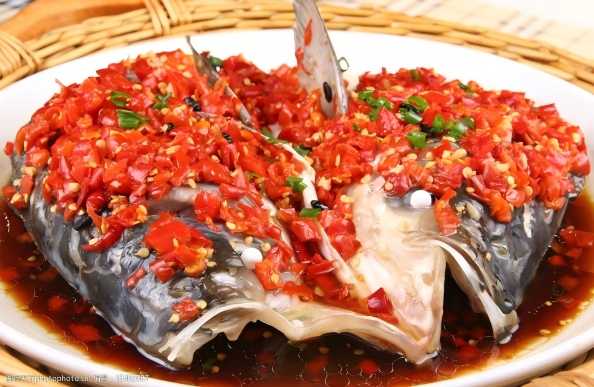
“The fish head with chopped chili, made by people from Hunan, is mostly sourced from carp in their own ponds or reservoirs. They seek fresh and plump fish that are lively and jumping, and then freshly slaughtered.” (Mao & Li,2024:66) This classic Hunan dish features a fresh fish head steamed with a generous amount of diced hot red peppers, garlic, ginger, and fermented black beans. The result is a tender, flavorful fish head bathed in a spicy, aromatic sauce that perfectly showcases Hunan Cuisine's love for chili peppers and bold flavors.
Chairman Mao's Red-Braised Pork (Máo Zédōng Hóngshāo Ròu)

Pic.3:[3]
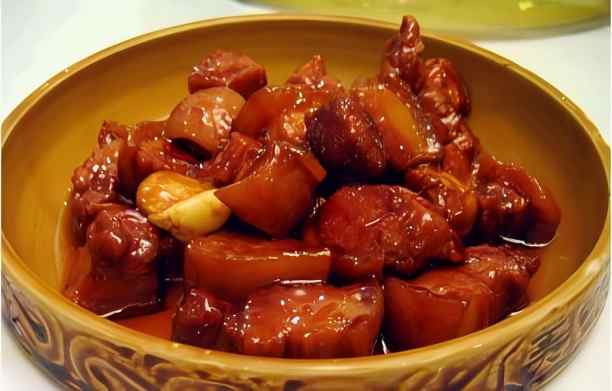
Because Chairman Mao was particularly fond of braised pork and he was from Hunan, this dish is named after him. The dish is made with pork belly, braised in a rich and savory sauce made of soy sauce, sugar, and Shaoxing wine. Its characteristics include a smooth and caramelized skin, tender and melt-in-your-mouth meat, which makes it a beloved delicacy among both locals and people from other regions, and a classic dish highly praised by all.
Stir-Fried Pork with Green Peppers (Là Jiāo Chǎo Ròu)

Pic.4:[4]
![[4]](https://p0.ssl.qhimgs1.com/t010161cff595bbe634.jpg)
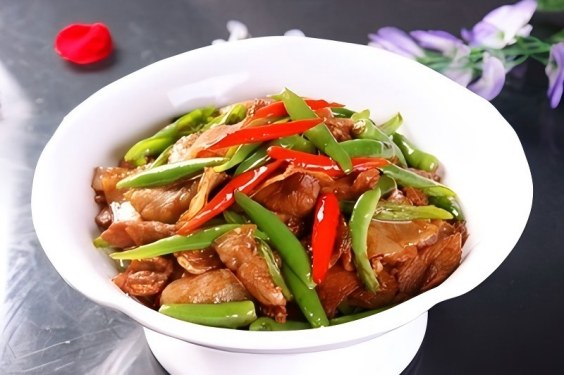
“Pepper and Meat Stir-Fry,” also known as “Little Stir-Fried Meat,” is a dish primarily made from pork front leg meat, green peppers, and garlic. It is prepared using the Hunan-style quick stir-fry technique. The dish is characterized by its oily, fragrant, fresh, and spicy flavors, making it an excellent companion for rice. (Peng,2024:12) The pork is sliced into thin, even pieces to ensure quick and even cooking, while the green peppers add a refreshing crunch that contrasts beautifully with the tender meat. Fresh garlic and ginger are used to enhance the aroma, creating a dish that is both deeply flavorful and satisfying. The stir-fry process, which involves high heat and rapid cooking, helps to seal in the juices of the pork and retain the vibrant colors of the peppers, resulting in a dish that is visually appealing and bursting with flavor.
Dong'an Chicken (Dōng'ān Jī)

Pic.5:[5]
![[5]](http://n.sinaimg.cn/sinacn09/209/w640h369/20180711/72b6-hfefkqp9803557.jpg)
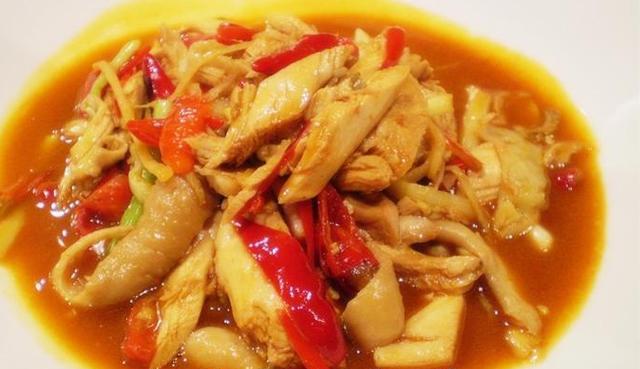
A signature dish from Hunan, Dong'an Chicken is renowned for its unique flavor and meticulous preparation. This dish features tender chicken pieces, typically from a young hen, cooked with a blend of local ingredients such as Dong'an vinegar, fresh ginger, garlic, and chili peppers. The result is a harmonious balance of sour, spicy, and aromatic flavors, with the chicken retaining its succulent texture. Dong'an Chicken is not only a culinary delight but also a testament to the rich culinary heritage of Hunan, reflecting the region's love for bold and complex flavors.
Stinky Tofu (Chòu Dòufu)

Pic.6:[6]
![[6]](https://p0.ssl.qhimgs1.com/t0149fbd11011ec3cc6.jpg)
A polarizing but beloved snack, stinky tofu is a fermented tofu dish that emits a strong, pungent aroma. “The brine is the soul of Changsha stinky tofu. Its ingredients include fermented black beans, lye, shiitake mushrooms, winter bamboo shoots, and salt. These various ingredients blend together and, through the refinement of time, develop a unique flavor.” (Li,2025:135) Despite its name, stinky tofu is prized for its creamy texture and complex flavor, which combines umami, saltiness, and a hint of sweetness. The dish is often served with chili sauce, pickled vegetables, or garlic for added flavor.
Current State of Hunan Cuisine
“Hunan cuisine, characterized by its unique personality and temperament, has become popular throughout China and has spread its aroma around the world, becoming a universally favored cuisine. Sometimes it is given special names, such as "A Land All Red" and "So Fair a Land".” (Mao & Li,2024:67) The current state of Hunan Cuisine reflects its dynamic growth and expanding influence both domestically and internationally. As its popularity continues to soar, it is clear that Hunan Cuisine is not just a regional culinary tradition but a significant cultural phenomenon that has captured the hearts and palates of people around the world. This widespread recognition and appreciation of Hunan Cuisine set the stage for its future development, as it continues to evolve and adapt to new trends and opportunities while preserving its unique heritage and identity.
Domestic Popularity
Within China, Hunan Cuisine has become a favorite among food lovers, with Hunan-style restaurants popping up in major cities across the country. The dish's bold flavors and vibrant presentation have made it a popular choice for family gatherings, business dinners, and casual meals alike. Additionally, the increasing availability of Hunan ingredients, such as chili peppers, fermented black beans, and preserved vegetables, has made it easier for home cooks to recreate Hunan dishes in their own kitchens.
International Recognition
Hunan Cuisine has also gained significant recognition on the international stage, with Hunan-style restaurants opening in cities around the world. The dish's bold flavors and unique culinary techniques have captured the imagination of food enthusiasts, who are eager to explore the diverse and complex world of Chinese cuisine. Moreover, the rise of food bloggers, social media influencers, and culinary tourism has further boosted Hunan Cuisine's global profile, making it a must-try experience for travelers seeking authentic Chinese flavors.
Cultural Dissemination
Hunan Cuisine plays a crucial role in cultural dissemination, serving as a bridge between China and the rest of the world. Through food, people from different cultures can gain insights into Chinese history, traditions, and values. Hunan Cuisine's emphasis on fresh ingredients, seasonal produce, and community dining reflects the Chinese philosophy of harmony and balance, which extends beyond the kitchen and into everyday life.
Furthermore, Hunan Cuisine's popularity has spurred the development of culinary exchange programs, food festivals, and cooking classes, providing opportunities for people to learn about and appreciate Chinese culinary culture firsthand. These initiatives not only promote Hunan Cuisine but also foster cross-cultural understanding and appreciation, contributing to a more inclusive and diverse global food landscape.
Challenges and Opportunities for Hunan Cuisine
As Hunan cuisine navigates the complexities of the modern culinary landscape, it stands at a pivotal moment. While facing significant challenges that threaten its traditional essence, it also encounters transformative opportunities that can redefine its future. This section explores both the hurdles and the potential pathways forward for Hunan cuisine.
Challenges for Hunan Cuisine
“Since the implementation of the reform and opening - up policy, the findings regarding the changes in the main characteristics of Hunan cuisine indicate that during the rapid development of the new - style Hunan cuisine, a series of problems have emerged, such as an insufficient variety of Hunan cuisine dishes, a lack of precision in knife skills, rather chaotic seasoning practices, and the excessive abandonment of traditional culinary techniques.”(Peng,2023:42) These observations highlight that Hunan cuisine is facing several modern challenges that threaten its traditional essence and popularity. The intricate cooking techniques, such as chili fermentation and dry-pot cooking, are being overshadowed by more convenient and streamlined modern methods, potentially eroding these ancestral skills. Meanwhile, commercial homogenization is diluting the unique flavors of Hunan dishes, and generational shifts towards convenience and fast food are reducing the appeal of labor-intensive cooking. These factors collectively pose significant obstacles to the continued prominence of Hunan cuisine in the contemporary culinary landscape.
Opportunities for Hunan Cuisine
Despite these challenges, Hunan cuisine also presents numerous transformative opportunities. The digital age offers a platform to document and share traditional recipes, allowing chefs and home cooks to rediscover and promote ancestral techniques globally. Collaborating with international chefs can introduce innovative twists while preserving the core authenticity of Hunan dishes, creating exciting new variations that appeal to a broader audience. Emphasizing the use of fresh, seasonal ingredients and highlighting the balanced flavors and nutritional benefits of Hunan cuisine can attract health-conscious consumers. Additionally, framing Hunan dishes within a narrative of cultural heritage and sustainability can position them as both guardians of traditional Chinese culinary practices and progressive forces in eco-conscious, health-driven gastronomy. By leveraging these opportunities, Hunan cuisine can reclaim its cultural essence and meet the demands of the modern world.
Conclusion
Hunan cuisine, with its distinctive spicy flavor and exquisite cooking techniques, holds a significant position in Chinese culinary culture. Its long history, from ancient trade exchanges to modern international dissemination, has seen it evolve and innovate while maintaining its unique charm. Classic dishes such as Fish Head with Chopped Chili and Chairman Mao's Red-Braised Pork are beloved not only by locals but also by diners from around the world. The spread of Hunan cuisine has facilitated the promotion of Chinese culinary culture and has become an important bridge for people from different cultural backgrounds to understand China. However, Hunan cuisine also faces many challenges in the modern era, such as the loss of traditional techniques and the homogenization of commercial practices, which pose a threat to its traditional status.
Despite these challenges, Hunan cuisine has also encountered numerous opportunities for development. The digital age has provided a new platform for the recording and dissemination of traditional recipes, and collaboration with international chefs has injected innovative elements into Hunan cuisine, making it more appealing. By emphasizing fresh ingredients and nutritional balance, Hunan cuisine can meet the modern consumers' demand for healthy eating. In the future, Hunan cuisine needs to preserve its traditional characteristics while actively adapting to the needs of modern society, enhancing its influence through innovation and cooperation. The continuous development of Hunan cuisine will rely on the protection and inheritance of traditional cooking techniques, as well as the exploration of new cooking methods and ingredient combinations to meet the demands of modern consumers. The future of Hunan cuisine lies in the fusion of tradition and modernity, where it will continue to contribute to the development of Chinese culinary culture.
Terms and Expressions
湘菜 Hunan Cuisine
中国八大菜系 Eight Major Culinary Traditions of China
剁椒鱼头 Fish Head with Chopped Chili
毛氏红烧肉 Chairman Mao's Red-Braised Pork
辣椒炒肉 Stir-Fried Pork with Green Peppers
东安鸡 Dong'an Chicken
臭豆腐 Stinky Tofu
干锅烹饪 Dry-pot cooking
发酵辣椒 Fermented chili peppers
湘江流域 Xiangjiang River basin
Questions
1.What are the main features of Hunan Cuisine?
2.How did Hunan Cuisine develop historically?
3.What are some iconic Hunan dishes?
4.How did Hunan Cuisine gain international recognition?
5.What role does Hunan Cuisine play in cultural dissemination?
6.What challenges does Hunan Cuisine face today?
7.How does Hunan Cuisine balance tradition and innovation?
Answers
1.Hunan Cuisine is known for its bold flavors, especially spiciness and sourness, and diverse cooking techniques.
2.It evolved from cultural exchanges along ancient trade routes and flourished in the Tang and Song dynasties.
3.Iconic dishes include Fish Head with Chopped Chili, Chairman Mao's Red-Braised Pork, and Stir-Fried Pork with Green Peppers.
4.It gained international recognition through food tourism, social media, and global Hunan-style restaurants.
5.It serves as a cultural bridge, offering insights into Chinese traditions and values through its unique flavors.
6.Challenges include preserving traditional techniques and combating commercial homogenization.
7.It balances tradition and innovation by preserving classic methods while introducing new flavors for modern tastes.
References
[1]郭佳悦.中国八大菜系形成的地理环境因素[J].阴山学刊(自然科学版),2016,30(04):104-107.[Guo Jiayue. The geographical environmental factors in the formation of the eight major Chinese cuisines[J]. Yinshan Journal (Natural Science Edition), 2016, 30(04): 104-107.][7]
[2]李清.到火宫殿品味长沙臭豆腐[J].中国食品,2025,(05):135.[Li Qing. Taste the stinky tofu of Changsha at Huo Palace[J]. China Food, 2025, (05): 135.][8]
[3]毛国清,李鸿新.湘味之绝:三亚湘菜馆里的剁椒鱼头[J].现代青年,2024,(11):66-67.[Mao Guoqing, Li Hongxin. The Quintessence of Hunan Flavor: The Pickled Chili Fish Head in a Sanya Hunan Restaurant[J]. Modern Youth, 2024, (11): 66-67.][9]
[4]彭军炜.“辣椒炒肉”发展历史与流行的影响因素[J].南宁职业技术学院学报,2024,32(03):12-17.[Peng Junwei. The Developmental History of "Stir-Fried Pork with Green Peppers" and the Influencing Factors of Its Popularity[J]. Journal of Nanning Vocational and Technical College, 2024, 32(03): 12-17.][10]
[5]彭军炜.湘菜主要特征的变化规律及发展思考[J].江苏调味副食品,2023,(02):39-44.[Peng Junwei. The Evolutionary Patterns of the Main Characteristics of Hunan Cuisine and Reflections on Its Development[J]. Jiangsu Seasoning and Food, 2023, (02): 39-44.][11]
[6]盛金朋,彭军炜.饮食美学视域下湘菜质感的特征及其表现[J].楚雄师范学院学报,2022,37(04):126-131.[Sheng Jinpeng, Peng Junwei. The Characteristics and Manifestations of the Texture of Hunan Cuisine from the Perspective of Aesthetics of Food[J]. Journal of Chuxiong Normal University, 2022, 37(04): 126-131.][12]
[7] Jiaqi Zheng, Huijing Yang, Shanghong Li, Li Chai. Environmental footprints in divergent cuisines: a case study of eight Chinese culinary traditions[J]. Frontiers in Sustainable Food Systems,2024, (08): 1366208.[13]
[8] Wenzhi Zhao, Zhongwei Jia, Hanping Shi. Nutrition and dietary inflammatory indices of the eight major cuisines of China[J]. BMC Nutrition,2025,11(1):63.[14]
[9] Savour the culinary delights of Hunan: two popular Hunan Cuisine amazed UN officials[J].M2 Presswire,2018.[15]
AI Statement
To help me write my final paper, I have used the following AI chatbots: Kimi and DeepSeek.
I prompted the chatbot Kimi with the following prompt: “Can you tell me some famous Hunan dishes and snacks?” I found the following problems with the outcome: The Hunan dishes and snacks I originally wrote were not representative enough. I have adjusted the output by the following measures (revising prompt as: “Can you tell me the most representative Hunan dishes and snacks?”). Written the following passage new: I have selected five representative dishes: Fish Head with Chopped Chili, Chairman Mao's Red-Braised Pork, Stir-Fried Pork with Green Peppers, Dong'an Chicken, and Stinky Tofu.
I prompted the chatbot Kimi with the following prompt: “Can you tell me something about these five dishes, such as their origins and flavors?” I found the following problems with the outcome: I originally didn't have a deep understanding of these dishes. I have adjusted the output by the following measures (revising prompt as: “Can you give me a detailed introduction to these five dishes, including their origins, flavors, and cooking methods?”). Written the following passage new: I have rewritten the paragraphs for each dish, clarifying their sources, flavors, and cooking methods.
I prompted the chatbot DeepSeek with the following prompt: “Can you help me check if there are any problems with my paper framework? What else do I need to add to make my paper framework more perfect?” I found the following problems with the outcome: My framework was still not perfect, and the introduction to Hunan cuisine was not comprehensive enough. I have adjusted the output by the following measures (revising prompt as: “Can you tell me what else I should add to the framework to make it more comprehensive?”). Written the following passage new: I have rewritten my paper framework, adding two more sections: the current situation of Hunan cuisine and the opportunities and challenges facing Hunan cuisine.
I prompted the chatbot DeepSeek with the following prompt: “Can you help me check if there are any problems with the English translation of my paper? Are there any grammatical or expressive issues?” I found the following problems with the outcome: Some parts of my English expression were still not perfect. I have adjusted the output by the following measures (revising prompt as: “Can you tell me which parts of the English translation need to be modified?”). Written the following passage new: I have rewritten some parts of the English translation that were not accurate, making the English version more complete.
During the process of writing this thesis, I have always maintained a rigorous academic attitude. From the selection of the topic, the construction of the structure, the core argumentation to the final completion of the manuscript, all are based on my own research and independent thinking. In the later stage of writing, I used an artificial intelligence chatbot to review the manuscript. Its function is mainly to help me identify redundant expressions, logical leaps, and potential minor oversights, thereby enabling me to express my views more clearly and organize my arguments more rigorously. The use of this tool is aimed at filling gaps and further improving the quality of the thesis, and it has not participated in the creation and conception of the core content.
中餐:湘菜
图一:[16]
中国菜因其丰富多样和复杂精湛而闻名于世,是中国辽阔的地域、悠久的历史和深厚的文化的集中体现。在中国八大菜系中,湘菜以其浓烈的口味、鲜艳的色泽和精湛的烹饪技艺脱颖而出。湘菜起源于位于中国中南部的湖南省,这片土地物产丰富、水资源充沛,湘菜是当地人民智慧的结晶。本文将踏上一场美食之旅,深入探索湘菜的细微之处、历史渊源、独特特点、经典菜肴以及它在当代文化交流与传播中的作用。
湘菜的发展历史
湘菜的历史可追溯至数千年前,考古证据表明,湖南地区的早期居民已经掌握了复杂的烹饪方法和风味组合。湖南地处古代贸易路线的要冲,这一战略位置促进了烹饪理念和食材的交流,推动了湘菜的演变。
在春秋时期(公元前770-前476年)和战国时期(公元前475-前221年),湖南是各种文化的熔炉,受到来自北方、南方、东方和西方的影响。这种文化融合为湘菜奠定了丰富多样的风味基础,融合了辣、酸、甜、咸等多种口味。
唐(618-907年)宋(960-1279年)时期是湘菜发展的关键时期。随着地区经济的繁荣和城市化进程的加快,人们对精致餐饮的需求不断增加,厨师们开始尝试新的食材和烹饪技艺,将湘菜提升到更高的烹饪艺术水平。
在近代,湘菜获得了国内和国际的认可,尤其是在1949年中华人民共和国成立之后。随着国家的开放和全球化的兴起,湘菜在世界舞台上得以展示,成为中国烹饪实力和文化多样性的象征。
湘菜的主要特色
湘菜以其独特的烹饪风格而闻名,这使其在中国众多地方菜系中脱颖而出。其独特魅力在于各种烹饪技艺与风味的和谐融合。一方面,厨师们精通多样化的烹饪方法,能够充分挖掘食材的潜力,制作出色香味俱全且口感丰富的菜肴。另一方面,湘菜的复杂而多层次的风味,以香辣和酸辣为特色,反映了湖南深厚的烹饪智慧和传统。“现实湘菜菜肴中均为多重质感,一般菜肴配料种类越多,菜肴的质感层次也就越丰富,特别传统湘菜名菜,在食材选择、烹饪技术、风味特征、饮食文化方面均具有较好的代表性。”(盛,彭,2022:127)
烹饪技艺
湘菜以丰富多样的烹饪方法为特色。炒是湘菜中常见的烹饪方式,湖南厨师擅长使用高温快速锁住食材的新鲜度和营养。经典的例子是辣椒炒肉,猪肉鲜嫩多汁,辣椒爽脆可口。蒸是另一种常用的方法,最大程度地保留了食材的原汁原味。例如,清蒸鱼头在蒸汽的作用下释放出天然的鲜美。炖则通过长时间的烹饪让食材充分融合,形成浓郁醇厚的汤汁。湖南的土鸡炖汤就是一个完美的例子,鸡肉变得酥软入味。此外,还有独特的烟熏和腌制方法。通过烟熏或腌制,食材如腊肉和腊鱼会获得特殊的烟熏香气和丰富的风味。这些烹饪方法共同创造了湘菜独特的风味——辣、鲜、多层次,反映了湖南独特的饮食文化和智慧。
风味类型
“湘菜亦是我国历史悠久的地方风味菜,为民间第三大菜系,主要分布于湘江流域、洞庭湖区和湘西山区,以油重色浓,酸辣、咸香、清香、软嫩、浓鲜为特色,炖菜、烧菜、蒸菜较为出名。”(郭,2016:105) 湘菜的灵魂在于对当地辣椒的精湛运用,例如衡东黄辣椒和发酵剁椒——这些辣椒不仅以其火辣的强度而闻名,还通过发酵和炒制等技术释放出烟熏和果香的香气。这些辣椒与蒜、姜、紫苏等香料交织在一起,创造出一种既大胆又细腻的多维度味觉体验。酸味来源于自制的腌制食材(如酸豆角或腌辣椒)或米醋,这种酸味能够中和油腻,同时增强辣味的层次感。通过使用发酵豆豉和腊肉等食材,湘菜精心调配出浓郁的鲜味,为菜肴奠定坚实的风味基础。尽管在某些特定菜肴(如毛氏红烧肉)中会偶尔出现甜味,但它仍然是湘菜本质中的次要元素。湘菜的核心在于“辣得霸道,香得摄魂”的哲学。这种烹饪方式反映了湖南丰富的农业遗产和对既强烈又令人满足的风味的文化偏好,每一口都是一次穿越该地区充满活力的美食传统的旅程。
湘菜名菜名点
湘菜独特的烹饪技艺和丰富的风味特点孕育了众多备受湖南本地及外地人喜爱的著名菜肴和小吃。每一道菜都有其独特的特点和文化意义,反映了湖南饮食文化的精髓。以下是一些最具代表性的例子,展现了湘菜的精华所在。
剁椒鱼头
图二:[17]
“湖南人所做的剁椒鱼头,多取材于自家池塘或者水库中的鲡鱼,追求新鲜肥大,活蹦乱跳,然后新鲜宰杀。”(毛,李,2024:66) 这道经典的湘菜以新鲜的鱼头为主料,搭配大量的剁辣椒、大蒜、生姜和豆豉一起清蒸而成。最终呈现出的鱼头鲜嫩多汁,浸泡在辣味浓郁、香气扑鼻的酱汁中,完美展现了湘菜对辣椒和浓烈风味的热爱。
毛氏红烧肉
图三:[18]
由于毛主席对红烧肉情有独钟,且他本人是湖南人,这道菜便以毛主席的名字命名。这道菜选用五花肉,搭配酱油、糖和绍兴酒调制的浓郁甜咸酱汁,经过慢炖而成。其特色在于外皮光滑且焦糖化,肉质鲜嫩、入口即化,深受湖南本地人和外地人的喜爱,成为一道备受推崇的经典美食。
辣椒炒肉
图四:[19]
“辣椒炒肉”又称“小炒肉”,是以猪前腿肉、青辣椒、大蒜为主要食材,运用湘菜小炒技法烹制而成,菜品具有油香鲜辣、宜下饭等特点。”(彭,2024:12)猪肉被切成薄而均匀的片,以确保快速且均匀地烹饪,而青椒则为菜肴增添清脆爽口的口感,与嫩滑的肉片形成美妙的对比。新鲜的大蒜和生姜用于提升香气,使整道菜风味浓郁且令人满足。在高温快速翻炒的过程中,猪肉的汁水得以锁住,青椒的鲜艳色泽得以保留,使得这道菜不仅视觉上令人赏心悦目,而且味道浓郁丰富。
东安鸡
图五:[20]
东安鸡是湖南的招牌菜肴,以其独特的风味和精细的制作工艺而闻名。这道菜通常会选用母鸡嫩滑的鸡肉,搭配东安醋、鲜姜、大蒜和辣椒等当地食材一起烹饪。最终呈现出的菜肴在酸、辣、香之间达到了完美的平衡,同时鸡肉保持了其多汁的质地。东安鸡不仅是一道美食佳肴,更是湖南丰富饮食遗产的见证,反映了该地区对浓烈且复杂风味的喜爱。
臭豆腐
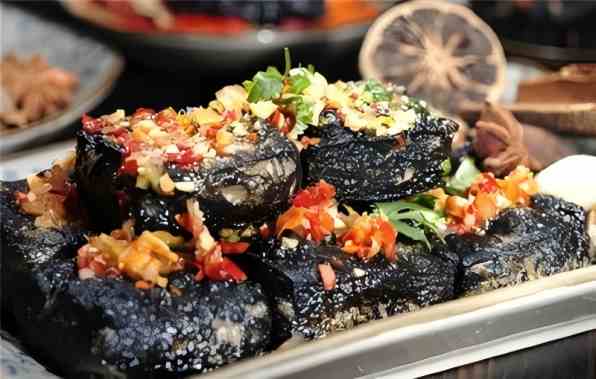
图六:[21]
臭豆腐是一种极具争议但备受喜爱的小吃,它是一种散发出强烈的刺鼻气味的发酵豆腐。“卤水是长沙臭豆腐的灵魂所在,其配料包括豆豉、纯碱、香菇、冬笋、盐等,各种食材相互交融,经过时间的淬炼,形成了独特的风味。”(李,2025:135) 尽管名字中有“臭”字,但臭豆腐因其奶油般的质地和复杂的风味而备受推崇,这种风味结合了鲜味、咸味和一丝甜味。这道菜通常搭配辣椒酱、腌菜或大蒜一起食用,以增加风味。
湘菜的现状
“湘菜以独特的个性和品格,已经风靡全国,飘香全球,成为人们普遍喜爱的美食。有时还被冠以特别的名字,如‘山河一片红’‘江山如此之娇’。”( 毛,李,2024:67) 湘菜的现状反映了其在国内和国际上动态增长和影响力不断扩大的态势。随着其受欢迎程度的持续攀升,很明显,湘菜不仅仅是一种地方性饮食传统,更是一种重要的文化现象,它已经赢得了全世界人民的心和味蕾。这种对湘菜的广泛认可和欣赏为其未来发展奠定了基础,因为它在继续演变和适应新趋势与机遇的同时,也在努力保留其独特的传统和身份。
国内受欢迎程度
在中国,湘菜已经成为美食爱好者的宠儿,湘菜餐厅在全国各大城市纷纷涌现。其浓烈的口味和生动的呈现方式使其成为家庭聚会、商务宴请和日常用餐的热门选择。此外,湘菜食材(如辣椒、豆豉和腌菜)的日益普及,也使得家庭厨师能够在自己的厨房中轻松复刻湘菜。
国际认可
湘菜在国际舞台上也获得了显著的认可,湘菜餐厅在世界各地的城市纷纷开业。其浓烈的口味和独特的烹饪技艺激发了美食爱好者的想象力,他们热衷于探索丰富而复杂的中国美食世界。此外,美食博主、社交媒体影响者和美食旅游的兴起进一步提升了湘菜的全球知名度,使其成为追求正宗中国风味的旅行者必尝的体验。
文化传播
湘菜在文化传播方面发挥着关键作用,成为中国与世界其他国家之间的桥梁。通过美食,不同文化背景的人们可以深入了解中国的历史、传统和价值观。湘菜强调新鲜食材、时令农产品和社区聚餐,反映了中国和谐与平衡的哲学思想,这种思想不仅体现在厨房中,也延伸到日常生活中。
此外,湘菜的流行还推动了烹饪交流项目、美食节和烹饪课程的发展,为人们提供了直接了解和欣赏中国饮食文化的机会。这些举措不仅推广了湘菜,还促进了跨文化交流与欣赏,为全球美食格局的多元化和包容性做出了贡献。
湘菜的挑战与机遇
在现代烹饪格局的复杂环境中,湘菜正处于一个关键的转折点。虽然它面临着威胁其传统本质的重大挑战,但也遇到了能够重新定义其未来的变革性机遇。本节将探讨湘菜面临的困难以及潜在的发展方向。
湘菜面临的挑战
“改革开放以来,湘菜主要特征的变化结果显示,新派湘菜在极速发展的进程中,暴露出湘菜品类不够丰富、刀工不够精细、调味比较混乱、传统工艺丢弃太多等问题。”(彭,2023:42)这些观察结果表明,湘菜正面临着一些现代挑战,这些挑战威胁着其传统本质和受欢迎程度。复杂的烹饪技艺,如辣椒发酵和干锅烹饪,正在被更便捷、更简化的现代方法所掩盖,可能会侵蚀这些祖传技艺。与此同时,商业同质化正在稀释湘菜的独特风味,而代际之间对便捷性和快餐的偏好正在降低劳动密集型烹饪的吸引力。这些因素共同构成了对湘菜在当代烹饪格局中持续显赫地位的重大障碍。
湘菜的机遇
尽管面临诸多挑战,湘菜也展现出众多转型发展的机遇。数字时代为记录和传播传统食谱提供了平台,让厨师和家庭烹饪者能够重新发掘并面向全球推广祖传技艺。与国际厨师合作既能保留湘菜的核心精髓,又能融入创新元素,创造出吸引更广泛受众的新颖变体。强调使用新鲜时令食材,并突出湘菜风味平衡、营养丰富的特点,可以吸引注重健康的消费者。此外,将湘菜置于文化遗产与可持续发展的叙事框架中,既能将其定位为中国传统烹饪技艺的守护者,又能使其成为生态环保、健康导向美食潮流中的先锋力量。通过把握这些机遇,湘菜既能重拾文化本真,又能满足现代社会的需求。
总结
湘菜以其独特的香辣风味和精湛的烹饪技艺,在中国饮食文化中占据着重要地位。其历史源远流长,从古代的贸易交流到近代的国际化传播,湘菜始终在演变与创新中保持其独特魅力。经典菜肴如剁椒鱼头、毛氏红烧肉等,不仅深受本地人喜爱,也吸引了众多国内外食客。湘菜的传播促进了中国饮食文化的推广,成为不同文化背景的人们了解中国的重要桥梁。然而,湘菜在现代也面临诸多挑战,如传统工艺的丢失和商业同质化等问题,这对湘菜的传统地位构成了威胁。
尽管面临挑战,湘菜也迎来了诸多发展机遇。数字时代为传统食谱的记录和传播提供了新平台,与国际厨师的合作为湘菜注入了创新元素,使其更具吸引力。强调新鲜食材和营养平衡,湘菜能够满足现代消费者对健康饮食的需求。未来,湘菜需在保留传统特色的基础上,积极适应现代社会的需求,通过创新和合作提升其影响力。湘菜的持续发展将依赖于对传统烹饪技艺的保护和传承,同时积极探索新的烹饪方法和食材组合,以满足现代消费者的需求。湘菜的未来,将在传统与现代的融合中,继续为中国饮食文化的发展贡献力量。
术语与表达
湘菜 Hunan Cuisine
中国八大菜系 Eight Major Culinary Traditions of China
剁椒鱼头 Fish Head with Chopped Chili
毛氏红烧肉 Chairman Mao's Red-Braised Pork
辣椒炒肉 Stir-Fried Pork with Green Peppers
东安鸡 Dong'an Chicken
臭豆腐 Stinky Tofu
干锅烹饪 Dry-pot cooking
发酵辣椒 Fermented chili peppers
湘江流域 Xiangjiang River basin
问题
1.湖南菜的主要特点是什么?
2.湖南菜在历史上是如何发展的?
3.有哪些标志性的湘菜?
4.湖南菜是如何获得国际认可的?
5.湖南菜在文化传播中扮演什么角色?
6.湖南菜今天面临哪些挑战?
7.湖南菜如何平衡传统与创新?
回答
1.湘菜以其大胆的风味,尤其是辣味和酸味,以及多样的烹饪技巧而闻名。
2.它从古代贸易路线上的文化交流演变而来,并在唐宋时期蓬勃发展。
3.标志性菜肴包括剁椒鱼头、毛氏红烧肉和辣椒炒肉。
4.它通过美食旅游、社交媒体和全球湖南风味餐厅获得了国际认可。
5.它充当文化桥梁,通过其独特的风味提供对中国传统和价值观的见解。
6.挑战包括保留传统技术和打击商业同质化。
7.它通过保留经典方法,同时为现代口味引入新口味,平衡传统与创新。
参考文献
[1]郭佳悦.中国八大菜系形成的地理环境因素[J].阴山学刊(自然科学版),2016,30(04):104-107.[Guo Jiayue. The geographical environmental factors in the formation of the eight major Chinese cuisines[J]. Yinshan Journal (Natural Science Edition), 2016, 30(04): 104-107.][22]
[2]李清.到火宫殿品味长沙臭豆腐[J].中国食品,2025,(05):135.[Li Qing. Taste the stinky tofu of Changsha at Huo Palace[J]. China Food, 2025, (05): 135.][23]
[3]毛国清,李鸿新.湘味之绝:三亚湘菜馆里的剁椒鱼头[J].现代青年,2024,(11):66-67.[Mao Guoqing, Li Hongxin. The Quintessence of Hunan Flavor: The Pickled Chili Fish Head in a Sanya Hunan Restaurant[J]. Modern Youth, 2024, (11): 66-67.][24]
[4]彭军炜.“辣椒炒肉”发展历史与流行的影响因素[J].南宁职业技术学院学报,2024,32(03):12-17.[Peng Junwei. The Developmental History of "Stir-Fried Pork with Green Peppers" and the Influencing Factors of Its Popularity[J]. Journal of Nanning Vocational and Technical College, 2024, 32(03): 12-17.][25]
[5]彭军炜.湘菜主要特征的变化规律及发展思考[J].江苏调味副食品,2023,(02):39-44.[Peng Junwei. The Evolutionary Patterns of the Main Characteristics of Hunan Cuisine and Reflections on Its Development[J]. Jiangsu Seasoning and Food, 2023, (02): 39-44.][26]
[6]盛金朋,彭军炜.饮食美学视域下湘菜质感的特征及其表现[J].楚雄师范学院学报,2022,37(04):126-131.[Sheng Jinpeng, Peng Junwei. The Characteristics and Manifestations of the Texture of Hunan Cuisine from the Perspective of Aesthetics of Food[J]. Journal of Chuxiong Normal University, 2022, 37(04): 126-131.][27]
[7] Jiaqi Zheng, Huijing Yang, Shanghong Li, Li Chai. Environmental footprints in divergent cuisines: a case study of eight Chinese culinary traditions[J]. Frontiers in Sustainable Food Systems,2024, (08): 1366208.[28]
[8] Wenzhi Zhao, Zhongwei Jia, Hanping Shi. Nutrition and dietary inflammatory indices of the eight major cuisines of China[J]. BMC Nutrition,2025,11(1):63.[29]
[9] Savour the culinary delights of Hunan: two popular Hunan Cuisine amazed UN officials[J].M2 Presswire,2018.[30]
人工智能声明
为了帮我完成期末论文,我使用了以下人工智能聊天机器人:Kimi 和 DeepSeek。
我向聊天机器人 Kimi 提出了以下提示:“能不能告诉我湘菜有哪些名菜名点呢?”我发现结果存在以下问题:我原本写的那些湘菜名菜名点不太具有代表性。我通过以下措施调整了输出内容(将提示修改为:“能不能告诉我最具有代表性的湘菜名菜名点呢?”)。重新撰写了名菜名点段落:我选取了五道代表性菜肴:剁椒鱼头、毛氏红烧肉、辣椒炒肉、东安鸡和臭豆腐。
我向聊天机器人 Kimi 提出了以下提示:“能不能告诉我这五道菜品的相关内容,例如:它的起源、风味等?”我发现结果存在以下问题:我原本对这些菜品的了解不够深入。我通过以下措施调整了输出内容(将提示修改为:“能不能给我详细介绍一下这五道菜品,包括它们的起源、风味和烹饪方法?”)。重新完善了名菜名点五道菜品的各个段落:我对每道菜品的段落进行了重新撰写,明确了它们的来源、风味和烹饪方法。
我向聊天机器人 DeepSeek 提出了以下提示:“能不能帮我检查一下我的论文框架有什么问题?还需要增加什么内容才能使我的论文框架更加完美?”我发现结果存在以下问题:我的框架仍然不够完善,对湘菜的介绍还不够全面。我通过以下措施调整了输出内容(将提示修改为:“能不能告诉我我应该在框架部分再增加哪些内容,使框架更加全面?”)。重新完善了框架部分:我对论文框架进行了重新撰写,增加了两个部分:湘菜的现状和湘菜面临的机遇与挑战。
我向聊天机器人 DeepSeek 提出了以下提示:“能不能帮我检查一下我的论文英文翻译有没有问题?语法或表达上有没有不妥之处?”我发现结果存在以下问题:我的英文表达仍有部分不够完美。我通过以下措施调整了输出内容(将提示修改为:“能不能告诉我哪些部分的英文翻译需要修改?”)。重新完善了英语部分翻译不太准确的部分:我已对之前译文中的部分不准确之处进行了修改,使英文版本更加完整。
在撰写本论文的过程中,我始终秉持严谨的学术态度。从选题、结构搭建、核心论证到最终成稿,全部基于我自己的研究和独立思考。在写作的后期阶段,我使用了人工智能聊天机器人来审阅稿件。其主要功能是帮助我识别表述冗余、逻辑跳跃以及潜在的细节疏漏,从而使我能够更清晰地表达观点、更严谨地组织论证。使用这一工具的目的是查漏补缺,进一步提升论文质量,而并未参与核心内容的创作与构思。