Difference between revisions of "User:Zhao Yashi"
Zhao Yashi (talk | contribs) |
Zhao Yashi (talk | contribs) |
||
| Line 1: | Line 1: | ||
Zhao Yashi | Zhao Yashi | ||
| − | =Chinese Folk Dance:Dai Ethic Dance== | + | ==Chinese Folk Dance:Dai Ethic Dance== |
In the fertile Lancang-Mekong River Basin in southwestern China, the Dai people express their national identity through dance. A bright pearl of Chinese national art, the Dai ethic dance vividly showcases the Dai people’s philosophy of life and spiritual world with its unique rhythm, profound cultural connotations, and distinctive vitality. Deeply rooted in the fertile soil of the Dai countryside in Xishuangbanna, Dehong and other parts of Yunnan, the most representative forms of Dai ethic dance are the peacock dance, the elephant foot drum dance and the Gaguang dance, together composing a magnificent chapter of Dai ethic dance art. | In the fertile Lancang-Mekong River Basin in southwestern China, the Dai people express their national identity through dance. A bright pearl of Chinese national art, the Dai ethic dance vividly showcases the Dai people’s philosophy of life and spiritual world with its unique rhythm, profound cultural connotations, and distinctive vitality. Deeply rooted in the fertile soil of the Dai countryside in Xishuangbanna, Dehong and other parts of Yunnan, the most representative forms of Dai ethic dance are the peacock dance, the elephant foot drum dance and the Gaguang dance, together composing a magnificent chapter of Dai ethic dance art. | ||
| − | =Types of Dai Ethic Dance== | + | ==Main Types of Dai Ethic Dance== |
===Peacock Dance=== | ===Peacock Dance=== | ||
A image of the Peacock Dance play Peacock from 360 Baike. Clic[ https://p2.ssl.qhimgs1.com/t013480614b4bcc9a7c.jpg]for original source. | A image of the Peacock Dance play Peacock from 360 Baike. Clic[ https://p2.ssl.qhimgs1.com/t013480614b4bcc9a7c.jpg]for original source. | ||
Revision as of 07:37, 5 June 2025
Zhao Yashi
Chinese Folk Dance:Dai Ethic Dance
In the fertile Lancang-Mekong River Basin in southwestern China, the Dai people express their national identity through dance. A bright pearl of Chinese national art, the Dai ethic dance vividly showcases the Dai people’s philosophy of life and spiritual world with its unique rhythm, profound cultural connotations, and distinctive vitality. Deeply rooted in the fertile soil of the Dai countryside in Xishuangbanna, Dehong and other parts of Yunnan, the most representative forms of Dai ethic dance are the peacock dance, the elephant foot drum dance and the Gaguang dance, together composing a magnificent chapter of Dai ethic dance art.
Main Types of Dai Ethic Dance
Peacock Dance
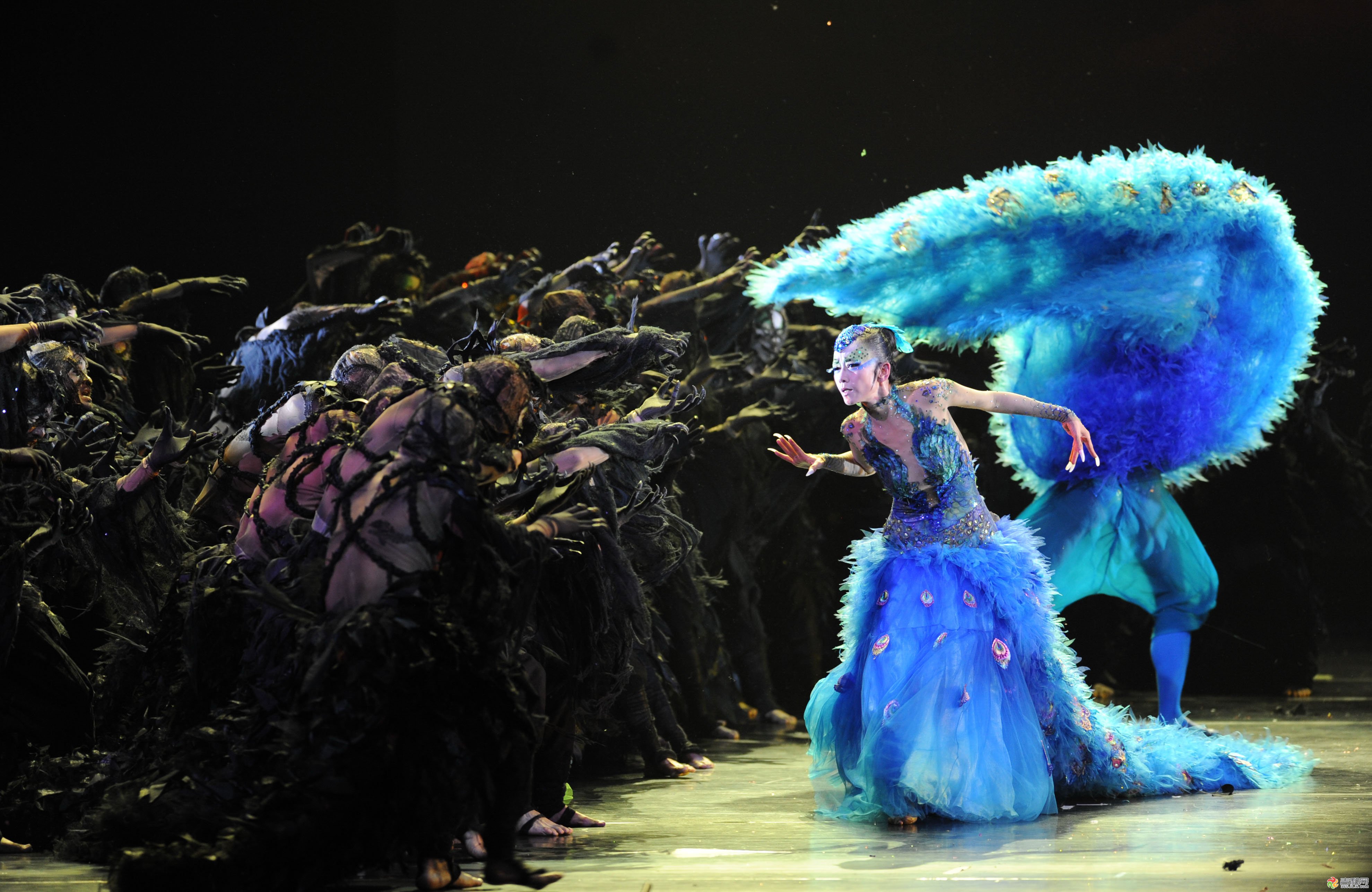
A image of the Peacock Dance play Peacock from 360 Baike. Clic[ https://p2.ssl.qhimgs1.com/t013480614b4bcc9a7c.jpg]for original source. The Peacock Dance is the soul of the Dai ethic dance art form. It is famous for its unrivalled lightness, softness and spirituality. Transcending simple animal imitation, it features a highly structured dance vocabulary comprising the “three bends” (smooth bending of the head, chest, waist, hips, knees and ankles) and the “one smooth side” movement (smooth movement of the same side of the hands and feet), as well as the dexterous “peacock’s beak” hand shape. These elements together elevate the charm of the peacock to a high level of artistry), and the “one smooth side” movement (the same-side movement of the hands and feet), together with the dexterous “peacock’s beak” hand shape, elevate the charm of the peacock to an artistic level. Dancers can interpret the solitude and elegance of a single peacock (Single Dance), the love of two peacocks (Double Dance) and the spectacle of a hundred peacocks singing together in a group dance. Peacock dance is an essential part of important festivals such as the Water Splashing Festival, the Closed Door Festival and the Open Door Festival, as well as religious ceremonies such as the Fine Buddha Dance. It connects the mundane and the sacred, conveying reverence for the beauty of nature and the desire for harmony and tranquillity (Lu Xinyi and Lu Qian, 2023, 118).
Elephant Foot Drum
Elephant Foot Drum Dance image from 360 Baike. Clic[ https://www.gov.cn/jrzg/images/images/1c6f6506c2380f26188202.jpg]for original source. In sharp contrast to the softness of the Peacock Dance, the Elephant Foot Drum Dance exudes masculine strength. It is a chance for Dai men to demonstrate their courage and strength. The dancers carry long drums shaped like an elephant’s legs diagonally and use their palms, fingers, elbows and heels to strike them, producing deep, thick sounds that are crisp and exciting and as fast as a hail of complex drumbeats. This drumming is the soul of the dance and provides an emotional release. Whether a solo dancer is showing the majesty and power of an elephant, pairs of dancers are competing in a drumming contest, or a group is performing a neat and shocking dance, all of these performances reflect the bravery and resilience of Dai men, as well as their respect for life's vitality (Liu Jiabao and Yu Rui, 2021, 90).

Gaguang Dance
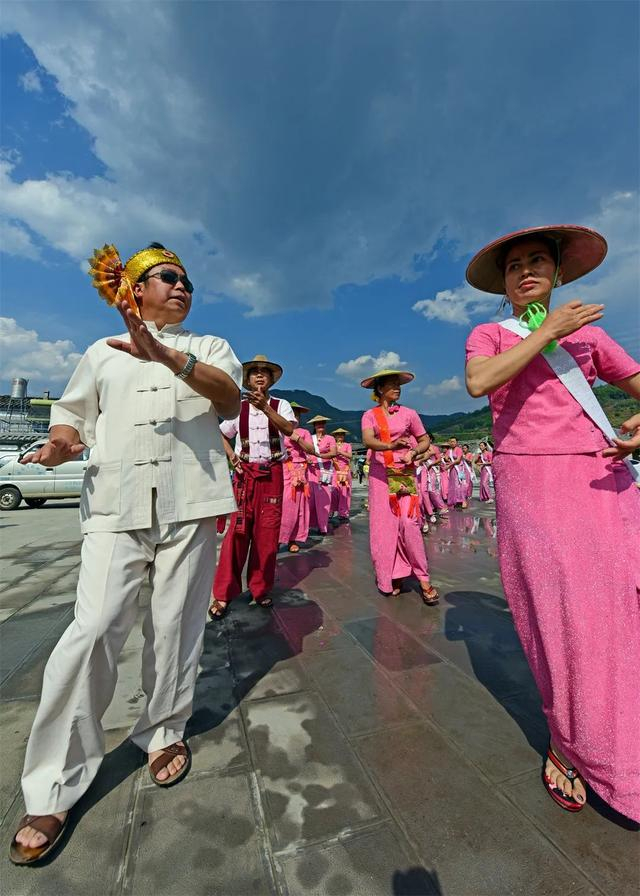
The image of Gaguang Dance from 360 Baike. Clic[ https://k.sinaimg.cn/n/sinakd20220711s/736/w640h896/20220711/1b0f-1635637f3b2f5fe9fb760023e8dab991.jpg/w700d1q75cms.jpg]for original source. The Gaguang Dance is a celebration of life. “Gaguang” means dancing around a drum and centers on the spontaneous joy of universal participation. During celebrations such as the Water Festival, men, women and children gather in a circle. Among the lively rhythms of elephant-footed drums, brightly lit fife gongs and other percussion instruments, people perform simple yet infectious steps — moving in and out, squatting and stepping — with their bodies swinging naturally. Although the movements are simple, when the crowd dances together to the unified, powerful drumbeat, the pure, collective joy that erupts instantly is extremely infectious. The Gaguang Dance vividly embodies the Dai people's hospitality, optimism and open-mindedness, as well as their heartfelt appreciation of communal harmony and unity (Huibo, 2024, 66).
Historical Origins
The Dai ethic dance has a long historical imprint, with its origins stretching far back in time. The Peacock Dance has its roots in ancient beliefs (the peacock is considered to be a divine creature) and the veneration of natural beauty. As early as 120 AD, records exist of the Dai ancestors performing music for the Han Dynasty (Lu Xinyi and Lu Qian, 2023). In contrast, the Elephant Foot Drum Dance is closely linked to tales of strength (e.g. a young man beheading a dragon by mimicking an elephant's gait to create a drum in celebration of his triumph) and the Dai people's long-standing tradition of capturing, taming, and honouring elephants (Liu Jiabao and Yu Rui, 2021, 90). The Ga Guang dance has its roots in daily labour and community life, with the spontaneous dances performed in fields or to celebrate a good harvest gradually becoming standardised. The Dai ethic dance is a profound form of cultural expression and spiritual sustenance. The Peacock Dance expresses reverence for nature and the pursuit of harmony, and it is heavily influenced by Southern Buddhist culture. The Elephant Foot Drum Dance embodies the worship of the life force and resilience symbolized by the elephant, and the rhythm of the drums conveys emotion. The Ga Guang Dance vividly embodies the collectivist spirit and interpersonal warmth of the Dai people. Dancing in a circle naturally symbolizes equality, unity, and sharing, and is a collective declaration of their cheerful and optimistic national character.
Cultural Connotation
In terms of artistic expression, the Dai ethic dance has formed a unique system. The Peacock Dance is renowned for its softness and spirit, characterised by the subtle “three bends” and “one smooth side” rhythm and delicate emotional expression (Liu Jiabao and Yu Rui, 2021, 90). The Elephant's Foot Drum Dance is renowned for its fusion of power and skill, with the perfect unity of drum rhythm and challenging steps (jumps and spins) showcasing the beauty of masculinity (Lu Xinyi and Lu Qian, 2023). The Ga Guang Dance, on the other hand, is renowned for its simplicity and harmony. The resonance of the group under the unifying drumbeats creates a powerful, infectious force that reflects the wisdom of “the great way is simple”.
Conclusion
With its unique artistic charm and profound cultural heritage, the Dai ethic dance is a vibrant addition to the world of dance. The Peacock Dance pays tribute to the spirituality of nature; the Elephant Foot Drum Dance celebrates the power of life; and the Ga Guang Dance honours community harmony. Together, they interpret the wisdom of the Dai people, their harmonious coexistence with nature, their reverence for life's vitality, and their eternal pursuit of a better life. The rhythm of life in the land of peacocks is the core symbol of Dai cultural identity, extolling the nation's immortal spiritual poetry to the world.
Reference
Bai Jingyi. 白靖毅. (2021). 傣族舞蹈的审美意韵——以孔雀舞、象脚鼓舞、武术舞为例. [The Aesthetic Meaning of Dai Dance--Taking Peacock Dance, Elephant Foot Drum Dance and Martial Arts Dance as Examples]. 北京舞蹈学院学报[Journal of Beijing Dance Academy](04), 59-62. Xu Liting. 徐丽婷. (2023). 傣族传统舞蹈的文化内涵及教学实践研究. [Research on Cultural Connotation and Teaching Practice of Dai Traditional Dance]. 中国民族博览[Panorama of Chinese Nationalities] (14), 187-189. Lu Xinyi, Lu Qian. 陆心怡, 路倩. (2023). 傣族民间舞蹈的文化内涵及其传承发展. [Cultural Connotation of Dai Folk Dance and its Inheritance Development]. 戏剧之家[Home Drama] (35), 118-120. Hui Bo. 惠博. (2024). 傣族舞蹈的自然相生. [The natural phases of Dai dance]. 文学艺术周刊[Literature and Arts Weekly] (12), 66-68. Liu Jiabao, Yu Rui. 刘家宝, 於睿. (2021). 浅谈傣族孔雀舞的发展与流变. [The Development and Flux of the Dai Peacock Dance]. 今古文创[Imago Creative](32), 90-93. Huang Zhangqi, Jiang Song, Sun Dechao. 黄章琪, 姜松, 孙德朝. (2024). 身体文化视角下傣族孔雀舞的美学阐释. [The Aesthetic Interpretation of Dai Peacock Dance from the Perspective of Body Culture]. 戏剧之家[Home Drama] (36), 131-133. Zhou Jieyinxuan. 周洁颖旋. (2024). 傣族舞蹈的艺术特征及民族文化内涵探究——以傣族舞蹈《邵多丽》为例. [Exploring the Artistic Characteristics and Ethnic Cultural Connotation of Dai Dance--Taking Dai Dance "Shao Duo Li" as an Example]. 大众文艺[mass literature] (06), 97-99. Wei Jiaying. 韦佳瑛. (2015). 浅析傣族孔雀舞的风格特征. [Analysing the Stylistic Characteristics of Dai Peacock Dance]. 黄河之声[Song of the Yellow River] (08), 110-111.
Terms and Expressions
Lancang-Mekong River Basin 澜沧江-湄公河流域 Dai ethic dance 傣族舞蹈 Peacock Dance 孔雀舞 Elephant Foot Drum Dance 象脚鼓舞 Gaguang Dance 嘎光舞 three bends 三道弯 one smooth side 一顺边 peacock’s beak 孔雀喙 Water Splashing Festival 泼水节 Southern Buddhist culture 南传佛教文化 collectivist spirit 集体主义精神
Questions
1. What are the three most representative forms of Dai ethnic dance? 2. What is the Peacock Dance famous for, and what are its key movement characteristics? 3. How does the Elephant Foot Drum Dance contrast with the Peacock Dance? 4. What are the origins of the Peacock Dance, Elephant Foot Drum Dance, and Gaguang Dance? 5. During which festival is the Gaguang Dance typically performed, and what values does it embody? 6. What three aspects of Dai wisdom do these dances collectively interpret?
中国民族舞:傣族舞
在中国西南澜沧江-湄公河流域的丰饶土地上,傣族人民用舞蹈书写着民族的诗篇。傣族舞蹈,这颗中国民族艺术的璀璨明珠,以其独特的韵律、深厚的文化内涵和鲜明的生命力,生动展现了傣族的生活哲学与精神世界。它深深植根于云南西双版纳、德宏等地的傣乡沃土,其中孔雀舞、象脚鼓舞和嘎光舞三种最具代表性的形式,共同谱写了傣族舞蹈艺术的华章。
傣族舞的主要类别
孔雀舞
孔雀舞是傣族舞蹈艺术的灵魂,以其无与伦比的轻盈、柔美和灵动闻名于世。它超越了简单的动物模仿,通过高度程式化的舞蹈语汇——“三道弯”体态(头、胸、腰、胯、膝、踝的流畅弯曲)和“一顺边”动律(手脚同侧运动),配合灵巧的“孔雀嘴”手型,将孔雀的神韵升华到艺术高度。舞者能细腻诠释孔雀的孤高清雅(单人舞),也能展现双孔雀的眷恋(双人舞),更能在群舞中营造百雀齐鸣的壮观景象。在泼水节、关门节、开门节等重要节庆和赕佛(供奉佛祖)等宗教仪式中,孔雀舞是不可或缺的圣洁表达,连接着世俗与神圣,传递着对自然之美的敬畏与对和谐宁静的向往(陆心怡、路倩,2023,118)。
象脚鼓舞
与孔雀舞的柔美形成鲜明对比的,是充满阳刚力量的象脚鼓舞。这是傣族男子展现勇气与力量的舞台。舞者斜挎形似象腿的长筒鼓,运用手掌、手指、肘部甚至脚跟击打,奏出深沉浑厚、清脆激昂或疾如骤雨的复杂鼓点。这鼓声是舞蹈的灵魂,是情感的宣泄。无论是独舞者展现大象的威严与力量,对舞者间的鼓技竞技,还是群舞的整齐震撼,都淋漓尽致地体现了傣族男性的勇敢坚韧和对生命活力的尊崇(刘家宝、於睿,2021,90)。
嘎光舞
嘎光舞则是最具群众基础的生命欢歌。“嘎光”意为“围着鼓跳舞”,核心在于全民参与的自发欢乐。每逢泼水节等庆典,男女老少便围成圆圈。在象脚鼓深沉的主奏、锉锣明亮的点缀及其他打击乐交织的热烈节奏中,人们踏着简单而富有感染力的步伐——进、退、蹲、踏,身体自然摆动。动作虽简洁,但当众人应和着统一强劲的鼓点共同舞动时,瞬间迸发出的纯粹集体欢愉极具感染力。嘎光舞生动体现了傣族人民热情好客、乐观豁达的天性,以及对社群和谐与团结共享的由衷礼赞(惠博,2024,66)。 追溯其源流,傣族舞蹈承载着悠久的历史印记。孔雀舞的起源交织着古老信仰(视孔雀为神灵化身)和对自然之美的崇拜,早在公元120年就有傣族先民向汉朝献乐的记载(陆心怡,路倩,2023)。象脚鼓舞则与力量传说(如青年斩蛟龙仿象腿制鼓庆胜利)及傣族悠久的捕象、驯象、敬象传统生活密切相关(刘家宝,於睿,2021)。嘎光舞的根深植于日常劳作与社群生活,田间休憩或丰收喜悦时的随性舞动逐渐规范成形。
傣族舞的文化内涵
傣族舞蹈是深刻的文化表达和精神寄托。孔雀舞蕴含着对自然的敬畏、对和谐的追求,深受南传佛教文化影响。象脚鼓舞外化了对大象象征的生命力与坚韧精神的崇拜,其鼓点本身就是情感的密码。嘎光舞则是傣族集体主义精神与人际温情的生动体现,围圈而舞的形式天然象征着平等、团结与共享,是其开朗乐天民族性格的集体宣言。 在艺术表现上,傣族舞蹈形成了独特体系:孔雀舞以“柔”与“灵”见长,精妙的“三道弯”、“一顺边”韵律和细腻情感表达是其精髓(刘家宝、於睿,2021,90)。象脚鼓舞以“力”与“技”融合著称,鼓点节奏与高难度舞步(跳跃、旋转)的完美统一展现阳刚之美(陆心怡,路倩,2023)。嘎光舞则以“简”而“和”取胜,集体在统一鼓点下的共振产生强大感染力,体现“大道至简”的智慧。
总结
傣族舞蹈以其独特的艺术魅力和深厚的文化底蕴,在世界舞蹈之林中独放异彩。孔雀舞礼赞自然灵性,象脚鼓舞讴歌生命力量,嘎光舞颂扬社群和谐。它们共同诠释了傣族人与自然和谐共生的智慧、对生命活力的敬畏以及对美好生活的永恒追求。这流淌于孔雀之乡的生命韵律,是傣族文化身份的核心象征,持续向世界传颂着这个民族不朽的精神诗篇。
参考文献
白靖毅. (2021). 傣族舞蹈的审美意韵——以孔雀舞、象脚鼓舞、武术舞为例. 北京舞蹈学院学报 (04), 59-62. 徐丽婷. (2023). 傣族传统舞蹈的文化内涵及教学实践研究. 中国民族博览 (14), 187-189. 陆心怡, 路倩. (2023). 傣族民间舞蹈的文化内涵及其传承发展. 戏剧之家 (35), 118-120. 惠博. (2024). 傣族舞蹈的自然相生. 文学艺术周刊 (12), 66-68. 刘家宝, 於睿. (2021). 浅谈傣族孔雀舞的发展与流变. 今古文创 (32), 90-93. 李梦洁. (2024). 全球化语境下云南傣族舞蹈的传承与发展研究. 艺术评论 (08), 75-80. 黄章琪, 姜松, 孙德朝. (2024). 身体文化视角下傣族孔雀舞的美学阐释. 戏剧之家 (36), 131-133. 周洁颖旋. (2024). 傣族舞蹈的艺术特征及民族文化内涵探究——以傣族舞蹈《邵多丽》为例. 大众文艺 (06), 97-99. 韦佳瑛. (2015). 浅析傣族孔雀舞的风格特征. 黄河之声 (08), 110-111.
生词表
Lancang-Mekong River Basin 澜沧江-湄公河流域 Dai ethic dance 傣族舞蹈 Peacock Dance 孔雀舞 Elephant Foot Drum Dance 象脚鼓舞 Gaguang Dance 嘎光舞 three bends 三道弯 one smooth side 一顺边 peacock’s beak 孔雀喙 Water Splashing Festival 泼水节 Southern Buddhist culture 南传佛教文化 collectivist spirit 集体主义精神
问题
1. 最具代表性的三种傣族舞蹈是什么? 2. 孔雀舞因何而闻名,其主要动作特点是什么? 3. 象脚鼓舞与孔雀舞有何不同? 4. 孔雀舞、象脚鼓舞和加光舞的起源是什么? 5. 加光舞通常在哪个节日里表演,它体现了什么价值? 6. 这些舞蹈共同诠释了傣族智慧的哪三个方面?