Difference between revisions of "User:Du Jiangping"
Du Jiangping (talk | contribs) (→Origin) |
Du Jiangping (talk | contribs) (→Origin) |
||
| Line 6: | Line 6: | ||
The Songs of Chu is an anthology of poetry originating in the mid-to-late Warring States period within the State of Chu, located in the Yangtze River basin (present-day Hubei and Hunan provinces). Centered around the core figure Qu Yuan, it stands as one of the origins of romantic literature in Chinese literary history. Its roots lie deep in the unique cultural soil of the Chu region, characterized by distinct local sacrificial traditions(秦勇怡,2024:10), a magnificent mythological system, and the rich expressive forms of its dialect, giving it a pronounced regional Chu style. The literary innovation was spurred by the historical context of Chu's decline amidst the Warring States and the political tragedy of Qu Yuan (c. 343–278 BC). | The Songs of Chu is an anthology of poetry originating in the mid-to-late Warring States period within the State of Chu, located in the Yangtze River basin (present-day Hubei and Hunan provinces). Centered around the core figure Qu Yuan, it stands as one of the origins of romantic literature in Chinese literary history. Its roots lie deep in the unique cultural soil of the Chu region, characterized by distinct local sacrificial traditions(秦勇怡,2024:10), a magnificent mythological system, and the rich expressive forms of its dialect, giving it a pronounced regional Chu style. The literary innovation was spurred by the historical context of Chu's decline amidst the Warring States and the political tragedy of Qu Yuan (c. 343–278 BC). | ||
| + | |||
| + | [[File:Map of Chu.png|300px|center|link=]] | ||
==Representative Figures and Works== | ==Representative Figures and Works== | ||
Revision as of 17:03, 19 June 2025
Du JiangPing
Literature: The Formation and Development of the Songs of Chu (Chu Ci)
Origin
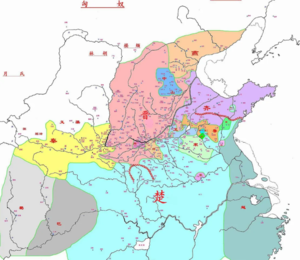
The Songs of Chu is an anthology of poetry originating in the mid-to-late Warring States period within the State of Chu, located in the Yangtze River basin (present-day Hubei and Hunan provinces). Centered around the core figure Qu Yuan, it stands as one of the origins of romantic literature in Chinese literary history. Its roots lie deep in the unique cultural soil of the Chu region, characterized by distinct local sacrificial traditions(秦勇怡,2024:10), a magnificent mythological system, and the rich expressive forms of its dialect, giving it a pronounced regional Chu style. The literary innovation was spurred by the historical context of Chu's decline amidst the Warring States and the political tragedy of Qu Yuan (c. 343–278 BC).
Representative Figures and Works
Representative Figure--Qu Yuan
Qu Yuan was a nobleman, statesman, and great patriotic poet of the State of Chu during China's Warring States period. Possessing vast knowledge, he enjoyed the deep trust of King Huai of Chu in his early years and held key positions at court. However, due to slander and exclusion by conservative aristocratic factions, he was alienated by King Huai and later exiled. During his exile, witnessing the decline of Chu and the fall of its capital to the Qin army, he succumbed to grief and despair. Tradition holds that on the fifth day of the fifth lunar month, he drowned himself in the Miluo River as an act of loyalty to his fallen state. To commemorate him, people began holding sacrificial rituals on this day, giving birth to the Dragon Boat Festival(林继富,2025:59).
Representative Work -- The Li Sao
The Li Sao is Qu Yuan's most famous and representative long poem(姚圣良,2024:151), the pinnacle of The Songs of Chu, and one of the grandest biographical lyric poems in Chinese literary history. The poem recounts the poet's lineage, talents, political ideals, and his struggles to realize them. It profoundly expresses his deep sorrow, anguish, and loneliness over his loyalty to his king and state being met with slander, alienation, and the shattering of his ideals. It showcases his unwavering will to maintain noble integrity in adversity and refuse to compromise with worldly vulgarity.
Development
The Songs of Chu underwent a journey from marginality to canonical status. In the late Warring States period, many literati emulated Qu Yuan’s style, but the tradition waned after Qin unified China. It was revitalized when Jia Yi, exiled to Changsha in the early Han dynasty, wrote "Lament for Qu Yuan (《吊屈原赋》)." During Emperor Wu of Han’s reign, Liu An authored the first commentary, Commentary on Li Sao (《离骚传》), elevating Li Sao to a status equal to The Book of Songs; Sima Qian’s Records of the Grand Historian(《史记》) established Qu Yuan as a paragon of loyalty; later, Liu Xiang compiled the anthology Chu Ci (《楚辞》), formally naming it and incorporating it into imperial archives. This marked its transformation from a regional literature into a spiritual source of Chinese culture, cementing its status as a Chinese classic. From the Eastern Han through the Qing dynasty, Wang Yi’s Annotations on the Verses of Chu (《楚辞章句》) pioneered systematic commentary; Zhu Xi’s Collected Commentaries on the Verses of Chu (《楚辞集注》) reinterpreted Qu Yuan’s spirit through Neo-Confucianism; and Qing textual scholars deepened philological studies, constructing a comprehensive interpretive framework.
Influences
The Songs of Chu profoundly influenced Chinese literature. Stylistically, its irregular lines foreshadowed the seven-character verse; Song Yu’s elaborate descriptions in Fu on the Gaotang Shrine directly catalyzed the formation of Han fu rhapsodies. Artistically, it pioneered new symbolic systems—using fragrant herbs to symbolize virtuous individuals(韦秀玉,2025:77)—renewing the bi xing (comparison-evocation) tradition and laying the foundation for expressing ideals through objects in Chinese poetry(方铭,2025:2). Later literary motifs often trace back to it: Li Bai’s "With rainbows as robes, winds as steeds(霓为衣兮风为马)" inherited Li Sao’s fantastical imagery, scaling romantic peaks in Tang poetry(李露菲,2025:248); Du Fu’s "All year grieving for the common folk (穷年忧黎元)" deepened Qu Yuan’s people-centered thought, extending the tradition of poetry concerned for nation and people(李露菲,2025:250); Wen Tianxiang’s Song of Righteousness honored Qu Yuan’s moral integrity with "The sages grow more distant each day (哲人日已远)," manifesting a millennia-long legacy of scholar-official spirit. The Songs of Chu also bridges civilizations: Dragon Boat Festival rituals honoring Qu Yuan spread across East Asia with Chinese immigrants, recognized as UNESCO Intangible Cultural Heritage; over 20 translations by scholars like David Hawkes and Yang Xianyi have globalized Chu Ci, making it a vital vehicle for understanding Chinese poetics worldwide.
Conlusion
As a product of the convergence between Yangtze and Yellow River civilizations, The Songs of Chu began with the tragedy of Qu Yuan’s individual life and ultimately ascended to a literary classic embodying core Chinese values. From its canonization in the Han dynasty to its creative transformation in Tang poetry, from a spiritual totem for literati to a symbol in global civilizational dialogue, The Songs of Chu perpetually illuminates the enduring vitality of Chinese literature and culture.
Reference
[1].方铭,范丽君.2022年屈原及楚辞研究综述[J].云梦学刊,2025,46(03):1-12.
[2].李露菲.楚辞对唐代诗歌发展的影响及文学价值传承[J].文化学刊,2025,(03):248-251.
[3].林继富,周曼.端午节的文明特性与中华民族共同体建设[J].中国非物质文化遗产,2025,(03):56-64.
[4].秦勇怡.《楚辞》中的浪漫主义特征及其对汉唐文学的影响研究[J].新传奇,2024,(41):10-12.
[5].孙少华.西汉王朝“文化身份”的确认与“文化认同”的形成——以屈原、楚辞的被发现为契机[J].社会科学文摘,2024,(09):40-42.
[6].韦秀玉,丛菲.《楚辞》植物意象及图像学阐释[J].长江大学学报(社会科学版),2025,48(01):76-80.
[7].姚圣良.屈原对华夏文化的认同及其对楚辞的影响[J].中州学刊,2024,(12):146-152.
Terms
The Songs of Chu 楚辞
Qu Yuan 屈原
Yangtze River basin 长江地区
The Warring States period 战国时期
The State of Chu 楚国
King Huai of Chu 楚怀王
The State of Qin 秦国
The Dragon Boat Festival 端午节
The Li Sao 《离骚》
Jia Yi 贾谊
Lament for Qu Yuan 《吊屈原赋》
Liu An 刘安
Commentary on Li Sao 《离骚传》
Sima Qian 司马迁
Records of the Grand Historian 《史记》
Liu Xiang 刘向
Chu Ci 《楚辞》
Wang Yi 王逸
Annotations on the Verses of Chu 《楚辞章句》
Zhu Xi 朱熹
Commentaries on the Verses of Chu 《楚辞集注》
UNESCO 联合国教科文组织
Question
1.Where was the Songs of Chu originated?
2.What's the represitive work of The Songs of Chu?
3.How did the Songs of Chu established the tradition of "expressing ideals through objects" in Chinese poetry
Answers
1.The State of Chu, today's Hubei and Hunan province.
2.The Li Sao
3.It used fragrant herbs to symbolize virtuous individuals, which renewed Chinese comparison-evocation tradition and laid the foundation for expressing ideals through objects in Chinese poetry
文学:楚辞的形成与发展
起源
楚辞是战国中后期诞生于长江流域楚国的诗歌总集,以屈原为核心创作者,诞生于长江流域的楚国(今湖北、湖南一带),是中国浪漫主义文学的起源之一。其起源植根于楚地独特的文化土壤,如当地独特的祭祀传统、瑰丽的神话体系(秦勇怡,2024:10)及当地方言中丰富的表达方式,具有鲜明的楚国地域风格。战国纷争中,楚国由盛转衰的历史背景与屈原(前343—前278)的政治悲剧,催生了这一文学革新。
代表人物与作品
代表人物--屈原
屈原是中国战国时期楚国的贵族、政治家、伟大的爱国诗人。他学识渊博,早年深受楚怀王信任,在朝廷内担任要职。但因遭贵族保守势力的排挤诽谤,被楚怀王疏远,后遭流放。在流放期间,他目睹楚国国势日衰,其都城被秦军攻破后,悲愤绝望,相传于农历五月初五在汨罗江投江殉国,人们为了纪念他,选择在这一天为他举行祭祀仪式,由此诞生了端午节(林继富,2025:59)。
代表作品--《离骚》
《离骚》是 屈原最著名、最具代表性的长诗(姚圣良,2024:151),也是楚辞的巅峰之作,中国文学史上最宏伟的自叙性抒情长诗之一。 诗中回顾了诗人的家世、才能、政治理想以及为理想奋斗的经历。深刻表达了他忠君爱国却遭谗被疏、理想破灭的满腔悲愤、苦闷和孤独。展现了在逆境中坚持高洁品格、不与世俗同流合污的坚定意志。
发展历程
楚辞的发展历经从边缘到主流的升华。战国末期,许多文人曾承袭屈原风格,但在秦统一全国后,楚辞一度沉寂。后来直至汉初贾谊贬谪长沙作《吊屈原赋》,重新发掘屈原精神(孙少华,2024:42)。西汉汉武帝时,刘安首作《离骚传》,认为《离骚》的地位可以与《诗经》相当;司马迁《史记》为屈原立传,把屈原确立为忠贞人格典范;后来刘向辑录《楚辞》一书,正式定名并将其纳入宫廷典籍,标志其从地域文学升华为汉文化精神源头,确立了其中国经典典籍的地位。东汉至清,王逸《楚辞章句》首开系统注释,朱熹《楚辞集注》以理学重构屈原精神,清代考据学派深化文本研究,构建起完整的阐释体系。
影响
楚辞对中国文学的影响深远而广泛。在文体方面,其参差句式是七言诗雏形,宋玉《高唐赋》的铺陈手法直接催化汉赋形成;在艺术范式上它开创了新的象征体系,即用各类香草比喻品德高尚的人(韦秀玉,2025:77),革新了比兴传统,奠定中国诗歌托物言志的根基(方铭,2025:2)。后世文学的精神母题多溯源于此:如李白“霓为衣兮风为马”承袭《离骚》的奇幻想象,开创唐诗浪漫主义高峰(李露菲,2025:248);杜甫“穷年忧黎元”深化屈原的民本思想,延伸出忧国忧民的诗歌传统(李露菲,2025:250);文天祥《正气歌》以“哲人日已远”致敬屈原气节,彰显士人精神的千年传承。楚辞更成为跨文明对话的桥梁:端午节祭屈原习俗随华人移民传遍东亚,入选人类非物质文化遗产;霍克斯、杨宪益等20余种译本推动《楚辞》走向世界,成为全球理解中国诗学的重要载体。
结论
作为长江文明与黄河文明碰撞的成果,楚辞以屈原的个体生命悲剧为起点,最终升华为承载中华核心价值的文学经典。从汉代正统化到唐诗的创造性转化,从士大夫的精神图腾到全球文明对话的符号,楚辞始终彰显着中国文学与文化的永恒生命力。
参考文献
[1].方铭,范丽君.2022年屈原及楚辞研究综述[J].云梦学刊,2025,46(03):1-12.
[2].李露菲.楚辞对唐代诗歌发展的影响及文学价值传承[J].文化学刊,2025,(03):248-251.
[3].林继富,周曼.端午节的文明特性与中华民族共同体建设[J].中国非物质文化遗产,2025,(03):56-64
[4].秦勇怡.《楚辞》中的浪漫主义特征及其对汉唐文学的影响研究[J].新传奇,2024,(41):10-12.
[5].孙少华.西汉王朝“文化身份”的确认与“文化认同”的形成——以屈原、楚辞的被发现为契机[J].社会科学文摘,2024,(09):40-42.
[6].韦秀玉,丛菲.《楚辞》植物意象及图像学阐释[J].长江大学学报(社会科学版),2025,48(01):76-80.
[7].姚圣良.屈原对华夏文化的认同及其对楚辞的影响[J].中州学刊,2024,(12):146-152.
名词
The Songs of Chu 楚辞
Qu Yuan 屈原
Yangtze River basin 长江地区
The Warring States period 战国时期
The State of Chu 楚国
King Huai of Chu 楚怀王
The State of Qin 秦国
The Dragon Boat Festival 端午节
The Li Sao 《离骚》
Jia Yi 贾谊
Lament for Qu Yuan 《吊屈原赋》
Liu An 刘安
Commentary on Li Sao 《离骚传》
Sima Qian 司马迁
Records of the Grand Historian 《史记》
Liu Xiang 刘向
Chu Ci 《楚辞》
Wang Yi 王逸
Annotations on the Verses of Chu 《楚辞章句》
Zhu Xi 朱熹
Commentaries on the Verses of Chu 《楚辞集注》
UNESCO 联合国教科文组织
问题
1.楚辞起源于哪里?
2.楚辞的代表作品有什么?
3.楚辞如何开创了中国古诗“托物言志”的传统?
回答
1.楚国,即今天的湖北、湖南一带。
2.《离骚》
3. 用各类香草比喻品德高尚的人,开创了全新的比兴体系,奠定中国诗歌托物言志的根基。
AI Statement
To help me write this paper, I have used the following chatbot: Deepseek R1 and Kimi.
Key Prompt
Before writing this paper, I uesd AI to give me some background information and ideas about paper's structure. Prompts I used are as followed.
1.Please give me a brief introduction about The Songs of Chu.
With this prompt, the chatbot gave me some information about The Songs of Chu, like its origin, represitive works and person.
2.If you need to write a paper on the theme of "The Songs of Chu" , from which aspect can you start?
By giving this prompt, chatbot output some general structure about the paper. Based on its output, I made some adjustment, added patterns like "The influence of The Songs of Chu", and finally confirmed my paper's sturcturte.
During the writing, I collected basic information that provided by AI, and conbined it with reference papers that I searched on CNKI. After that, I wrote a Chinese draft first, then translated it into English. Then I asked AI to help me check whether my translation has any problems, and help me to polish it. Prompt is as followed.
"Please help me to check whether this translation has any language problems, and help me to polish it."
By giving this prompt, Ai gave me some suggestions about how to revise my translation. Then I accepted AI's suggestions and made some adjustment, then confirmed my English version.