Difference between revisions of "Confucius"
| (36 intermediate revisions by 4 users not shown) | |||
| Line 1: | Line 1: | ||
[[File:424px-Konfuzius-1770.jpg|300px|thumb|right|Confucius. Unknown Artist. Click [http://commons.wikimedia.org/wiki/File:Konfuzius-1770.jpg] for original source.]] | [[File:424px-Konfuzius-1770.jpg|300px|thumb|right|Confucius. Unknown Artist. Click [http://commons.wikimedia.org/wiki/File:Konfuzius-1770.jpg] for original source.]] | ||
| + | ==Background== | ||
| + | Before I was born there were a number of things happening in China that may have had a great influence on the path my life would eventually take. During the Eastern Period (770-256 B.C.E.) of the Zhou Dynasty, China began slipping from a peaceful state of | ||
| + | prosperity into a state of chaos and war. The Zhou kings used to rule and control the many regions throughout China by appointing dukes or lords to certain areas called states. However, over time the lords began to grow too powerful and prideful and the Kings began to lose control over their subordinates. The lords of these regions were constantly competing with one another which sometimes led to broken pacts and war between one state or another (Ebrey, 38). | ||
| − | + | As time progressed, wars and battles became more frequent and costly and many people began to question humanity as it steered towards the brink of barbarianism. The victorious states even began presenting "the cut-off ears of enemies at their ancestral temples," and spreading the blood of their prisoners "on ceremonial drums." Harsh punishments were given for crimes committed, such as feet being cut off for stealing. During this time, no one was completely safe. Even the lords faced the risk of assassination on a regular basis. New military advancements and strategies were constantly being invented, making war more and more deadly (Ebrey, 39-40). | |
| + | From this chaos emerges a large number of philosophical thinkers. Out of survival, the lords began to look for new ideas to advance their own states and governments. They began hiring more advisors and assistants which encouraged more and more people to engage in philosophy and theories. It was during this time period that the Hundred Schools of Thought came into existence. Also, this is the same time period into which I was born, and the things I saw people do caused me to think a lot about morals and ethics which led my life into the shape it has become (Ebrey, 41-2). | ||
| − | My life | + | == My life == |
| − | + | My life has become more symbolic than fact. It has been said by scholar Ming Dong Gu, quoting scholar Brayn W. Van Norden,that "Since his death over two millennia ago, Confucius has ceased to be a historical figure. Indeed, as Van Norden puts it, he has become “a symbol for a variety of different (and often contrasting) things: meritocracy, aristocracy, traditionalism, rationalism, aestheticism, ‘feudalism,’ secularism, wisdom, ignorance, Chinese culture, virtue, hypocrisy, and ‘the Orient.’(Gu 34)” So little is known about me as a person, it is easy to see why I have become such a symbol. My words were recorded by others, allowing them to be open to such symbolic interpretations. | |
| + | There are no known documents of which I have been authenticated as the author of. Therefore, many believe that most of the documents attributed to me were written by my disciples, which means that all the writing we have about my life is questionable. Furthermore, documentation about my life is very minimal. Most of the documents are about my teachings ("Confucius-Biography"). Many of your modern scholars have theories about my life, ranging from the fantastic to the simple. Some claim that I was even born to royalty, while others say I was really a malicious individual. | ||
[[File:1xarzhou.jpg|400px|thumb|left|Zhou Dynasty States. Map by depts.washington.edu. Click [http://depts.washington.edu/chinaciv/1xarzhou.htm] for original source.]] | [[File:1xarzhou.jpg|400px|thumb|left|Zhou Dynasty States. Map by depts.washington.edu. Click [http://depts.washington.edu/chinaciv/1xarzhou.htm] for original source.]] | ||
| − | Most scholars agree that I was born in the small town of Zou in the ancient state of Lu (near modern day Qufu in what is now the Chinese Province of Shandong)(Creel, 25). It is said that I was born in answer to my parent's prayers and so I was given the surname Kong (which means literally an utterance of thankfulness when prayers have been answered). My family given name was Kong Qiu, and my courtesy name was Zhongni (Riegel). Throughout the ages I have been given a number of other names and titles which include: Kong Fuzi (or Master Kong), The Great Sage, and The First Teacher of China. Most modern day Chinese call me Kongzi, which is another way of saying "Master Kong". By the 1500's Kong Fuzi was Latinized and became Confucius, which is what English speakers call me today (Phan, 170). | + | Most scholars agree that I was born in the small town of Zou in the ancient state of Lu (near modern day Qufu in what is now the Chinese Province of Shandong) during the Spring and Autumn Period (770-481 BCE) of the Zhou Dynasty (Creel, 25). It is said that I was born in answer to my parent's prayers and so I was given the surname Kong (which means literally an utterance of thankfulness when prayers have been answered)("Confucius-Biography"). My family given name was Kong Qiu, and my courtesy name was Zhongni (Riegel). Sima Qian said, "[And since his parents prayed at Mount Ni (Ni Qiu),] he was given the personal name of Qiu and the courtesy name of Zhongni. His family name was Kong" (quoted in Chin, 25). Throughout the ages I have been given a number of other names and titles which include: Kong Fuzi (or Master Kong), The Great Sage, and The First Teacher of China. Most modern day Chinese call me Kongzi, which is another way of saying "Master Kong". By the 1500's Kong Fuzi was Latinized and became Confucius, which is what English speakers call me today (Phan, 170). |
| + | I might have been a descendant of royalty from the the Shang Dynasty, but my great grandfather and his family were forced to leave their home in the state of Song and migrated to Lu, and in the process, lost most of their family fortune. Soon my family was demoted to the Shi (warrior) class, which was in between the commoners and the aristocracy. This hardship, however, forced the members of my family to work and study hard in order to acquire the knowledge and skills necessary to better their situation (Chin, 24). | ||
| + | |||
| + | My father, Kong He, was a magistrate and soldier for the state of Lu. By the time I was born he already had nine daughters, which his wife had given birth to, and one son born with a club-foot from his concubine. Apparently, my father may have divorced his wife because of her inability to produce a male heir, and chased away his concubine because she produced a physically handicap child. Later, he fell in love with another girl from the Yan family who was in her teenage years (Chin, 24-5). According to Sima Qian I was conceived the night when my father made love to this girl in the fields, which may be an indicator that my father was not yet married to this girl and has trying to keep their love secret (Chin, 25). After My father and mother found out that she was with child Sima Qian said that "the couple prayed at Mount Ni, and she gave birth to Confucius. Confucius was born in the twenty-second year of Duke Xiang of Lu with a concavity in the top of his head, like a roof with turned up eaves" (quoted in Chin, 25). | ||
| − | + | When I was about three years old, my father died, which led my family to sink into humble living conditions. I supposedly said that ‘being of humble station when young so that I was able to handle many menial things’ (Lunyu, 9: 6) which led some scholars to think I took on jobs such as cow herding and shepherding. If it was not for the dedication of my mother, I probably would not have received an adequate education (Yao, 23). I may have even studied with the great "Lao Dan, the Daoist Master, as well as with Chang Hong and Xiang in music and lute respectively." Whether I studied with these men or not, I still hold education to be of crucial importance ("Confucius-Biography"). I am "recorded in the Analects as saying: 'He who learns but does not think is lost. He who thinks but does not learn is in great danger'" (quoted in "Confucius-Biography"). | |
| + | At about 18-19 years of age, I met a lovely young girl named Qi Guan from the Binguan family, whom I married. Some years later, my wife gave birth to my son, Kong Li, and also to a daughter (Chin, 25). At the age of 22, I started the first private school in China, teaching a philosophy of ideal personal conduct, benevolence, and justice by law. When I was about fifty, I became the magistrate of the Zhongdu district. After having much success as a magistrate I advanced to the position of "Minister for Construction" and later to become "Chief Justice." There is also debate on whether I served as "Acting Prime Minister" for a short while (Yao, 24). | ||
| − | + | By the time I achieved the height of my political career as Chief Justice, or Minister of Crime, I already began to accumulate many followers. Due to my success in politics, I had risen to a prestigious level, being a man from the Shi class. Most of my followers had very little in political status and wealth, came to me because I had once been in their position. They became my apprentices in order to learn from me, and tried to emulate me in a hope of rising to greater levels just as I had done. They were very close to me and spent years upon years by my side, writing down the things I said and discussed with them. | |
| + | A common tale told about my life is that I was somehow offended by the ruler of Lu and left my job. After leaving that position, I spent the last 13 years of my life traveling around China, teaching my philosophies (Yao, 24). Mencius (one of my later disciples) said: | ||
| + | ::''"Confucius was the minister of crime in the state of Lu, but [the ruler] did not adopt his measures or make use of his talents. Still, Confucius took part in an official sacrifice. Afterwards, he was not given a portion of the meat from the sacrificial animal. So he left right away and did not even have time to take off his ceremonial cap...Those who did not understand him thought that Confucius was begrudging about not getting a share of the meat. But those who understood him knew that he had to go because [the ruling elite of] Luhad acted contrary to the rites" (quoted in Chin, 26).'' | ||
| + | However, this might have been a fictional tale made up by Mencius who was looking to better his own position by making my history more like his own life's story. No matter what the truth about my life was, I had and have many followers. It was my disciples who later wrote down the things I taught. These teachings later became known as the 5 great classics of China along with the Analects and other books. | ||
In the Analects, it claims that I said, “At fifteen I was intent on learning; by thirty I was standing straight; by forty I was no longer confused; by fifty I knew heaven's commands; by sixty I was attuned; and at seventy, I could follow my heart's desires without transgressing what was right.” (Ebrey, p46) | In the Analects, it claims that I said, “At fifteen I was intent on learning; by thirty I was standing straight; by forty I was no longer confused; by fifty I knew heaven's commands; by sixty I was attuned; and at seventy, I could follow my heart's desires without transgressing what was right.” (Ebrey, p46) | ||
| − | |||
I lived between the years 551-479 BC, according to your modern calendar. I never wanted to become a philosopher. My ambitions were to "transform government" (Yao, 24). I died thinking I had failed in my life goals. I had no idea that I had started, what would prove to be, a nationwide movement that would change China forever. | I lived between the years 551-479 BC, according to your modern calendar. I never wanted to become a philosopher. My ambitions were to "transform government" (Yao, 24). I died thinking I had failed in my life goals. I had no idea that I had started, what would prove to be, a nationwide movement that would change China forever. | ||
[[File:682px-Confucius Monument.JPG|250px|thumb|right|Confucius statue in Rizal Park, Manila, Philippines. Photo by Elmer B. Domingo. Click [http://en.wikipedia.org/wiki/File:Confucius_Monument.JPG] for original source.]] | [[File:682px-Confucius Monument.JPG|250px|thumb|right|Confucius statue in Rizal Park, Manila, Philippines. Photo by Elmer B. Domingo. Click [http://en.wikipedia.org/wiki/File:Confucius_Monument.JPG] for original source.]] | ||
| − | |||
== After My Death == | == After My Death == | ||
| Line 34: | Line 44: | ||
I never had thought that I would become famous after I died. They even rebuilt my home as a temple and carved statues of me as if I was some of kind of Diety![[File:Dacheng_Hall_photo_by_Gisling.JPG|200px|thumb|left|Dacheng Hall at Kong Miao (the Confucian Temple) in Qufu. photo by Gisling. Click [http://en.wikipedia.org/wiki/File:Dacheng_Hall.JPG here] for original source.]] My teachings, or those teachings attributed to me, have been the basis for most of China's governments since the Han dynasty! In my life, I felt that few political leaders would listen to me. It was only until after I died that they began to pay attention. | I never had thought that I would become famous after I died. They even rebuilt my home as a temple and carved statues of me as if I was some of kind of Diety![[File:Dacheng_Hall_photo_by_Gisling.JPG|200px|thumb|left|Dacheng Hall at Kong Miao (the Confucian Temple) in Qufu. photo by Gisling. Click [http://en.wikipedia.org/wiki/File:Dacheng_Hall.JPG here] for original source.]] My teachings, or those teachings attributed to me, have been the basis for most of China's governments since the Han dynasty! In my life, I felt that few political leaders would listen to me. It was only until after I died that they began to pay attention. | ||
| − | |||
Because I personally never wrote any of my thoughts or teachings, after my death my disciples compiled my works into what is now called the Analects. The problem with this is that many works that I had no part in have been attributed to me. Early 20th century Chinese studies professor Homer H. Dubs said “…[T]he real teaching of Confucius became distorted anew each time a new Confucian philosophy appeared. Many sayings were put into his mouth which he never could have uttered…(Dubs 30)” And so such things make it difficult to tell what was from me or attributed to me after my death. Often times my name was used to validate someone else's philosophies. | Because I personally never wrote any of my thoughts or teachings, after my death my disciples compiled my works into what is now called the Analects. The problem with this is that many works that I had no part in have been attributed to me. Early 20th century Chinese studies professor Homer H. Dubs said “…[T]he real teaching of Confucius became distorted anew each time a new Confucian philosophy appeared. Many sayings were put into his mouth which he never could have uttered…(Dubs 30)” And so such things make it difficult to tell what was from me or attributed to me after my death. Often times my name was used to validate someone else's philosophies. | ||
| + | [[File:1280px-Confucius temple Kaohsiung amk.jpg|200px|thumb|left|Confucius Temple at the Lotus Lake in Kaohsiung, Taiwan. Photo by AngMoKio. Click [http://en.wikipedia.org/wiki/File:Confucius_temple_Kaohsiung_amk.jpg] for original source.]] | ||
| − | + | As the Han Dynasty (206 B.C.E.-220 C.E.) approached my philosophies were gaining more and more popularity, and soon began to be established throughout the empire. The first Han Emperor Gaozu, eventually took a liking to the confucian scholars and believed that Confucianism was better than Legalism (which was prevalent in the former Qin Dynasty) when it came to ruling an empire. Gaozu employed some of these confucian scholars to set up many of the rituals and regulations in court. However, it was not until the Han Emperor Wudi (156-87 B.C.E.) that confucianism began to be strongly established (Ebrey, 77). | |
| − | + | Inspired by my doctrines, Wudi "developed a state educational system to train potential officials in the Confucian classics" (Ebrey, 77). After developing this educational system, he established an "imperial academy" that was run by scholars who were each specialized in one of the Five Classics. Soon, everyone began to expect all officials to be adequately literate in the Five Classics and to conduct themselves morally and respectfully. The honor and respect that came with being an official at this time created a craze among the Chinese people to study and practice my philosophies in a competitive manner, so as to gain a higher rank in government (Ebrey, 77-8). While Confucianism exploded in China, it gradually began to spread to other countries just outside its borders, such as: Japan, Korea, and Taiwan (Fisher, 198). | |
| − | |||
| + | == My Teachings == | ||
| − | |||
| + | I never claimed to have any of my own teachings. I simply was sharing ancient knowledge that had been forgotten (Yao, 26). During my life in China, everyone was at war, and I saw many troubling things in humanity. This caused me to think and talk a lot about the proper way human beings should live their lives. I believed that if people acted according to these ancient principles, the wars and chaos would end (Ebrey, 42-3). | ||
| − | The | + | [[File:Confucius_The_teaching_Confucius_Portait_by_Wu_Daozi_Tang_Dynasty.jpg|250px|thumb|right|"The teaching Confucius" portrait by Wu Daozi. Photo of portrait by Louis le Grand. Click [http://en.wikipedia.org/wiki/File:Confucius_Tang_Dynasty.jpg here] for original source.]] |
| + | The Ancient principles I taught include: | ||
| − | + | *The Golden Rule: “Do not unto others what you would not have done unto you” (Analects 15:23). | |
| + | |||
| + | ::''"Tzu-kung said, 'What I do not want others to do to me, I have no desire to do to others.' The Master said, 'Oh Ssu! You have not quite got to that point yet.'(Analects 5:11)"'' | ||
| + | *Filial Piety: This was a principle of hierarchical, mutual respect. It included five bonds: ruler to subject, father to son, husband to wife, elder brother to younger brother, and friend to friend (Runes, 338). | ||
| − | [[File: | + | ::''"Meng I Tzu asked about the treatment of parents. The Master said, 'Never disobey!' When Fan Ch'ih was driving his carriage for him, the Master said, 'Meng asked me about the treatment of parents and I said, Never disobey!' Fan Ch'ih said, 'In what sense did you mean it?' The Master said, 'While they are alive, serve them according to the ritual. When they die, bury them according to ritual and sacrifice to them according to ritual.'(Analects 2:5)"'' |
| + | [[File:teaching.jpg|250px|thumb|left|"Confucius Teaching". Click [http://people.cohums.ohio-state.edu/bender4/eall131/EAHReadings/module03/imageforcontent/confucius-teaching_small.jpg here] for original source.]] | ||
| − | + | *Ren or humanism: This was concern for the welfare of others or simply being humane (Runes, 338). | |
| − | + | ::''"One cultivates oneself so as to help other people. (Analects 14:45)"'' | |
| + | *Zhong or Loyalty: This principle was mainly for loyalty towards a ruler. However, if the ruler does not follow the virtue of Ren, the people are not obligated to be loyal (Runes, 338). | ||
| − | ' | + | ::''"Hold faithfulness and sincerity as first principles. Then no friends would not be like yourself (all friends would be as loyal as yourself). If you make a mistake, do not be afraid to correct it (Analects 1)."'' |
| + | *Li: This principle has many aspects. It is considered ancient ceremonial rites, but also acts as the basic rules of conduct in your everyday life (Ivanhoe, 1). | ||
| − | The | + | ::''"Tzu-lu said, 'If the prince of Wei were waiting for you to come and administer his country for him, what would be your first measure?' The Master said, 'It would certainly be to correct language.' Tzu-lu said, 'Can I have heard you aright? Surely what you say has nothing to do with the matter. Why should language be corrected?' The Master said, 'Yu! How boorish you are! A gentleman, when things he does not understand are mentioned, should maintain an attitude of reserve. If language is incorrect, then what is said does not concord with what was meant; and if what is said does not concord with what was meant, what is to be done cannot be effected. If what is to be done cannot be effected, then rites and music will not flourish. If rites and music do not flourish, then mutilations and lesser punishments will go astray And if mutilations and lesser punishments go astray, then the people have nowhere to put hand or foot. Therefore the gentleman uses only such language as is proper for speech, and only speaks of what it would be proper to carry into effect. The gentleman, in what he says, leaves nothing to mere chance.'(Analects 13:3)"'' |
| + | *Junzi or Gentleman: The idea behind this principle is that anyone (regardless of social class) can become a Junzi if they conduct themselves morally and respectfully (Ivanhoe, 2). | ||
| − | + | ::''"Tsai Yu asked saying, 'I take it a Good Man, even he were told that another Good Man were at the bottom of a well, would go to join him?' The Master said, 'Why would you think so? A gentleman can be broken but cannot be dented; may be deceived, but cannot be led astray.'(Analects 6:24)"'' | |
| + | *Te/De: political power.Te establishes the guidelines for a just government/subjects relationship. Government should be virtuous while ruling, and must keep the confidence of the people(ThinkQuest).De occurs 40 times in the Confucian Lunyu or ''Analects.'' | ||
| − | + | ::''"If you are virtuous, you will not be lonely. You will always have friends." (4:25)'' | |
| + | *Wen: The Arts. Wen is my respect for art for art's sake, and for society's sake as well. I noticed that that great and powerful nations has extensively cultivated their arts, leading me to notice that as knowledge grows, so does the country, leading me to a higher esteem of a country by the beauty of its art and the intellect of their philosophers(ThinkQuest). | ||
| − | + | ::''"Young men should be filial when at home and respectful to their elders when away from home. They should be earnest and faithful. They should love all extensively and be intimate with men of humanity. When they have any energy to spare after the performance of moral duties, they should use it to study literature and the arts (wen). (Analects 1:6)"'' | |
| + | ::''"When substance exceeds refinement (wen), one becomes rude. When refinement exceeds substance, one becomes urbane. It is only when one's substance and refinement are properly blended that he becomes a superior man.(Analects 6:16)"'' | ||
| − | + | Most of my teachings focused on how peace can be obtained. Because of the tribulation I saw during my lifetime, I wanted to see peace for all. This is why so much of my teaching focused on being basically a good human. This is done through kindness and rituals. We need to treat each other as we want to be treated. We as humans truly must be concerned with the welfare of each other. All I really ask is that we treat each other as we wish to be treated. These are just a few examples of my Teachings, as I often taught based on my students needs and questions. This results in many ideas and teachings in ''The Analects'' (Beck). | |
| + | ==Creation and Versions of ''The Analects''== | ||
| + | Because I had so many students and followers, many versions of my teachings arose. Like I said before, I tailored my words to each student, and by doing so I caused many different thoughts to happen and be written down(Beck).At first there was no canonized version of ''The Analects'' because everyone just wrote as they saw fit and how they interpreted my sayings. Chapters in the Analects are grouped by individual themes instead of any real order, then the chapters are not arranged in any sort of way so as to carry a continuous stream of thought or idea. In fact, the sequence of the chapters could be said to be completely random, with the themes of adjacent chapters completely unrelated to each other. Themes recur repeatedly in different chapters, sometimes in the same wording or with small variations. This has led some to believe that the book was not written by a single individual, but was the collective effort of many. It is likely that the final editors of the Analects were likely disciples of Zengzi, one of my students.(www.cultural-china.com) | ||
| − | + | A version of ''The Analects,'' written on bamboo strips from before 55 BCE, was discovered in a tomb at Dingzhou/Dingxian in Hebei province in 1973 and published in 1997. Although fragmentary, the version could shed considerable light on the textual tradition of ''The Analects.'' | |
| + | Towards the late Western Han Dynasty, Zhang Yu, who was a teacher of Emperor Cheng, combined the Lu and Qi versions of Analects but kept to the number of chapters in the Lu Analects. Zhang's version then came to be known as the Marquis Zhang Analects, which is largely the version known today.(www.cultural-china.com) | ||
| − | [[File: | + | [[File:versions.jpeg|250px|thumb|left|"Variations of ''The Analects''" Click [http://history.cultural-china.com/en/173H495H13120.html here] for original source.]] |
| − | The | + | Many scholars believe that the text was written and compiled within a century after my death (d.473 BC), causing it to be mainly by my first- and second- generation pupils. According to this traditional account, the work would have been written and completed sometime during the Warring States period (476 BC-221 BC). It is also believed that by the early Han dynasty (206 BC-220 AD) the book was widely known and transmitted throughout China in a somewhat complete version. Because no texts dated earlier than about 50 BC have been discovered, and because ''The Analects'' was not referred to by name in any existing source before the early Han dynasty, some scholars have proposed dates as late as 140 BCE for the text's compilation.(Els 21-23) |
| + | No matter how early ''The Analects'' existed, the complete form became finalized during the Han dynasty. According to the Han dynasty scholar Liu Xiang, there were two versions of the Analects that existed at the beginning of the Han dynasty: the "Lu version" and the "Qi version". The Lu version contained twenty chapters, and the Qi version contained twenty-two chapters. Of the twenty chapters that both versions had in common, the Lu version had more passages. Each version had its own masters and students, its own teachings. (Gardner 52-23) | ||
| − | + | Emperor Jing of Han (157-141 BC), discovered a third version (the "old text version") hidden in a wall of the home then believed to be mine. The home was in the process of being destroyed by King Gong of Lu (153-128 BC) in order to expand his palace. The new version did not contain the two extra chapters found in the Qi version, but rather it broke one chapter found in the Lu and Qi versions in two, so it had twenty-one chapters. There where other differences as well, such as the order of the chapters(Gardner 52-53). The "old text version" got its name because it was written in a earlier character system that not used since the Warring States period(Els 20). According to the Han dynasty scholar Huan Tan, the "old text version" had four hundred characters different from the Lu version, and it seriously differed from the Lu version in twenty-seven places. Of these twenty-seven differences, the Lu only agrees with the old text version in two places(Whaley 24). | |
| + | [[File:ver1.jpeg|250px|thumb|left|"Modern Variation of ''The Analects''" Click [http://ecimages.kobobooks.com/Image.ashx?imageID=oghMHGfImUGS-k_9FwMRJg&Type=Full here] for original source.]] | ||
| − | + | Over a century later, a scholar of ''The Analects'' for Emperor Cheng of Han, Zhang Yu, synthesized the Lu and Qi versions by taking the Lu version as authoritative and selectively adding sections from the Qi. This ened up producing a composite text of ''The Analects'' known as the "Zhang Hou Lun". This text soon was recognized by Zhang Yu's contemporaries and by Han scholars as superior to either individual version. This combined version is the text that is recognized as the Analects today(Gardner 15-6). There are no remaining complete copies of either the Lu version, the Qi version, or the "old text version" (Els 20).[[File:ver 3.jpeg|250px|thumb|right|"Modern Variation of ''The Analects''" Click [http://img.alibaba.com/wsphoto/v0/489809236/Confucius-Lun-Yu-China-s-ancient-art-The-Analects-of-Confucius-History-of-Ancient-China-chinese.jpg here] for original source.]] | |
| − | + | The oldest existing copy of ''The Analects'' known to scholars was found in the "Stone Classics of the Xinping Era", a copy of the Confucian classics written in stone. They are believed to have been written in the old Eastern Han dynasty capital of Luoyang around 175 AD. These were discovered in the late 20th Century. Archaeologists have since discovered two handwritten copies of ''The Analects'' that were written around 50 BCE, during the Western Han dynasty. They are known as the "Dingzhou Analects", and the "Pyongyang Analects", after the location of the tombs in which they were found. The Dingzhou Analects were discovered in 1973, but no transcription of its contents was published until 1997. The Pyongyang Analects were discovered in 1992, but their Academic access has been highly restricted, and no academic study on it was published until 2009(Els 1-2). | |
| − | + | All of these variations of the ''Analects'' have lead to what is commonly used now. The important part of ''The Analects'' is how individual its teachings are and how it effects each of its students. In today' world there are even more variations emerging in response to changes in society. There is a surge of new translations and interpretations. | |
| − | |||
| − | |||
| − | |||
| − | |||
| − | |||
| − | |||
| − | |||
| − | |||
| − | |||
| − | |||
| − | |||
| − | |||
| − | |||
| − | |||
| − | |||
| − | |||
| − | |||
| − | |||
| − | The | ||
| − | |||
| − | |||
| − | |||
| − | |||
== My Teaching Philosophy == | == My Teaching Philosophy == | ||
| Line 128: | Line 131: | ||
Knowing my students individually was also important to my teaching style. Once I understood the character of my students, then I was able to individualize their teaching for the good of each person. For example, Zilu and Ran Qiu both became important in government; yet they had to be handled them in opposite ways if each was to improve. Zilu once asked whether one should put a maxim into practice as soon as he heard it. I pointed out that Zilu's father and elder brother were still alive, and he asked me how could he apply it immediately. Yet when Ran Qiu asked exactly the same question, Confucius told him that one should immediately put it into practice. A third student who had heard both conversations became confused and asked for an explanation(Beck). My answer? "Qiu is retiring and slow; so I urged him on. Yu tends to be fanatical; so I held him back.(Analects 11:21)" | Knowing my students individually was also important to my teaching style. Once I understood the character of my students, then I was able to individualize their teaching for the good of each person. For example, Zilu and Ran Qiu both became important in government; yet they had to be handled them in opposite ways if each was to improve. Zilu once asked whether one should put a maxim into practice as soon as he heard it. I pointed out that Zilu's father and elder brother were still alive, and he asked me how could he apply it immediately. Yet when Ran Qiu asked exactly the same question, Confucius told him that one should immediately put it into practice. A third student who had heard both conversations became confused and asked for an explanation(Beck). My answer? "Qiu is retiring and slow; so I urged him on. Yu tends to be fanatical; so I held him back.(Analects 11:21)" | ||
| + | |||
| + | == Conclusion == | ||
| + | While not much actual fact can be claimed about me and my life, one thing is for sure; that I left a lasting impact on China and on the whole world. This is not so much me as a person or individual, but as the symbol I have become. Much of what is claimed by others to be my works is not. I simply taught those who where ready and willing to listen. I never thought my teachings would be able to help so many, especially because I never wrote any of them down. ''The Analects'' are thought to be one of my greatest achievements, but even these were written by others. They have undergone expansive changes throughout their life. Even so, they can help guide us as a people to greater joy and peace. I hope that as you all seek higher knowledge and understanding, you too can achieve such joy. | ||
== References == | == References == | ||
| Line 139: | Line 145: | ||
Ming Dong, Gu. "Everyone's Confucius, All Readers' Analects." ''Journal Of Chinese Philosophy'' 37.1 (2010): 34-47. Academic Search Premier. Web. 12 Feb. 2013. | Ming Dong, Gu. "Everyone's Confucius, All Readers' Analects." ''Journal Of Chinese Philosophy'' 37.1 (2010): 34-47. Academic Search Premier. Web. 12 Feb. 2013. | ||
| − | “Confucius- Biography.” ''The European Graduate School.'' EGS. n.d. Web. 9 Feb. 2013 | + | “Confucius- Biography.” ''The European Graduate School.'' EGS. n.d. Web. 9 Feb. 2013 URL= <http://www.egs.edu/library/confucius/biography/> |
Chin, Ann-ping. "The authentic Confucius: A life of thought and politics." New York: Scribner, 2007. Print. | Chin, Ann-ping. "The authentic Confucius: A life of thought and politics." New York: Scribner, 2007. Print. | ||
| Line 147: | Line 153: | ||
Phan, Peter. "Catholicism and Confucianism: An Intercultural and Interreligious Dialogue." New York: Oxford University Press, 2012. Print. | Phan, Peter. "Catholicism and Confucianism: An Intercultural and Interreligious Dialogue." New York: Oxford University Press, 2012. Print. | ||
| − | Beck, Sanderson. "How | + | Beck, Sanderson. "How Confucius Taught." '' CONFUCIUS AND SOCRATES Teaching Wisdom. '' WPC, 2006. 26 Feb. 2013. Web URL=<http://www.san.beck.org/CONFUCIUS3-How.html> |
Ivanhoe, Philip. "Readings In Classical Chinese Philosophy." New York: Seven Bridges Press, 2001. Print. | Ivanhoe, Philip. "Readings In Classical Chinese Philosophy." New York: Seven Bridges Press, 2001. Print. | ||
Yao, Xinzhong. "An introduction to Confucianism." New York: Cambridge University Press, 2000. Print. | Yao, Xinzhong. "An introduction to Confucianism." New York: Cambridge University Press, 2000. Print. | ||
| + | |||
| + | Legge, James. THE CHINESE CLASSICS (CONFUCIAN ANALECTS). 2002. Project Gutenburg. Web. 26 Feb 2013. URL = <http://www.gutenberg.org/catalog/world/readfile?fk_files=1451946&pageno=1>. | ||
| + | |||
| + | Gardner, Daniel K. Zhu Xi's Reading of the Analects: Canon, Commentary, and the Classical Tradition. New York: Columbia University Press. 2003. Print. | ||
| + | |||
| + | Els, Paul van. "Confucius' sayings entombed: On Two Han Dynasty Analects Manuscripts". Analects Studies. Leiden: Brill. 2012. Web. 27 Feb 2013 | ||
| + | |||
| + | Waley, Arthur. "Terms". In The Analects of Confucius. Trans. Arthur Waley. New York: Vintage Books. 1938. | ||
| + | |||
| + | "History and Versions of the Analects of Confucius." Cultural China. 2010. Web. 27 Feb 2013. URL= <http://history.cultural-china.com/en/173H495H13120.html> | ||
| + | |||
| + | Runes, Dagobert D. "Dictionary of Philosophy." New York: Kessinger Publishing, 2006. Print | ||
| + | |||
| + | Fisher, Mary Pat. "Living Religions: Eastern Traditions." New Jersey: Prentice-Hall Inc., 2003. Print. | ||
| + | |||
| + | "Confucianism." ThinkQuest. Web. 27 Feb 2013. URL=<http://library.thinkquest.org/12255/temple/confucianism.html> | ||
| + | |||
| + | ==Other Webpages of Interest == | ||
| + | ''The Analects'' online <http://www.rjbaker.com/RJBDup/analects.htm> | ||
| + | |||
== Powerpoint presentations for classroom use == | == Powerpoint presentations for classroom use == | ||
Latest revision as of 19:28, 4 March 2013

![[1]](http://commons.wikimedia.org/wiki/File:Konfuzius-1770.jpg)
Background
Before I was born there were a number of things happening in China that may have had a great influence on the path my life would eventually take. During the Eastern Period (770-256 B.C.E.) of the Zhou Dynasty, China began slipping from a peaceful state of prosperity into a state of chaos and war. The Zhou kings used to rule and control the many regions throughout China by appointing dukes or lords to certain areas called states. However, over time the lords began to grow too powerful and prideful and the Kings began to lose control over their subordinates. The lords of these regions were constantly competing with one another which sometimes led to broken pacts and war between one state or another (Ebrey, 38).
As time progressed, wars and battles became more frequent and costly and many people began to question humanity as it steered towards the brink of barbarianism. The victorious states even began presenting "the cut-off ears of enemies at their ancestral temples," and spreading the blood of their prisoners "on ceremonial drums." Harsh punishments were given for crimes committed, such as feet being cut off for stealing. During this time, no one was completely safe. Even the lords faced the risk of assassination on a regular basis. New military advancements and strategies were constantly being invented, making war more and more deadly (Ebrey, 39-40).
From this chaos emerges a large number of philosophical thinkers. Out of survival, the lords began to look for new ideas to advance their own states and governments. They began hiring more advisors and assistants which encouraged more and more people to engage in philosophy and theories. It was during this time period that the Hundred Schools of Thought came into existence. Also, this is the same time period into which I was born, and the things I saw people do caused me to think a lot about morals and ethics which led my life into the shape it has become (Ebrey, 41-2).
My life
My life has become more symbolic than fact. It has been said by scholar Ming Dong Gu, quoting scholar Brayn W. Van Norden,that "Since his death over two millennia ago, Confucius has ceased to be a historical figure. Indeed, as Van Norden puts it, he has become “a symbol for a variety of different (and often contrasting) things: meritocracy, aristocracy, traditionalism, rationalism, aestheticism, ‘feudalism,’ secularism, wisdom, ignorance, Chinese culture, virtue, hypocrisy, and ‘the Orient.’(Gu 34)” So little is known about me as a person, it is easy to see why I have become such a symbol. My words were recorded by others, allowing them to be open to such symbolic interpretations.
There are no known documents of which I have been authenticated as the author of. Therefore, many believe that most of the documents attributed to me were written by my disciples, which means that all the writing we have about my life is questionable. Furthermore, documentation about my life is very minimal. Most of the documents are about my teachings ("Confucius-Biography"). Many of your modern scholars have theories about my life, ranging from the fantastic to the simple. Some claim that I was even born to royalty, while others say I was really a malicious individual.

Most scholars agree that I was born in the small town of Zou in the ancient state of Lu (near modern day Qufu in what is now the Chinese Province of Shandong) during the Spring and Autumn Period (770-481 BCE) of the Zhou Dynasty (Creel, 25). It is said that I was born in answer to my parent's prayers and so I was given the surname Kong (which means literally an utterance of thankfulness when prayers have been answered)("Confucius-Biography"). My family given name was Kong Qiu, and my courtesy name was Zhongni (Riegel). Sima Qian said, "[And since his parents prayed at Mount Ni (Ni Qiu),] he was given the personal name of Qiu and the courtesy name of Zhongni. His family name was Kong" (quoted in Chin, 25). Throughout the ages I have been given a number of other names and titles which include: Kong Fuzi (or Master Kong), The Great Sage, and The First Teacher of China. Most modern day Chinese call me Kongzi, which is another way of saying "Master Kong". By the 1500's Kong Fuzi was Latinized and became Confucius, which is what English speakers call me today (Phan, 170).
I might have been a descendant of royalty from the the Shang Dynasty, but my great grandfather and his family were forced to leave their home in the state of Song and migrated to Lu, and in the process, lost most of their family fortune. Soon my family was demoted to the Shi (warrior) class, which was in between the commoners and the aristocracy. This hardship, however, forced the members of my family to work and study hard in order to acquire the knowledge and skills necessary to better their situation (Chin, 24).
My father, Kong He, was a magistrate and soldier for the state of Lu. By the time I was born he already had nine daughters, which his wife had given birth to, and one son born with a club-foot from his concubine. Apparently, my father may have divorced his wife because of her inability to produce a male heir, and chased away his concubine because she produced a physically handicap child. Later, he fell in love with another girl from the Yan family who was in her teenage years (Chin, 24-5). According to Sima Qian I was conceived the night when my father made love to this girl in the fields, which may be an indicator that my father was not yet married to this girl and has trying to keep their love secret (Chin, 25). After My father and mother found out that she was with child Sima Qian said that "the couple prayed at Mount Ni, and she gave birth to Confucius. Confucius was born in the twenty-second year of Duke Xiang of Lu with a concavity in the top of his head, like a roof with turned up eaves" (quoted in Chin, 25).
When I was about three years old, my father died, which led my family to sink into humble living conditions. I supposedly said that ‘being of humble station when young so that I was able to handle many menial things’ (Lunyu, 9: 6) which led some scholars to think I took on jobs such as cow herding and shepherding. If it was not for the dedication of my mother, I probably would not have received an adequate education (Yao, 23). I may have even studied with the great "Lao Dan, the Daoist Master, as well as with Chang Hong and Xiang in music and lute respectively." Whether I studied with these men or not, I still hold education to be of crucial importance ("Confucius-Biography"). I am "recorded in the Analects as saying: 'He who learns but does not think is lost. He who thinks but does not learn is in great danger'" (quoted in "Confucius-Biography").
At about 18-19 years of age, I met a lovely young girl named Qi Guan from the Binguan family, whom I married. Some years later, my wife gave birth to my son, Kong Li, and also to a daughter (Chin, 25). At the age of 22, I started the first private school in China, teaching a philosophy of ideal personal conduct, benevolence, and justice by law. When I was about fifty, I became the magistrate of the Zhongdu district. After having much success as a magistrate I advanced to the position of "Minister for Construction" and later to become "Chief Justice." There is also debate on whether I served as "Acting Prime Minister" for a short while (Yao, 24).
By the time I achieved the height of my political career as Chief Justice, or Minister of Crime, I already began to accumulate many followers. Due to my success in politics, I had risen to a prestigious level, being a man from the Shi class. Most of my followers had very little in political status and wealth, came to me because I had once been in their position. They became my apprentices in order to learn from me, and tried to emulate me in a hope of rising to greater levels just as I had done. They were very close to me and spent years upon years by my side, writing down the things I said and discussed with them.
A common tale told about my life is that I was somehow offended by the ruler of Lu and left my job. After leaving that position, I spent the last 13 years of my life traveling around China, teaching my philosophies (Yao, 24). Mencius (one of my later disciples) said:
- "Confucius was the minister of crime in the state of Lu, but [the ruler] did not adopt his measures or make use of his talents. Still, Confucius took part in an official sacrifice. Afterwards, he was not given a portion of the meat from the sacrificial animal. So he left right away and did not even have time to take off his ceremonial cap...Those who did not understand him thought that Confucius was begrudging about not getting a share of the meat. But those who understood him knew that he had to go because [the ruling elite of] Luhad acted contrary to the rites" (quoted in Chin, 26).
However, this might have been a fictional tale made up by Mencius who was looking to better his own position by making my history more like his own life's story. No matter what the truth about my life was, I had and have many followers. It was my disciples who later wrote down the things I taught. These teachings later became known as the 5 great classics of China along with the Analects and other books.
In the Analects, it claims that I said, “At fifteen I was intent on learning; by thirty I was standing straight; by forty I was no longer confused; by fifty I knew heaven's commands; by sixty I was attuned; and at seventy, I could follow my heart's desires without transgressing what was right.” (Ebrey, p46)
I lived between the years 551-479 BC, according to your modern calendar. I never wanted to become a philosopher. My ambitions were to "transform government" (Yao, 24). I died thinking I had failed in my life goals. I had no idea that I had started, what would prove to be, a nationwide movement that would change China forever.

![[3]](http://en.wikipedia.org/wiki/File:Confucius_Monument.JPG)
After My Death
I never had thought that I would become famous after I died. They even rebuilt my home as a temple and carved statues of me as if I was some of kind of Diety!


My teachings, or those teachings attributed to me, have been the basis for most of China's governments since the Han dynasty! In my life, I felt that few political leaders would listen to me. It was only until after I died that they began to pay attention.
Because I personally never wrote any of my thoughts or teachings, after my death my disciples compiled my works into what is now called the Analects. The problem with this is that many works that I had no part in have been attributed to me. Early 20th century Chinese studies professor Homer H. Dubs said “…[T]he real teaching of Confucius became distorted anew each time a new Confucian philosophy appeared. Many sayings were put into his mouth which he never could have uttered…(Dubs 30)” And so such things make it difficult to tell what was from me or attributed to me after my death. Often times my name was used to validate someone else's philosophies.

![[4]](http://en.wikipedia.org/wiki/File:Confucius_temple_Kaohsiung_amk.jpg)
As the Han Dynasty (206 B.C.E.-220 C.E.) approached my philosophies were gaining more and more popularity, and soon began to be established throughout the empire. The first Han Emperor Gaozu, eventually took a liking to the confucian scholars and believed that Confucianism was better than Legalism (which was prevalent in the former Qin Dynasty) when it came to ruling an empire. Gaozu employed some of these confucian scholars to set up many of the rituals and regulations in court. However, it was not until the Han Emperor Wudi (156-87 B.C.E.) that confucianism began to be strongly established (Ebrey, 77).
Inspired by my doctrines, Wudi "developed a state educational system to train potential officials in the Confucian classics" (Ebrey, 77). After developing this educational system, he established an "imperial academy" that was run by scholars who were each specialized in one of the Five Classics. Soon, everyone began to expect all officials to be adequately literate in the Five Classics and to conduct themselves morally and respectfully. The honor and respect that came with being an official at this time created a craze among the Chinese people to study and practice my philosophies in a competitive manner, so as to gain a higher rank in government (Ebrey, 77-8). While Confucianism exploded in China, it gradually began to spread to other countries just outside its borders, such as: Japan, Korea, and Taiwan (Fisher, 198).
My Teachings
I never claimed to have any of my own teachings. I simply was sharing ancient knowledge that had been forgotten (Yao, 26). During my life in China, everyone was at war, and I saw many troubling things in humanity. This caused me to think and talk a lot about the proper way human beings should live their lives. I believed that if people acted according to these ancient principles, the wars and chaos would end (Ebrey, 42-3).


The Ancient principles I taught include:
- The Golden Rule: “Do not unto others what you would not have done unto you” (Analects 15:23).
- "Tzu-kung said, 'What I do not want others to do to me, I have no desire to do to others.' The Master said, 'Oh Ssu! You have not quite got to that point yet.'(Analects 5:11)"
- Filial Piety: This was a principle of hierarchical, mutual respect. It included five bonds: ruler to subject, father to son, husband to wife, elder brother to younger brother, and friend to friend (Runes, 338).
- "Meng I Tzu asked about the treatment of parents. The Master said, 'Never disobey!' When Fan Ch'ih was driving his carriage for him, the Master said, 'Meng asked me about the treatment of parents and I said, Never disobey!' Fan Ch'ih said, 'In what sense did you mean it?' The Master said, 'While they are alive, serve them according to the ritual. When they die, bury them according to ritual and sacrifice to them according to ritual.'(Analects 2:5)"


- Ren or humanism: This was concern for the welfare of others or simply being humane (Runes, 338).
- "One cultivates oneself so as to help other people. (Analects 14:45)"
- Zhong or Loyalty: This principle was mainly for loyalty towards a ruler. However, if the ruler does not follow the virtue of Ren, the people are not obligated to be loyal (Runes, 338).
- "Hold faithfulness and sincerity as first principles. Then no friends would not be like yourself (all friends would be as loyal as yourself). If you make a mistake, do not be afraid to correct it (Analects 1)."
- Li: This principle has many aspects. It is considered ancient ceremonial rites, but also acts as the basic rules of conduct in your everyday life (Ivanhoe, 1).
- "Tzu-lu said, 'If the prince of Wei were waiting for you to come and administer his country for him, what would be your first measure?' The Master said, 'It would certainly be to correct language.' Tzu-lu said, 'Can I have heard you aright? Surely what you say has nothing to do with the matter. Why should language be corrected?' The Master said, 'Yu! How boorish you are! A gentleman, when things he does not understand are mentioned, should maintain an attitude of reserve. If language is incorrect, then what is said does not concord with what was meant; and if what is said does not concord with what was meant, what is to be done cannot be effected. If what is to be done cannot be effected, then rites and music will not flourish. If rites and music do not flourish, then mutilations and lesser punishments will go astray And if mutilations and lesser punishments go astray, then the people have nowhere to put hand or foot. Therefore the gentleman uses only such language as is proper for speech, and only speaks of what it would be proper to carry into effect. The gentleman, in what he says, leaves nothing to mere chance.'(Analects 13:3)"
- Junzi or Gentleman: The idea behind this principle is that anyone (regardless of social class) can become a Junzi if they conduct themselves morally and respectfully (Ivanhoe, 2).
- "Tsai Yu asked saying, 'I take it a Good Man, even he were told that another Good Man were at the bottom of a well, would go to join him?' The Master said, 'Why would you think so? A gentleman can be broken but cannot be dented; may be deceived, but cannot be led astray.'(Analects 6:24)"
- Te/De: political power.Te establishes the guidelines for a just government/subjects relationship. Government should be virtuous while ruling, and must keep the confidence of the people(ThinkQuest).De occurs 40 times in the Confucian Lunyu or Analects.
- "If you are virtuous, you will not be lonely. You will always have friends." (4:25)
- Wen: The Arts. Wen is my respect for art for art's sake, and for society's sake as well. I noticed that that great and powerful nations has extensively cultivated their arts, leading me to notice that as knowledge grows, so does the country, leading me to a higher esteem of a country by the beauty of its art and the intellect of their philosophers(ThinkQuest).
- "Young men should be filial when at home and respectful to their elders when away from home. They should be earnest and faithful. They should love all extensively and be intimate with men of humanity. When they have any energy to spare after the performance of moral duties, they should use it to study literature and the arts (wen). (Analects 1:6)"
- "When substance exceeds refinement (wen), one becomes rude. When refinement exceeds substance, one becomes urbane. It is only when one's substance and refinement are properly blended that he becomes a superior man.(Analects 6:16)"
Most of my teachings focused on how peace can be obtained. Because of the tribulation I saw during my lifetime, I wanted to see peace for all. This is why so much of my teaching focused on being basically a good human. This is done through kindness and rituals. We need to treat each other as we want to be treated. We as humans truly must be concerned with the welfare of each other. All I really ask is that we treat each other as we wish to be treated. These are just a few examples of my Teachings, as I often taught based on my students needs and questions. This results in many ideas and teachings in The Analects (Beck).
Creation and Versions of The Analects
Because I had so many students and followers, many versions of my teachings arose. Like I said before, I tailored my words to each student, and by doing so I caused many different thoughts to happen and be written down(Beck).At first there was no canonized version of The Analects because everyone just wrote as they saw fit and how they interpreted my sayings. Chapters in the Analects are grouped by individual themes instead of any real order, then the chapters are not arranged in any sort of way so as to carry a continuous stream of thought or idea. In fact, the sequence of the chapters could be said to be completely random, with the themes of adjacent chapters completely unrelated to each other. Themes recur repeatedly in different chapters, sometimes in the same wording or with small variations. This has led some to believe that the book was not written by a single individual, but was the collective effort of many. It is likely that the final editors of the Analects were likely disciples of Zengzi, one of my students.(www.cultural-china.com)
A version of The Analects, written on bamboo strips from before 55 BCE, was discovered in a tomb at Dingzhou/Dingxian in Hebei province in 1973 and published in 1997. Although fragmentary, the version could shed considerable light on the textual tradition of The Analects. Towards the late Western Han Dynasty, Zhang Yu, who was a teacher of Emperor Cheng, combined the Lu and Qi versions of Analects but kept to the number of chapters in the Lu Analects. Zhang's version then came to be known as the Marquis Zhang Analects, which is largely the version known today.(www.cultural-china.com)

Many scholars believe that the text was written and compiled within a century after my death (d.473 BC), causing it to be mainly by my first- and second- generation pupils. According to this traditional account, the work would have been written and completed sometime during the Warring States period (476 BC-221 BC). It is also believed that by the early Han dynasty (206 BC-220 AD) the book was widely known and transmitted throughout China in a somewhat complete version. Because no texts dated earlier than about 50 BC have been discovered, and because The Analects was not referred to by name in any existing source before the early Han dynasty, some scholars have proposed dates as late as 140 BCE for the text's compilation.(Els 21-23)
No matter how early The Analects existed, the complete form became finalized during the Han dynasty. According to the Han dynasty scholar Liu Xiang, there were two versions of the Analects that existed at the beginning of the Han dynasty: the "Lu version" and the "Qi version". The Lu version contained twenty chapters, and the Qi version contained twenty-two chapters. Of the twenty chapters that both versions had in common, the Lu version had more passages. Each version had its own masters and students, its own teachings. (Gardner 52-23)
Emperor Jing of Han (157-141 BC), discovered a third version (the "old text version") hidden in a wall of the home then believed to be mine. The home was in the process of being destroyed by King Gong of Lu (153-128 BC) in order to expand his palace. The new version did not contain the two extra chapters found in the Qi version, but rather it broke one chapter found in the Lu and Qi versions in two, so it had twenty-one chapters. There where other differences as well, such as the order of the chapters(Gardner 52-53). The "old text version" got its name because it was written in a earlier character system that not used since the Warring States period(Els 20). According to the Han dynasty scholar Huan Tan, the "old text version" had four hundred characters different from the Lu version, and it seriously differed from the Lu version in twenty-seven places. Of these twenty-seven differences, the Lu only agrees with the old text version in two places(Whaley 24).

Over a century later, a scholar of The Analects for Emperor Cheng of Han, Zhang Yu, synthesized the Lu and Qi versions by taking the Lu version as authoritative and selectively adding sections from the Qi. This ened up producing a composite text of The Analects known as the "Zhang Hou Lun". This text soon was recognized by Zhang Yu's contemporaries and by Han scholars as superior to either individual version. This combined version is the text that is recognized as the Analects today(Gardner 15-6). There are no remaining complete copies of either the Lu version, the Qi version, or the "old text version" (Els 20).

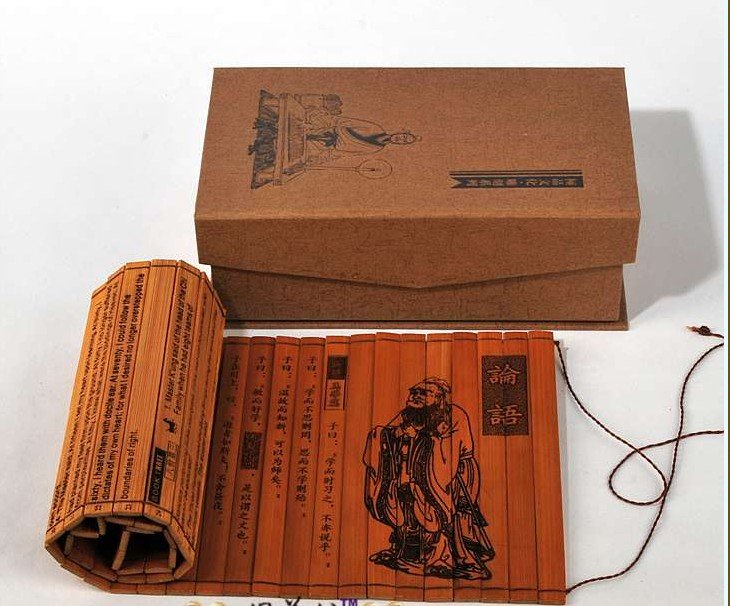
The oldest existing copy of The Analects known to scholars was found in the "Stone Classics of the Xinping Era", a copy of the Confucian classics written in stone. They are believed to have been written in the old Eastern Han dynasty capital of Luoyang around 175 AD. These were discovered in the late 20th Century. Archaeologists have since discovered two handwritten copies of The Analects that were written around 50 BCE, during the Western Han dynasty. They are known as the "Dingzhou Analects", and the "Pyongyang Analects", after the location of the tombs in which they were found. The Dingzhou Analects were discovered in 1973, but no transcription of its contents was published until 1997. The Pyongyang Analects were discovered in 1992, but their Academic access has been highly restricted, and no academic study on it was published until 2009(Els 1-2).
All of these variations of the Analects have lead to what is commonly used now. The important part of The Analects is how individual its teachings are and how it effects each of its students. In today' world there are even more variations emerging in response to changes in society. There is a surge of new translations and interpretations.
My Teaching Philosophy
I never turned away a student. I am willing to teach whoever is willing to learn and has a willing heart. I always considered myself a teacher and worked as diligently as I could to instruct my students. I have said: "...From the very poorest upwards - beginning even with the man who could bring no better present than a bundle of dried flesh - none has ever come to me without receiving instruction.(Analects 7:7)"
This is in part because of how I taught. If you look at my words, often they were taught in the form of a question or in statements that inspire thought. The main requirement to study is a desire to learn, although I did accept pay or gifts in order to live and survive(Beck). I never set myself up as a man of wisdom. No matter how humble the student may have been, I was ready and willing to discuss the issue on its own terms; thus anyone in the world could become a fellow learner with me because of my openness(Beck). "But if even a simple peasant comes in all sincerity and asks me a question, I am ready to thrash the matter out,with all its pros and cons, to the very end.(Analects 9:7)"

My teaching style was always meant to inspire and cultivate thought. That is why I was was willing to teach all those possible. But the student had to be willing to learn. I will not teach a lazy student. "I do not enlighten those who are not eager to learn,nor arouse those who are not anxious, to give an explanation themselves.If I have presented one corner of the square and they cannot come back to me with the other three, I should not go over the points again. (Analects 7:8)" If a student was unwilling to learn, what was the point of teaching them? No one would gain a higher knowledge through this(Beck). "No matter how much one knows, there is always more to learn; and no matter how advanced one becomes, there is always room for improvement.(Beck)" Knowledge is to be sought after continually and wholeheartedly. One must always be seeking to improve their knowledge. I have often said "Learn as if you were following someone you could not catch up to, as though it were someone you were frightened of losing.(Analects 8:17)"
Knowing my students individually was also important to my teaching style. Once I understood the character of my students, then I was able to individualize their teaching for the good of each person. For example, Zilu and Ran Qiu both became important in government; yet they had to be handled them in opposite ways if each was to improve. Zilu once asked whether one should put a maxim into practice as soon as he heard it. I pointed out that Zilu's father and elder brother were still alive, and he asked me how could he apply it immediately. Yet when Ran Qiu asked exactly the same question, Confucius told him that one should immediately put it into practice. A third student who had heard both conversations became confused and asked for an explanation(Beck). My answer? "Qiu is retiring and slow; so I urged him on. Yu tends to be fanatical; so I held him back.(Analects 11:21)"
Conclusion
While not much actual fact can be claimed about me and my life, one thing is for sure; that I left a lasting impact on China and on the whole world. This is not so much me as a person or individual, but as the symbol I have become. Much of what is claimed by others to be my works is not. I simply taught those who where ready and willing to listen. I never thought my teachings would be able to help so many, especially because I never wrote any of them down. The Analects are thought to be one of my greatest achievements, but even these were written by others. They have undergone expansive changes throughout their life. Even so, they can help guide us as a people to greater joy and peace. I hope that as you all seek higher knowledge and understanding, you too can achieve such joy.
References
Ebrey, Patrica Buckley. "The Cambridge Illustrated History of China". New York, Cambridge University Press, 2010, 2d ed.
Riegel, Jeffrey, "Confucius", The Stanford Encyclopedia of Philosophy (Spring 2012 Edition), Edward N. Zalta (ed.), URL = <http://plato.stanford.edu/archives/spr2012/entries/confucius/>. Accessed April 18, 2012
Dubs, Homer H. “Confucius: His Life and Teaching.” Philosophy. Jan. 1951: pp. 30-36. Print.
Ming Dong, Gu. "Everyone's Confucius, All Readers' Analects." Journal Of Chinese Philosophy 37.1 (2010): 34-47. Academic Search Premier. Web. 12 Feb. 2013.
“Confucius- Biography.” The European Graduate School. EGS. n.d. Web. 9 Feb. 2013 URL= <http://www.egs.edu/library/confucius/biography/>
Chin, Ann-ping. "The authentic Confucius: A life of thought and politics." New York: Scribner, 2007. Print.
Creel, Herrlee Glessner. "Confucius: The man and the myth." New York: John Day Company, 1949. Print.
Phan, Peter. "Catholicism and Confucianism: An Intercultural and Interreligious Dialogue." New York: Oxford University Press, 2012. Print.
Beck, Sanderson. "How Confucius Taught." CONFUCIUS AND SOCRATES Teaching Wisdom. WPC, 2006. 26 Feb. 2013. Web URL=<http://www.san.beck.org/CONFUCIUS3-How.html>
Ivanhoe, Philip. "Readings In Classical Chinese Philosophy." New York: Seven Bridges Press, 2001. Print.
Yao, Xinzhong. "An introduction to Confucianism." New York: Cambridge University Press, 2000. Print.
Legge, James. THE CHINESE CLASSICS (CONFUCIAN ANALECTS). 2002. Project Gutenburg. Web. 26 Feb 2013. URL = <http://www.gutenberg.org/catalog/world/readfile?fk_files=1451946&pageno=1>.
Gardner, Daniel K. Zhu Xi's Reading of the Analects: Canon, Commentary, and the Classical Tradition. New York: Columbia University Press. 2003. Print.
Els, Paul van. "Confucius' sayings entombed: On Two Han Dynasty Analects Manuscripts". Analects Studies. Leiden: Brill. 2012. Web. 27 Feb 2013
Waley, Arthur. "Terms". In The Analects of Confucius. Trans. Arthur Waley. New York: Vintage Books. 1938.
"History and Versions of the Analects of Confucius." Cultural China. 2010. Web. 27 Feb 2013. URL= <http://history.cultural-china.com/en/173H495H13120.html>
Runes, Dagobert D. "Dictionary of Philosophy." New York: Kessinger Publishing, 2006. Print
Fisher, Mary Pat. "Living Religions: Eastern Traditions." New Jersey: Prentice-Hall Inc., 2003. Print.
"Confucianism." ThinkQuest. Web. 27 Feb 2013. URL=<http://library.thinkquest.org/12255/temple/confucianism.html>
Other Webpages of Interest
The Analects online <http://www.rjbaker.com/RJBDup/analects.htm>
Powerpoint presentations for classroom use
- Confucius_by_Loren_S.pptx (Media:Confucius1.ppt and Media:Confucius2.ppt)
- Confucius_by_Tara_F.pptx (Media:Confucius and the Analects.pptx)