The 5 Canonized Classics
History

Chinese literature includes 5 canonized classics, the five books that have commonly been used, learned from, and commented on throughout Chinese history. They are a standard in Chinese literature and have had a huge influence in China. These documents were the text of the ancient schools, handed down by tradition to be learned from so they could follow the examples of the past and better solve the problems of the present (Ti-Shan). Originally, there was believed to be six books in the collection of documents that make up the classics. The Classic of Music is no longer part of the canonized classics because it was lost in the Burning of the Books, and we are left with only five.
- 1. 易經 Classic of Changes (I Ching or Book of Changes)
- 2. 春秋 Spring and Autumn Annals
- 3. 禮記 Classic of Rites (literally Record of Rites)
- 4. 尚書 Classic of History (Book of Documents)
- 5. 詩經 Classic of Poetry (Book of Songs, Book of Poetry, Book of Odes)
Yang Hsiung, a Chinese poet and author, in his book Fa-yen makes the statement regarding the five classics: "For explaining Heaven there is nothing clearer than the Book of Changes. For judging affairs the Book of History is the clearest book. For explaining dignity the Book of Rites is the best. For explaining the will there is no book better than the Odes. And for explaining civil relations the Spring and Autumn Annals is of all books the most distinct" (Ti-Shan).
Many believe that these five books, or parts of them, were either commented, compiled, or edited by Confucius himself [1]. However, recent scholarship suggests that Confucius did not write them [2]. Debates still continue on the topic, many arguing that the classics were no the classics until Confucius accepted them, edited them, and made them as part of his accepted documents (Ti-Shan 278). Evidence suggests that while Confucius may not have had a part in compiling or editing the five canonized classics, he did have deep respect for them and used the Shijing and the Shujing or Shangshu for learning exercises with his disciples [3].
Confucius often taught his disciples using the five classics, commonly referring to them as Wen. He frequently referred to them in his documents. For example, in the Analects, he says "If you have a reserve of energy beside what is needed for your daily tasks, then study the Wen. He also commented that "A princely man must have extensive learning in literature (Wen)" (Ti-Shan 275).
Commentary
Although incomplete and often ambiguous, the Classics have had a huge influence on Chinese history. Even today they are considered an important part of studies and they continue to influence the people of China. Other documents have been added to the canonized classics, making up the twelve classics and so forth, but none have had as significant and enduring impact as the original five classics. It's very unfortunate that we are missing the Classic of Music.
I Ching (Book of Changes)

The oldest manuscript that has been found, albeit incomplete, dates back to the Warring States Period. Traditionally, the I Ching and its hexagrams were thought to be before recorded history. It is suggested that the earliest layer of the text may date from the end of the 2nd millennium BC, but place doubts on the mythological aspects in the traditional accounts. It is not the work of one or several legendary or historical figures and is an accumulation of Western Zhou divinatory concepts. During the Warring States Period, the text was re-interpreted as a system of cosmology and philosophy. It is focused on the ideas of the dynamic balance of opposites, the evolution of events as a process, and acceptance of the inevitability of change. Often considered the heart of early Chinese philosophical thought, serving as a common ground for the Confucian and Taoist schools.
- I Ching had two distinct functions.
- A compendium and classic of ancient cosmic principles.
- Used as a divination text. In this case, used by marketplace fortune tellers and roadside oracles. These individuals served the illiterate peasantry.
Hexagrams
- 64 sets of the grid – many types.
- Each hexagram is accompanied with a description, often cryptic, akin to parables. Each line in every hexagram is also given a similar description.
- Article: Explication de l'Arithmétique Binaire (1703) Gottfried Leibniz : he found in the hexagrams a base for claiming the universality of the binary numeral system.
- Hexagrams possibly represented the binary sequences, so that ¦¦¦¦¦¦ would correspond to the binary sequence 000000 and ¦¦¦¦¦| would be 000001, and so forth.
Spring and Autumn Annals

The First Emperor of the Qin Dynasty, wishing to control political though, ordered the burning of many Confucian classics including the Book of Songs, the Book of History, the Book of Changes, the Book of Rites, the Spring and Autumn Annals, the Analectss and the commentary of Gong Yang. These classics were carved in stone in A.D. 172 - 178, and erected at the Imperial College in Luoyang in an attempt to settle differing interpretations of Confucian classics.]] Because it was traditionally regarded as having been compiled by Confucius (after a claim to this effect by Mencius), it was included as one of the Five Classics of Chinese literature.
The Annals were formed by various chroniclers from the State of Lu. Essentially the Annals are an early primitive archive-type record. This document consists of brief dated recordings of the lives of the rulers of Lu. It records births, deaths, marriages, visits to other states, received visitors, and other various happenings (Dobson).
The scope of events recorded in the book is quite limited. The focus is on various feudal states' diplomatic relations, alliances and military actions, as well as births and deaths among the ruling families. The chronicle also takes note of natural disasters such as floods, earthquakes, locusts and solar eclipses.
Events are narrated in chronological order, dated by the reign-year of the Duke of Lu, the season, the month and the day. The annalist structure is followed strictly, to the extent of listing the four seasons of each year even when no events are recorded.
The style is terse and impersonal, and gives no clue as to the actual authorship. Again, many argue that evidence suggests Confucius had a hand in either editing or composing it, due to the fact that entries end a short time before Confucius' death. Mencius, a well-known Chinese philosopher and follower of Confucianism, suggests in certain passages that Confucius did have a hand in the Annals composition (Dobson, 222).
Classic of Rites

The Classic of Rites described the social forms, governmental system, and ancient/ceremonial rites of the Zhou Dynasty (c. 1050–256 BCE). During "The Burning of the Books", which occurred in 213 BCE, most traditional books were burned with the exception of books on war, medicine, astrology, agriculture, and divination. The Classic of Rites was one of those books that was burned and lost for a time. Fortunately, some Confucian scholars had memorized the Classics and thus transmitted the Classics to their disciples who in turn recorded them in manuscripts. These disciples recorded each of the Classics from memory but the Classic of Music (Yuejing) could not be recompiled. However, a chapter in the Classic of Rites is the Record of Music (Yueji), which was derived from the lost Classic.
The Classic of Rites was rewritten and edited by Confucius' disciples after the "Burning of the Books." Other scholars have attempted to shorten these scripts. Dai De who reworked the text in the 1st Century BCE, reducing the original 214 books to 85. It was later further reduced by his younger brother Dai Sheng to 46 books, to which three were added towards the end of the Han Dynasty, bringing the total to 49.
Classic of History
- The Classic of History was compiled between the 6th and 4th centuries BC, and reportedly included over 100 chapters.
- Many citations of its content can be found in the bamboo slips texts from the tombs of Guodian, in Hubei, dated to around 300 BC.
- Many copies of the work were destroyed in the Burning of Books during the Qin dynasty.
The book has four writing forms:
- "codes" - the documentation of law codes and statutes;
- "written admonitions" - the conversations between emperors and ministers and those between ministers, as well as prayers at sacrificial rituals;
- "pledges" - the pledges made by emperors and vassals;
- "mandates" - the imperial mandates emperors made when appointing officials or rewarding vassals.
- The language of these documents is quite archaic, closely resembling inscriptions found on Western Zhou bronzes.
Classic of Poetry (Shijing)
The Classic of Poetry is also variously translated as the Book of Songs, Book of Odes, The Classic of Odes, and The Book of Poetry. All, however, refer to the same compilation of poetry which dates back to the Han dynasty’s (206 BCE–220 CE). Although there is some disagreement over when this compilation was put together, sinologists generally agree it was around this time (Chin, 53, 73).

In the ancient times, poems were lyrics for accompanying tunes, which is where the title Book of Songs derives from. Those tunes have been lost over the years, so the poems now stand alone. They were also often accompanied by dance, though those dances too have been lost.
The Classic of Poetry is the oldest known anthology of Chinese poems and songs. The Odes preserve the descriptions of daily life among the ancient Chinese culture of the Yellow River watershed.
Topics
Many of the poems are about basic human problems such as love, marriage, work, and war. Arthur Waley, a well-known translator, breaks them down into several different categories, offering insights into the topics commonly addressed in the Classic of Poetry. His categories include courtship, marriage, warriors and battles, agriculture, blessings on gentle folk, welcome, feasting, the clan feast, sacrifice, music and dancing, dynastic songs, dynastic legends, building, hunting, friendship, moral pieces, and lamentations. While the traditional order of poems does not have them arranged by subjects, Waley's categories offer examples of the topics commonly discussed in the poetry.
The content of the poems are unique for the time period when compared to the western poetry. Tradition has it that the emperors during this time wanted to know how the common folk were feeling. They sent out people from the court to find out what the people were saying and singing. Unlike many western poems of the same time which are largely based on wars central to the culture, the poems in the Book of Songs have a very different feeling. Rather than reading about war as the main subject, one reads about war from the perspective of a soldier far away from home or his experiences (Pollard, 154). Other examples include the people complaining about taxes, as is illustrated in one of the well-known poems from the Classic of Poetry.
Big rat, big rat,
Do not gobble our millet!
Three years we have slaved for you,
Yet you take no notice of us.
At last we are going to leave you
And go to that happy land;
Happy land, happy land,
Where we shall have our place.
Big rat, big rat,
Do not gobble our corn!
Three years we have slaved for you,
Yet you give us no credit.
At last we are going to leave you
And go to that happy kingdom;
Happy kingdom, happy kingdom,
Where we shall get our due.
Big rat, big rat,
Do not eat our rice-shoots!
Three years we have slaved for you.
Yet you did nothing to reward us.
At last we are going to leave you
And go to those happy borders;
Happy borders, happy borders
Where no sad songs are sung.
While this poem seems to speak nothing of social discontentment, merely complaints against rats, the underlying message is clearly one of complaint against the government, taxing them until they have little left. Wisely disguising their complaints as a children's poem, the people spoke out against the burdens of their time. This poem is perhaps one of the earliest examples of its kind where the common people speak out in social discontentment.
Other poems in the compilation speak of love and courtship, often comparing loved ones to trees of various sorts, a common usage of language in the poetry.
Buxom is the peach-tree;
How its flowers blaze!
Our lady going home
Brings good to family and house.
Buxom is the peach-tree;
How its fruit swells!
Our lady going home
Brings good to family and house.
Buxom is the peach-tree;
How thick its leaves!
Our lady going home
Brings good to the people of her house.
Characteristics of Early Chinese Poetry
- Often don't use "like" or "as" in descriptions.
- Speak often of nature and compare nature to peoples, lives, and so forth. One common use of comparison was, as discussed earlier, to compare lovers to trees. Comparisons were also used to show the opposite of nature's beauty with the harshness of life as is illustrated in the example below.
Tall stands that pear-tree;
Its leaves are fresh and fair.
But alone I walk, in utter solitude.
True indeed, there are other men;
But they are not like children of one's own
- Father.
Heigh, you that walk upon the road,
Why do you not join me?
A man that has no brothers,
Why do you not help him?
Tall stands that pear-tree;
Its leaves grow very thick.
Alone I walk and unbefriended.
True indeed, there are other men;
But they are not like people of one's own
- Clan.
Heigh, you that walk upon the road,
Why do you not join me?
A man that has no brothers,
Why do you not help him?
- The poems frequently mention clothes and articles of personal adornment.
- There is also use of play on words. They often use words that have a couple of different meanings and often both meanings are intended. Unfortunately with translation from Chinese to English, some of the meanings are lost. The use of play on words are mostly an additional decoration (Waley).
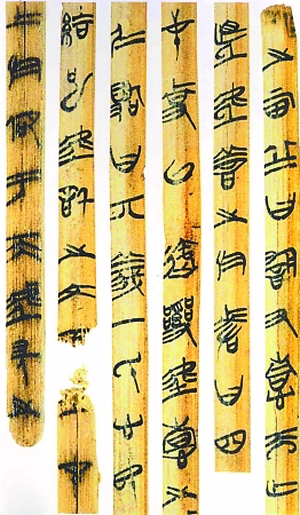 Click [5]for original source


![[1]](http://en.wikipedia.org/wiki/File:I_Ching_Song_Dynasty_print.jpg#file)
![[2]](http://commons.wikimedia.org/wiki/File:CMOC_Treasures_of_Ancient_China_exhibit_-_fragment_of_Xiping_stone_classics.jpg)
![[3]](http://wiki.vm.rub.de/uvu/index.php/File:Liji_2.jpg)
![[4]](http://en.wikipedia.org/wiki/File:Shi_Jing.jpg)
![[5]](http://commons.wikimedia.org/wiki/File:Manuscript_from_Shanghai_Museum_1.jpg)
Origins
Many theories exist as to who composed the works and who compiled them. One theory suggests that Confucius either wrote or compiled the works, that he had a selection of 3,000 poems and chose three hundred and eleven to be in the Book of Songs. Other similar theories exist. While we cannot be certain which, if any, of the theories are correct, it is clear from the Analects, the compilation of sayings attributed to Confucius, that he admired the poems, though it is unlikely that he wrote them or was involved in their compilation (Siu-Kit, 209-210). Most scholars believe however that Confucius had little if anything at all to do with the compilation of the poems. Many believe the collection was around from the time Confucius was a young boy.
Although the Shijing does not specify the names of authors in association with the contained works, we have hints as to who wrote some of them. Only a small part of them have been researched out by later generations.
Influence
The Odes provided founding principles in composition and rhyme that were patterned by Chinese writers for well over two thousand years, and are thus a seminal influence on Chinese Classical poetry.
The Odes became an important and controversial force, influencing political, social and educational phenomena. There were often used in political discourse. They were used as "'incitements,' as 'diplomatic feelers,' as a veiled means of displaying one's own intentions or sounding those of a fellow-diplomatist." Failing to recognize the allusion in a song could result in the failure of a mission and often could lead to being discredited and speedy ruin (Waley, Appendix 1).
The songs continue to be an influential force in Chinese culture. Students continue to memorize and study the poems as part of their education.
References
1. Terrace, Gloucester. "Statistical Notices of China." The Gentleman's Magazine Apr. 1833: 291-93. Print.
2. Creel, H., 1949, Confucius, Harper.
3. Heinz, Carolyn B. Asia, A New Introduction, Waveland Press. 1997
4. Siu-Kit, Wong, and Lee Kar-Shui. "Poems of Depravity : A Twelfth Century Dispute On the Moral Character of the Book of Songs." T'oung Pao 75.4 (1989): 209-25. JSTOR. Web. 25 Feb. 2013.
5. Pollard, Scott. "Lyrical Culture: Rethinking Western Literature After Reading The Book of Songs." College Literature 26.2 (1999): 151-64. EBSCOhost. Web. 25 Feb. 2013.
6. Waley, Arthur, trans. The Book of Songs: The Ancient Chinese Classic of Poetry. London: Allan & Unwin, 1937. Rev. ed. New York; Grove Press, 1987.
7. Ti-Shan, Hsü. "The History of the Canon of the Chinese Classics." Journal of the American Oriental Society 44 (1924): 273-84. Web. 25 Feb. 2013.
8. Dobson, W. A. C. H. "Studies in Middle Archaic Chinese: The Spring and Autumn Annals." T'oung Pao, Second Series 50 (1963): 221-38. JSTOR. Web. 25 Feb. 2013.